
Historical · U.S. Senate · Alabama
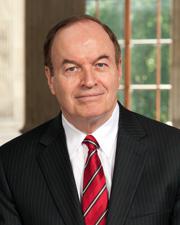
Richard Shelby
Former U.S. Senator from Alabama · 1987–2023 · Republican · Class 3
Richard Shelby represented Alabama in the United States Senate (1987–2023) for the Republican party. The page below collects sourced biographical facts, term history, committee roles, and provenance for Shelby.
Bioguide ID: S000320
Key facts
- Full name
- Richard Shelby
- State
- Alabama
- Party
- Republican
- Senate class
- Class III
- Senate service
- 1987–2023
- First Senate term
- 1987
- Status
- Left office
- Current term ends
- —
- Born
- 1934
- Bioguide ID
- S000320
- Committee assignments
- —
- Dataset version
- 1.20260601-3
Biographical narrative
825 words · sourced from the Wikipedia REST extract
Richard C. Shelby is a former United States senator who represented Alabama from 1987 until 2023. Initially elected as a Democrat, Shelby switched to the Republican Party in 1994 and became the longest-serving senator in Alabama's history, holding office for a total of 36 years. His extensive political career includes significant roles in various Senate committees and a reputation for being a conservative voice within the legislature.
Early life and career
Richard Craig Shelby was born on May 6, 1934, in Birmingham, Alabama. He is the son of Alice L. Skinner and Ozie Houston Shelby, and he is a fifth-generation resident of Alabama. Shelby pursued higher education at the University of Alabama, where he earned a bachelor's degree in 1957. Following his undergraduate studies, he was admitted to the Alabama State Bar in 1961 and subsequently obtained his LL.B. from the University of Alabama School of Law in 1963.
Shelby began his professional career as a city prosecutor in Tuscaloosa, Alabama, serving in that capacity from 1963 to 1971. His legal career also included positions as a U.S. magistrate for the Northern District of Alabama and as a special assistant attorney general for the state. In 1970, he entered politics by winning a seat in the Alabama State Senate, where he served until 1978. That year, he was elected to the United States House of Representatives, representing Alabama's 7th congressional district. During his time in the House, Shelby was known as one of the conservative Democrats, often referred to as "boll weevils," who collaborated with the Reagan administration on various defense issues. He was reelected to Congress three times, serving until 1987.
Senate tenure
Shelby’s tenure in the U.S. Senate began when he was elected in 1986, winning the Democratic nomination for the Senate seat previously held by Republican Jeremiah Denton. His victory marked a significant moment for the Democratic Party, as it regained control of the Senate. Shelby's initial election was closely contested, but he managed to secure his position. In 1994, following the Republican Revolution that saw the GOP gain control of Congress, Shelby switched his party affiliation from Democrat to Republican. This shift was significant, as it contributed to the Republicans achieving a majority in the Senate.
After switching parties, Shelby was reelected in 1998 with a substantial margin, indicating strong support from his constituents. His subsequent elections in 2004, 2010, and 2016 saw him face little to no significant opposition, allowing him to maintain a strong presence in the Senate. Throughout his career, Shelby consistently garnered more than 60% of the vote in his reelections, with the exception of his narrow win in 1986 as a Democrat.
Legislative focus and committees
During his time in the Senate, Shelby was known for his involvement in various legislative initiatives and committee leadership roles. He chaired the Senate Appropriations Committee from 2018 to 2021, overseeing the allocation of federal funds. Additionally, he held leadership positions in several other committees, including the Senate Intelligence Committee, the Senate Banking Committee, and the Senate Rules Committee. His committee work allowed him to influence a wide range of policy areas, from national security to financial regulation.
Shelby’s legislative record reflects a blend of conservative values and a focus on issues pertinent to Alabama. In the early years of his Senate career, he opposed President Ronald Reagan's nomination of Robert Bork to the Supreme Court, a decision influenced by lobbying efforts from African American leaders in Alabama. Conversely, he supported the nomination of Clarence Thomas during George H. W. Bush's presidency.
Throughout the 1990s, Shelby was active in various legislative efforts, including sponsoring a bill to grant federal recognition to the MOWA Band of Choctaw Indians. His commitment to this cause highlighted his engagement with issues affecting Native American communities. Additionally, Shelby was known for his critical stance toward the Clinton administration, particularly regarding fiscal policies. He publicly criticized the administration's approach to taxation and spending during a meeting with Vice President Al Gore.
Shelby served on the Senate Select Committee on Intelligence from 1995 until 2003, where he took a confrontational approach toward the intelligence community during both the Clinton and Bush administrations. His tenure on the committee was marked by significant actions, including opposing the nomination of Anthony Lake as CIA director and advocating for investigations into the use of American-made satellites by China for intelligence purposes. He also introduced legislation aimed at criminalizing the unauthorized release of national defense information, although this proposal faced opposition from civil liberties groups and was ultimately vetoed by President Clinton.
In 2021, Shelby announced that he would not seek reelection in 2022, concluding his long political career. His departure from the Senate marked the end of an era for Alabama politics, with Katie Britt, his former chief of staff, elected to succeed him. Shelby's legacy includes a significant impact on both state and national politics, characterized by his long service and active participation in key legislative issues.
Notable legislation
Sponsored and co-sponsored legislation for Richard Shelby is pending operator curation. The biographical narrative above carries the same provenance trail until per-bill rows are written.
Sources
- [1]https://en.wikipedia.org/wiki/Richard_ShelbyWikipedia · retrieved 2026-06-01
Notable quotes
Sourced quotes for Richard Shelby are pending operator curation. Narrative-scope provenance remains attached below.
Sources
- [1]https://en.wikipedia.org/wiki/Richard_ShelbyWikipedia · retrieved 2026-06-01
Key positions
Curated policy positions for Richard Shelby are pending operator review. The biographical narrative above carries the same provenance trail until per-topic positions are written.
Sources
- [1]https://en.wikipedia.org/wiki/Richard_ShelbyWikipedia · retrieved 2026-06-01
Terms served
- 1979–1981U.S. House · District 7 · Term 1 · Democratic
- 1981–1983U.S. House · District 7 · Term 2 · Democratic
- 1983–1985U.S. House · District 7 · Term 3 · Democratic
- 1985–1987U.S. House · District 7 · Term 4 · Democratic
- 1987–1993U.S. Senate · Term 5 · Democratic · Class III
- 1993–1999U.S. Senate · Term 6 · Republican · Class III
- 1999–2005U.S. Senate · Term 7 · Republican · Class III
- 2005–2011U.S. Senate · Term 8 · Republican · Class III
- 2011–2017U.S. Senate · Term 9 · Republican · Class III
- 2017–2023U.S. Senate · Term 10 · Republican · Class III
Sources & provenance
Every attributable claim above carries a per-section [N] marker that resolves to the corresponding URL below. Each entry records the upstream provider, the canonical URL, and the timestamp at which the source was retrieved by the ingest pipeline.
Key facts
- https://bioguide.congress.gov/search/bio/S000320bioguide · retrieved 2026-06-01
- https://www.shelby.senate.govsenate.gov · retrieved 2026-06-01
Biographical narrative
- https://en.wikipedia.org/wiki/Richard_Shelbywikipedia · retrieved 2026-06-01
Find your senator
Every U.S. state elects two senators. Browse Alabama’s delegation, the full former-senator roster, or explore the role and term length.
Related on The Candidate
- Preceded by Jeremiah Denton Jr.Earlier holder of the Alabama Class III Senate seat · Republican.Open
- Arthur BagbyFormer U.S. Senator from Alabama · DemocraticOpen
- Benjamin FitzpatrickFormer U.S. Senator from Alabama · DemocraticOpen
- Braxton ComerFormer U.S. Senator from Alabama · DemocraticOpen
- Clement ClayFormer U.S. Senator from Alabama · DemocraticOpen
- Republican PartyFederal candidates and office holders on the Republican line.Open