
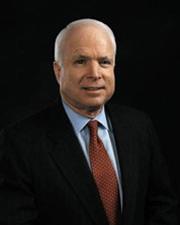
Historical · U.S. Senate · Arizona
John McCain
Former U.S. Senator from Arizona · 1987–2018 · Republican · Class 3
John McCain represented Arizona in the United States Senate (1987–2018) for the Republican party. The page below collects sourced biographical facts, term history, committee roles, and provenance for McCain.
Bioguide ID: M000303
Key facts
- Full name
- John McCain
- State
- Arizona
- Party
- Republican
- Senate class
- Class III
- Senate service
- 1987–2018
- First Senate term
- 1987
- Status
- Left office
- Current term ends
- —
- Born
- 1936
- Bioguide ID
- M000303
- Committee assignments
- —
- Dataset version
- 1.20260601-5
Biographical narrative
1,182 words · sourced from the Wikipedia REST extract
John McCain was a prominent American politician and naval officer who served as a U.S. Senator from Arizona for over three decades. A member of the Republican Party, he was known for his independent streak and willingness to cross party lines on various issues. McCain's political career began in the House of Representatives before he transitioned to the Senate, where he became a significant figure in American politics. He was also the Republican nominee for President in the 2008 election. His life was marked by his military service, particularly during the Vietnam War, where he was a prisoner of war, as well as his later contributions to U.S. foreign policy and campaign finance reform.
Early life and career
John Sidney McCain III was born on August 29, 1936, at Coco Solo Naval Air Station in the Panama Canal Zone. He was the son of John S. McCain Jr., a naval officer, and Roberta Wright McCain. McCain had an older sister, Sandy, and a younger brother, Joe. The McCain family had a strong military background, with both his father and grandfather achieving the rank of four-star admirals in the United States Navy. This legacy influenced McCain's path, as he would eventually follow in their footsteps.
Due to his father's naval career, McCain moved frequently during his childhood, attending approximately 20 different schools. In 1951, the family settled in Northern Virginia, where McCain attended Episcopal High School, a prestigious preparatory boarding school in Alexandria. He excelled in wrestling and graduated in 1954. Initially identifying as an Episcopalian, he later described himself as a Baptist.
In 1954, McCain entered the United States Naval Academy, where he developed a reputation for being a charismatic leader among his peers. He participated in boxing and was known for his social life. Academically, he performed well in subjects that interested him, such as literature and history, but struggled with mathematics, which affected his overall class ranking. Despite these challenges, he graduated from the Naval Academy in 1958.
Following his graduation, McCain was commissioned as an ensign and began his training to become a naval aviator. His early military career included two and a half years of training in Pensacola, Florida, where he earned a reputation for his social activities. After completing flight school in 1960, he became a naval pilot, flying ground-attack aircraft. His assignments included service on aircraft carriers such as the USS Intrepid and USS Enterprise, where he operated in the Caribbean and Mediterranean Seas.
McCain's military service took a dramatic turn during the Vietnam War. In October 1967, while on a bombing mission over Hanoi, he was shot down and captured by North Vietnamese forces. He endured years of imprisonment and torture as a prisoner of war until his release in 1973. His experiences during this time left him with lasting physical disabilities. After retiring from the Navy in 1981 with the rank of captain, McCain transitioned into politics, moving to Arizona.
Senate tenure
McCain began his political career in 1982 when he was elected to the U.S. House of Representatives, where he served two terms. In 1986, he successfully ran for the U.S. Senate, beginning a long tenure that would last until his death in 2018. Throughout his Senate career, McCain was known for his willingness to engage in bipartisan efforts and for his reputation as a "maverick" within the Republican Party. He often broke from party lines on various issues, demonstrating a commitment to his principles over strict party loyalty.
During his time in the Senate, McCain was involved in numerous significant legislative efforts. He gained national attention for his role in campaign finance reform, which culminated in the passage of the McCain–Feingold Act in 2002. This legislation aimed to regulate the financing of political campaigns and was a response to concerns about the influence of money in politics. McCain's advocacy for reform was influenced by his experiences in the Keating Five scandal, where he was investigated but ultimately exonerated.
In addition to his work on campaign finance, McCain was instrumental in restoring diplomatic relations with Vietnam in the 1990s, reflecting his commitment to foreign policy and international relations. He served as the chairman of the Senate Commerce Committee during two separate terms, where he focused on issues such as reducing earmarks and opposing pork barrel spending. McCain was also a member of the bipartisan "Gang of 14," which played a crucial role in addressing judicial nominations and preventing a potential crisis in the Senate.
McCain's presidential ambitions were evident when he ran for the Republican nomination in the 2000 election. Although he lost to George W. Bush, he continued to build his political profile. In 2008, he secured the Republican nomination for president, defeating candidates such as Mitt Romney and Mike Huckabee. However, he lost the general election to Democratic nominee Barack Obama.
Throughout his Senate career, McCain's positions evolved, particularly regarding foreign policy. He became a vocal critic of the Obama administration's foreign policy decisions and adopted more traditional conservative stances. In 2015, he was appointed chairman of the Senate Armed Services Committee, where he continued to influence military and defense policy.
Legislative focus and committees
McCain's legislative focus encompassed a wide range of issues, reflecting his diverse interests and experiences. He was particularly known for his commitment to campaign finance reform, which he viewed as essential for maintaining the integrity of American democracy. His work on the McCain–Feingold Act was a significant milestone in this regard, as it sought to limit the influence of money in politics and promote transparency in campaign financing.
In addition to campaign finance, McCain was deeply engaged in foreign policy matters. His experiences as a prisoner of war shaped his views on military intervention and national security. He was a strong advocate for a robust U.S. military presence abroad and often emphasized the importance of American leadership in global affairs. His work in the Senate included efforts to address issues related to veterans' affairs, military readiness, and international alliances.
McCain's role in the Senate also included significant committee assignments. He chaired the Senate Commerce Committee, where he focused on issues such as telecommunications, transportation, and consumer protection. His leadership in this committee was marked by a commitment to reducing unnecessary government spending and promoting efficiency in federal programs.
As a member of the Senate Armed Services Committee, McCain was influential in shaping defense policy and military strategy. He often sought to ensure that the U.S. military was adequately funded and prepared to address emerging threats. His advocacy for veterans' issues was also a key aspect of his legislative focus, as he worked to improve healthcare and benefits for those who served in the armed forces.
Throughout his career, McCain's willingness to collaborate with members of both parties earned him respect across the political spectrum. His legacy is characterized by his commitment to public service, his advocacy for reform, and his dedication to the principles of democracy and governance. McCain's passing in 2018 marked the end of a significant chapter in American politics, leaving behind a complex legacy shaped by his experiences and convictions.
Notable legislation
Sponsored and co-sponsored legislation for John McCain is pending operator curation. The biographical narrative above carries the same provenance trail until per-bill rows are written.
Sources
- [1]https://en.wikipedia.org/wiki/John_McCainWikipedia · retrieved 2026-06-01
Notable quotes
Sourced quotes for John McCain are pending operator curation. Narrative-scope provenance remains attached below.
Sources
- [1]https://en.wikipedia.org/wiki/John_McCainWikipedia · retrieved 2026-06-01
Key positions
Curated policy positions for John McCain are pending operator review. The biographical narrative above carries the same provenance trail until per-topic positions are written.
Sources
- [1]https://en.wikipedia.org/wiki/John_McCainWikipedia · retrieved 2026-06-01
Terms served
- 1983–1985U.S. House · District 1 · Term 1 · Republican
- 1985–1987U.S. House · District 1 · Term 2 · Republican
- 1987–1993U.S. Senate · Term 3 · Republican · Class III
- 1993–1999U.S. Senate · Term 4 · Republican · Class III
- 1999–2005U.S. Senate · Term 5 · Republican · Class III
- 2005–2011U.S. Senate · Term 6 · Republican · Class III
- 2011–2017U.S. Senate · Term 7 · Republican · Class III
- 2017–2018U.S. Senate · Term 8 · Republican · Class III
Sources & provenance
Every attributable claim above carries a per-section [N] marker that resolves to the corresponding URL below. Each entry records the upstream provider, the canonical URL, and the timestamp at which the source was retrieved by the ingest pipeline.
Key facts
- https://bioguide.congress.gov/search/bio/M000303bioguide · retrieved 2026-06-01
- https://www.mccain.senate.govsenate.gov · retrieved 2026-06-01
Biographical narrative
- https://en.wikipedia.org/wiki/John_McCainwikipedia · retrieved 2026-06-01
Find your senator
Every U.S. state elects two senators. Browse Arizona’s delegation, the full former-senator roster, or explore the role and term length.
Related on The Candidate
- Preceded by Barry GoldwaterEarlier holder of the Arizona Class III Senate seat · Republican.Open
- Succeeded by Martha McSallyLater holder of the Arizona Class III Senate seat · Republican.Open
- Carl HaydenFormer U.S. Senator from Arizona · DemocraticOpen
- Dennis DeConciniFormer U.S. Senator from Arizona · DemocraticOpen
- Ernest McFarlandFormer U.S. Senator from Arizona · DemocraticOpen
- Republican PartyFederal candidates and office holders on the Republican line.Open