
Historical · U.S. Senate · Arizona
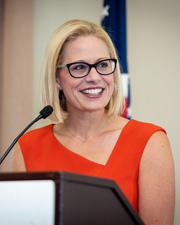
Kyrsten Sinema
Former U.S. Senator from Arizona · 2019–2025 · Independent · Class 1
Kyrsten Sinema represented Arizona in the United States Senate (2019–2025) for the Independent party. The page below collects sourced biographical facts, term history, committee roles, and provenance for Sinema.
Bioguide ID: S001191
Key facts
- Full name
- Kyrsten Sinema
- State
- Arizona
- Party
- Independent
- Senate class
- Class I
- Senate service
- 2019–2025
- First Senate term
- 2019
- Status
- Left office
- Current term ends
- —
- Born
- 1976
- Bioguide ID
- S001191
- Committee assignments
- —
- Dataset version
- 1.20260601-3
Biographical narrative
922 words · sourced from the Wikipedia REST extract
Kyrsten Sinema is an American politician and former U.S. Senator from Arizona, known for her unique political trajectory and her role as a key swing vote in the Senate. Initially a member of the Democratic Party, she became an independent in December 2022. Sinema served as a U.S. Senator from January 2019 until January 2025, following a career that included multiple terms in the Arizona state legislature and the U.S. House of Representatives. Her political career has been marked by her advocacy for various progressive issues, as well as her moderate stances on certain policies, which have contributed to her reputation as a centrist figure in a polarized political landscape.
Early life and career
Kyrsten Lea Sinema was born on July 12, 1976, in Tucson, Arizona, to Marilyn and Dan Sinema. She has an older brother and a younger sister. Sinema's family faced significant challenges during her childhood, particularly after her parents divorced when she was young. Her mother, who gained custody of the children, remarried, and the family relocated to DeFuniak Springs, Florida. During this time, they experienced financial difficulties, which led to a period of living in an abandoned gas station without basic utilities. Sinema has recounted these experiences, highlighting the impact they had on her perspective and values.
Raised in the Church of Jesus Christ of Latter-day Saints (LDS Church), Sinema later distanced herself from the faith after completing her education. She graduated as valedictorian from Walton High School in DeFuniak Springs at the age of 16. Sinema pursued higher education at Brigham Young University (BYU), where she earned a Bachelor of Arts degree in 1995. After returning to Arizona, she worked as a social worker and obtained a Master of Social Work degree from Arizona State University in 1999. Sinema continued her education, earning a Juris Doctor degree from Arizona State University College of Law in 2004 and later a Ph.D. in justice studies in 2012. In 2018, she completed an online Master of Business Administration from the W. P. Carey School of Business.
Sinema's professional career began in academia, where she served as an adjunct professor at Arizona State University School of Social Work and Arizona Summit Law School. Her political journey commenced in the Arizona Green Party, where she was an advocate for progressive causes, including anti-war activism and the repeal of the death penalty. She later transitioned to the Arizona Democratic Party in 2004, describing herself as a "Prada socialist." Sinema's early political activities included working on Ralph Nader's presidential campaign in 2000 and running for local office as an independent, although these initial attempts were unsuccessful.
Senate tenure
Kyrsten Sinema's tenure in the U.S. Senate began in January 2019, following her election to replace retiring Senator Jeff Flake. She won the Senate seat by defeating Republican nominee Martha McSally, marking a significant milestone as the first woman elected to the Senate from Arizona and the first openly bisexual individual to serve in that body. Sinema's election was notable not only for her gender and sexual orientation but also for her status as the only religiously unaffiliated member of the Senate at the time.
During her time in the Senate, Sinema was recognized as a key swing vote, particularly during the 117th and 118th Congresses, when the Senate was nearly evenly divided between Democrats and Republicans. Her moderate positions often placed her in a unique position to influence legislation, as she frequently collaborated with both parties to achieve bipartisan solutions. Sinema's approach to governance has been characterized by a willingness to engage with colleagues across the aisle, reflecting her belief in the importance of compromise and collaboration in a divided political environment.
In March 2024, Sinema announced that she would not seek reelection, concluding her Senate career on January 3, 2025. She was succeeded by Democrat Ruben Gallego, who won the subsequent election.
Legislative focus and committees
Throughout her Senate tenure, Kyrsten Sinema focused on a range of issues, reflecting her moderate and pragmatic approach to governance. She was involved in various legislative efforts, particularly in areas such as healthcare, infrastructure, and immigration reform. Sinema's ability to work across party lines allowed her to play a significant role in shaping bipartisan legislation, which was crucial in a Senate characterized by narrow margins and intense partisanship.
Sinema served on several Senate committees, where she contributed to discussions and decisions on key policy matters. Her participation in these committees provided her with a platform to advocate for the interests of Arizona and to address national issues that resonated with her constituents. Her legislative record includes a mix of progressive and moderate initiatives, demonstrating her ability to navigate the complexities of a diverse political landscape.
In addition to her committee work, Sinema's public statements and actions often highlighted her commitment to issues such as veterans' affairs, mental health, and economic development. She sought to address the needs of her constituents while also engaging in broader national conversations about policy and governance. Sinema's tenure in the Senate was marked by her distinctive political identity, which combined elements of progressivism with a centrist approach, allowing her to appeal to a wide range of voters in Arizona.
Overall, Kyrsten Sinema's career in the U.S. Senate was characterized by her unique position as an independent who caucused with the Democratic Party, her role as a swing vote in a closely divided Senate, and her commitment to bipartisanship and pragmatic governance. Her experiences and background shaped her perspectives on various issues, influencing her legislative priorities and approach to public service.
Notable legislation
Sponsored and co-sponsored legislation for Kyrsten Sinema is pending operator curation. The biographical narrative above carries the same provenance trail until per-bill rows are written.
Sources
- [1]https://en.wikipedia.org/wiki/Kyrsten_SinemaWikipedia · retrieved 2026-06-01
Notable quotes
Sourced quotes for Kyrsten Sinema are pending operator curation. Narrative-scope provenance remains attached below.
Sources
- [1]https://en.wikipedia.org/wiki/Kyrsten_SinemaWikipedia · retrieved 2026-06-01
Key positions
Curated policy positions for Kyrsten Sinema are pending operator review. The biographical narrative above carries the same provenance trail until per-topic positions are written.
Sources
- [1]https://en.wikipedia.org/wiki/Kyrsten_SinemaWikipedia · retrieved 2026-06-01
Terms served
- 2013–2015U.S. House · District 9 · Term 1 · Democratic
- 2015–2017U.S. House · District 9 · Term 2 · Democratic
- 2017–2019U.S. House · District 9 · Term 3 · Democratic
- 2019–2025U.S. Senate · Term 4 · Independent · Class I
Sources & provenance
Every attributable claim above carries a per-section [N] marker that resolves to the corresponding URL below. Each entry records the upstream provider, the canonical URL, and the timestamp at which the source was retrieved by the ingest pipeline.
Key facts
- https://bioguide.congress.gov/search/bio/S001191bioguide · retrieved 2026-06-01
- https://www.sinema.senate.govsenate.gov · retrieved 2026-06-01
Biographical narrative
- https://en.wikipedia.org/wiki/Kyrsten_Sinemawikipedia · retrieved 2026-06-01
Find your senator
Every U.S. state elects two senators. Browse Arizona’s delegation, the full former-senator roster, or explore the role and term length.
Related on The Candidate
- Preceded by Jeff FlakeEarlier holder of the Arizona Class I Senate seat · Republican.Open
- Barry GoldwaterFormer U.S. Senator from Arizona · RepublicanOpen
- Carl HaydenFormer U.S. Senator from Arizona · DemocraticOpen
- Dennis DeConciniFormer U.S. Senator from Arizona · DemocraticOpen
- Ernest McFarlandFormer U.S. Senator from Arizona · DemocraticOpen
- Independent PartyFederal candidates and office holders on the Independent line.Open