
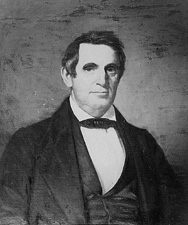
Historical · U.S. Senate · Connecticut
Jabez Huntington
Former U.S. Senator from Connecticut · 1840–1847 · Whig · Class 1
Jabez Huntington represented Connecticut in the United States Senate (1840–1847) for the Whig party. The page below collects sourced biographical facts, term history, committee roles, and provenance for Huntington.
Bioguide ID: H000997
Key facts
- Full name
- Jabez Huntington
- State
- Connecticut
- Party
- Whig
- Senate class
- Class I
- Senate service
- 1840–1847
- First Senate term
- 1840
- Status
- Left office
- Current term ends
- —
- Born
- 1788
- Bioguide ID
- H000997
- Committee assignments
- —
- Dataset version
- 1.20260602
Biographical narrative
1,027 words · sourced from the Wikipedia REST extract
Jabez Huntington was a prominent American politician who served as a United States Senator from Connecticut. A member of the Whig Party, Huntington's political career spanned several significant roles, including serving in the U.S. House of Representatives and as a judge on the Connecticut Supreme Court of Errors. His tenure in the Senate was marked by his leadership in the Committee on Commerce, where he contributed to discussions and legislation pertinent to trade and economic issues of his time. Huntington's life and career reflect the political landscape of early 19th-century America, characterized by evolving party dynamics and legislative priorities.
Early life and career
Jabez Williams Huntington was born on November 8, 1788, in Norwich, Connecticut. He was the son of Zachariah Huntington and Hannah Mumford Huntington. Growing up in a family that valued education, Huntington pursued classical studies, which laid a strong foundation for his future endeavors. He attended Yale College, from which he graduated in 1806. Following his graduation, he took on the role of educator at the Litchfield South Farms Academy for a year, where he likely influenced the next generation of students with his knowledge and commitment to education.
In 1808, Huntington began studying law at the Litchfield Law School, a prestigious institution known for training many prominent lawyers of the time. He was admitted to the bar in 1810, marking the beginning of his legal career in Litchfield, Connecticut. His legal practice provided him with valuable experience and insights into the workings of the law, which would later inform his political career.
Huntington's personal life included his marriage to Sally Ann Huntington on May 22, 1833. Sally was the youngest daughter of his first cousin, Joseph Huntington. The couple did not have any children, which was not uncommon in that era, and their family life remained relatively private compared to his public career.
Huntington's political career began in earnest when he was elected to the Connecticut House of Representatives in 1828, representing Litchfield. This role marked his entry into public service, where he could influence local governance and policy. His effectiveness in this position likely contributed to his subsequent election to the U.S. House of Representatives, where he served three consecutive terms during the Twenty-first, Twenty-second, and Twenty-third Congresses. His tenure in the House lasted from March 4, 1829, until August 16, 1834, when he resigned to accept an appointment as a judge on the Connecticut Supreme Court of Errors. This judicial role allowed him to further engage with the legal system and contribute to the interpretation of laws in Connecticut.
Senate tenure
In 1840, Jabez Huntington transitioned from the judiciary to the legislative branch when he was elected as a Whig to the United States Senate. His election filled the vacancy left by the death of Senator Thaddeus Betts. Huntington's Senate term began on May 4, 1840, and he was subsequently re-elected, continuing to serve until his death in 1847. His time in the Senate was characterized by active participation in legislative discussions and committee work, particularly in areas related to commerce.
During his Senate career, Huntington was appointed as the chairman of the Committee on Commerce during the Twenty-seventh and Twenty-eighth Congresses. This position placed him at the forefront of discussions regarding trade, transportation, and economic policy, which were critical issues as the nation was experiencing significant growth and change. The role of the Committee on Commerce was vital in shaping legislation that affected the economy, including matters related to shipping, trade routes, and infrastructure development. Huntington's leadership in this committee underscored his commitment to addressing the economic needs of the country during a transformative period in American history.
Huntington's Senate tenure coincided with a time of considerable political and social change in the United States. The Whig Party, of which he was a member, emerged in the 1830s as a response to the policies of the Democratic Party, particularly those associated with President Andrew Jackson. The Whigs advocated for a strong legislative role in economic development, infrastructure improvements, and protective tariffs. Huntington's alignment with these principles was evident in his legislative focus and committee work.
Legislative focus and committees
Throughout his time in the Senate, Jabez Huntington was involved in various legislative initiatives that reflected the priorities of the Whig Party and the interests of his constituents in Connecticut. As chairman of the Committee on Commerce, he played a significant role in shaping policies that promoted economic growth and development. The committee's work often revolved around issues such as trade regulation, transportation infrastructure, and maritime commerce, which were essential for a nation expanding its economic horizons.
Huntington's legislative focus was indicative of the broader economic context of the time. The United States was experiencing rapid industrialization and urbanization, leading to increased demand for efficient transportation systems and trade routes. Huntington's contributions to discussions on commerce were crucial as the nation sought to navigate these changes and establish a robust economic framework.
In addition to his work on the Committee on Commerce, Huntington's legislative activities likely encompassed a range of issues pertinent to his constituents and the nation. While specific bills and legislative actions are not detailed, it can be inferred that his role as a senator involved addressing the concerns of his state and the nation, particularly in areas related to economic policy and infrastructure development.
Jabez Huntington's career in the Senate came to an end with his death on November 1, 1847, just days before his 59th birthday. His passing marked the end of a significant chapter in Connecticut's political history, as he had served the state in various capacities, including as a representative, judge, and senator. He was interred at the Old Norwich Town Cemetery, where he rests alongside other notable figures from the region.
In summary, Jabez Huntington's life and career reflect the complexities of early American politics and the evolving landscape of governance in the 19th century. His contributions to the U.S. Senate, particularly in the realm of commerce, underscore the importance of legislative leadership during a time of significant economic change. Through his various roles, Huntington left a lasting impact on the political fabric of Connecticut and the nation as a whole.
Notable legislation
Sponsored and co-sponsored legislation for Jabez Huntington is pending operator curation. The biographical narrative above carries the same provenance trail until per-bill rows are written.
Sources
- [1]https://en.wikipedia.org/wiki/Jabez_W._HuntingtonWikipedia · retrieved 2026-06-02
Notable quotes
Sourced quotes for Jabez Huntington are pending operator curation. Narrative-scope provenance remains attached below.
Sources
- [1]https://en.wikipedia.org/wiki/Jabez_W._HuntingtonWikipedia · retrieved 2026-06-02
Key positions
Curated policy positions for Jabez Huntington are pending operator review. The biographical narrative above carries the same provenance trail until per-topic positions are written.
Sources
- [1]https://en.wikipedia.org/wiki/Jabez_W._HuntingtonWikipedia · retrieved 2026-06-02
Terms served
- 1829–1831U.S. House · District -1 · Term 1 · Whig
- 1831–1833U.S. House · District -1 · Term 2 · Whig
- 1833–1835U.S. House · District -1 · Term 3 · Whig
- 1840–1845U.S. Senate · Term 4 · Whig · Class I
- 1845–1847U.S. Senate · Term 5 · Whig · Class I
Sources & provenance
Every attributable claim above carries a per-section [N] marker that resolves to the corresponding URL below. Each entry records the upstream provider, the canonical URL, and the timestamp at which the source was retrieved by the ingest pipeline.
Key facts
- https://bioguide.congress.gov/search/bio/H000997bioguide · retrieved 2026-06-02
- https://www.govtrack.us/congress/members/405837govtrack · retrieved 2026-06-02
Biographical narrative
- https://en.wikipedia.org/wiki/Jabez_W._Huntingtonwikipedia · retrieved 2026-06-02
Find your senator
Every U.S. state elects two senators. Browse Connecticut’s delegation, the full former-senator roster, or explore the role and term length.
Related on The Candidate
- Preceded by Nathan SmithEarlier holder of the Connecticut Class I Senate seat · Anti-Jacksonian.Open
- Succeeded by Roger BaldwinLater holder of the Connecticut Class I Senate seat · Whig.Open
- Abraham RibicoffFormer U.S. Senator from Connecticut · DemocraticOpen
- Augustine LonerganFormer U.S. Senator from Connecticut · DemocraticOpen
- Brien McMahonFormer U.S. Senator from Connecticut · DemocraticOpen
- Calvin WilleyFormer U.S. Senator from Connecticut · AdamsOpen