
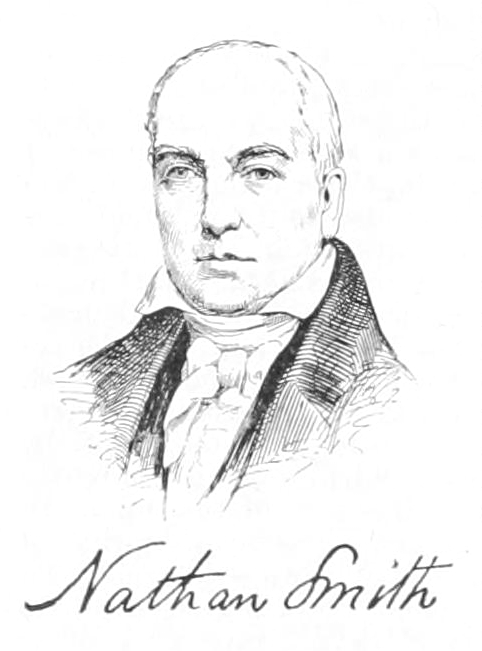
Historical · U.S. Senate · Connecticut
Nathan Smith
Former U.S. Senator from Connecticut · 1833–1835 · Anti-Jacksonian · Class 1
Nathan Smith represented Connecticut in the United States Senate (1833–1835) for the Anti-Jacksonian party. The page below collects sourced biographical facts, term history, committee roles, and provenance for Smith.
Bioguide ID: S000594
Key facts
- Full name
- Nathan Smith
- State
- Connecticut
- Party
- Anti-Jacksonian
- Senate class
- Class I
- Senate service
- 1833–1835
- First Senate term
- 1833
- Status
- Left office
- Current term ends
- —
- Born
- 1770
- Bioguide ID
- S000594
- Committee assignments
- —
- Dataset version
- 1.20260602
Biographical narrative
1,035 words · sourced from the Wikipedia REST extract
Nathan Smith was a U.S. Senator from Connecticut who served in the early 19th century. Born on January 8, 1770, in Woodbury, Connecticut, he had a legal career that spanned several decades before entering the Senate. Smith was affiliated with the Anti-Jacksonian Party and held office during a significant period in American political history. His tenure in the Senate began in 1833 and concluded with his death in 1835, marking a brief but notable chapter in his life dedicated to public service.
Early life and career
Nathan Smith was born to Richard and Annis (Hurd) Smith in Woodbury, Connecticut. He was part of a family that included his brother, Nathaniel Smith, and he later became the uncle of Truman Smith, who would also have a political career. Smith's early education was modest, reflecting the common educational opportunities available in the late 18th century. Despite this, he pursued a legal career, studying law with his brother and attending the prestigious Litchfield Law School in 1790. This institution was known for training many prominent lawyers of the time and played a significant role in shaping the legal landscape of early America.
After completing his studies, Smith was admitted to the bar in 1792 and began practicing law in New Haven, Connecticut. His legal career was marked by a commitment to public service, and he became the prosecuting attorney for New Haven County in 1817, a position he held until his death in 1835. This role allowed him to engage deeply with the legal system and the community, addressing various legal matters and contributing to the administration of justice in the region.
In addition to his legal practice, Smith was involved in educational initiatives. He was an incorporator of Washington College, which would later be known as Trinity College, located in Hartford, Connecticut. This involvement highlights his dedication to advancing education in his home state, reflecting the values of the time that emphasized the importance of learning and civic responsibility. In recognition of his contributions to education, Smith received an honorary master's degree from Yale University in 1808, further solidifying his standing in the community.
Throughout his career, Smith also engaged in political activities. He was a delegate to the State constitutional convention in 1818, where he participated in discussions that would shape the governance of Connecticut. Although he ran unsuccessfully for governor of Connecticut in 1825, his political aspirations did not end there. He was appointed as the United States Attorney for the district of Connecticut, serving in this capacity during 1828 and 1829. This position allowed him to further his influence in the legal and political spheres of Connecticut, preparing him for his eventual election to the Senate.
Senate tenure
Nathan Smith's entry into the United States Senate came as a result of his affiliation with the National Republican Party, a political group that emerged in opposition to President Andrew Jackson's policies. He was elected to the Senate and took office on March 4, 1833. At the age of 63, Smith was one of the older members of the Senate, bringing with him a wealth of experience from his legal and political career. His tenure in the Senate was characterized by his commitment to the principles of his party and the interests of his constituents in Connecticut.
During his time in the Senate, Smith participated in the legislative processes of the nation, contributing to discussions and decisions that would shape the future of the United States. While specific details of his legislative actions are not extensively documented, his role as a senator during a transformative period in American history is significant. The early 1830s were marked by intense political debates over issues such as states' rights, economic policy, and the expansion of slavery, all of which would have influenced the legislative environment in which Smith operated.
Smith's Senate career was relatively short-lived, as he served until his death on December 6, 1835. His passing marked the end of his only term in elected office, and he did not have the opportunity to seek re-election or further his political career. His death occurred in Washington, D.C., where he was honored with a funeral attended by President Jackson and his Cabinet, indicating the respect he garnered during his time in office. Following his funeral, a large service was also held in New Haven, Connecticut, where he was interred at the Grove Street Cemetery.
Legislative focus and committees
While specific details regarding Nathan Smith's legislative focus and committee assignments during his Senate tenure are not provided, it is important to contextualize his role within the broader political landscape of the time. As a member of the Anti-Jacksonian Party, Smith would have aligned himself with policies that opposed the Jackson administration, particularly regarding issues such as the centralization of power and the role of the federal government in economic matters.
The early 1830s were a period of significant political realignment in the United States, with the emergence of new political factions and the redefinition of existing parties. Smith's affiliation with the National Republicans placed him in opposition to the Democratic Party led by Andrew Jackson, which was known for its populist approach and emphasis on agrarian interests. This political dynamic likely influenced Smith's legislative priorities and the issues he championed during his time in the Senate.
In addition to his political affiliations, Smith's background as a lawyer and prosecuting attorney would have informed his approach to legislation. His legal expertise may have guided his contributions to discussions on judicial matters, law enforcement, and the rights of citizens. Furthermore, his involvement in the constitutional convention and his role as a U.S. Attorney suggest a commitment to upholding the rule of law and ensuring justice within the framework of the government.
In summary, Nathan Smith's career as a U.S. Senator from Connecticut was marked by his dedication to public service and his engagement in the political issues of his time. His contributions to the Senate, while brief, were set against the backdrop of a rapidly changing political landscape in the United States. Smith's legacy is one of a committed public servant whose life and career reflected the complexities of early American governance and the evolution of its political institutions.
Notable legislation
Sponsored and co-sponsored legislation for Nathan Smith is pending operator curation. The biographical narrative above carries the same provenance trail until per-bill rows are written.
Sources
- [1]https://en.wikipedia.org/wiki/Nathan_Smith_(politician)Wikipedia · retrieved 2026-06-02
Notable quotes
Sourced quotes for Nathan Smith are pending operator curation. Narrative-scope provenance remains attached below.
Sources
- [1]https://en.wikipedia.org/wiki/Nathan_Smith_(politician)Wikipedia · retrieved 2026-06-02
Key positions
Curated policy positions for Nathan Smith are pending operator review. The biographical narrative above carries the same provenance trail until per-topic positions are written.
Sources
- [1]https://en.wikipedia.org/wiki/Nathan_Smith_(politician)Wikipedia · retrieved 2026-06-02
Terms served
- 1833–1835U.S. Senate · Term 1 · Anti-Jacksonian · Class I
Sources & provenance
Every attributable claim above carries a per-section [N] marker that resolves to the corresponding URL below. Each entry records the upstream provider, the canonical URL, and the timestamp at which the source was retrieved by the ingest pipeline.
Key facts
- https://bioguide.congress.gov/search/bio/S000594bioguide · retrieved 2026-06-02
- https://www.govtrack.us/congress/members/410074govtrack · retrieved 2026-06-02
Biographical narrative
- https://en.wikipedia.org/wiki/Nathan_Smith_(politician)wikipedia · retrieved 2026-06-02
Find your senator
Every U.S. state elects two senators. Browse Connecticut’s delegation, the full former-senator roster, or explore the role and term length.
Related on The Candidate
- Preceded by Samuel FootEarlier holder of the Connecticut Class I Senate seat · Adams.Open
- Succeeded by Thaddeus BettsLater holder of the Connecticut Class I Senate seat · Whig.Open
- Abraham RibicoffFormer U.S. Senator from Connecticut · DemocraticOpen
- Augustine LonerganFormer U.S. Senator from Connecticut · DemocraticOpen
- Brien McMahonFormer U.S. Senator from Connecticut · DemocraticOpen
- Calvin WilleyFormer U.S. Senator from Connecticut · AdamsOpen