
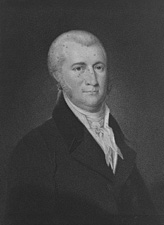
Historical · U.S. Senate · Delaware
James Bayard Sr.
Former U.S. Senator from Delaware · 1804–1813 · Federalist · Class 2
James Bayard Sr. represented Delaware in the United States Senate (1804–1813) for the Federalist party. The page below collects sourced biographical facts, term history, committee roles, and provenance for Sr..
Bioguide ID: B000249
Key facts
- Full name
- James Bayard Sr.
- State
- Delaware
- Party
- Federalist
- Senate class
- Class II
- Senate service
- 1804–1813
- First Senate term
- 1804
- Status
- Left office
- Current term ends
- —
- Born
- 1767
- Bioguide ID
- B000249
- Committee assignments
- —
- Dataset version
- 1.20260602
Biographical narrative
909 words · sourced from the Wikipedia REST extract
James Bayard Sr. was an American lawyer and politician who served as a U.S. Senator from Delaware. A member of the Federalist Party, he held office during a pivotal time in early American history, participating in significant legislative actions and negotiations. His political career spanned multiple terms in both the U.S. House of Representatives and the Senate, where he was known for his leadership and involvement in key events such as the impeachment of a senator and the negotiations that ended the War of 1812.
Early life and career
James Bayard Sr. was born on July 28, 1767, in Philadelphia, Pennsylvania. He was the son of Dr. James Asheton Bayard and Ann Hodge. The Bayard family had a notable lineage, tracing their ancestry back to a sister of Petrus Stuyvesant, the Dutch Director-General of New Amsterdam. The family settled in Bohemia Manor, Cecil County, Maryland, in 1698. Additionally, Bayard's heritage included French Huguenot and English roots. Following the early death of his parents, he was raised by his uncle, Colonel John Bubenheim Bayard, in Philadelphia.
Bayard pursued higher education at Princeton College, graduating in 1784. He then studied law under the tutelage of prominent figures, including General Joseph Reed and Jared Ingersoll. He was admitted to the Delaware Bar in 1787 and began practicing law in Wilmington, Delaware. On February 11, 1795, he married Ann Bassett, the daughter of Richard Bassett, a wealthy Delaware lawyer and U.S. Senator. The couple had six children: Richard, Caroline, James Jr., Edward, Mary, and Henry M. The family resided in Wilmington, where they owned property and enslaved individuals.
Bayard's political career began when he was elected to the U.S. House of Representatives in 1796. He served three consecutive terms from March 4, 1797, until March 3, 1803. During his time in the House, he gained recognition as an orator and constitutional lawyer, emerging as a leader within the Federalist Party. Notably, he played a significant role in the impeachment proceedings against Senator William Blount from Tennessee in 1798. Although the House impeached Blount, the Senate ultimately dismissed the charges, establishing a precedent regarding the limitations on congressional actions against its members.
Bayard was also influential in the presidential election of 1800, which resulted in a tie in the Electoral College. He was part of a group of Federalists who facilitated the election of Thomas Jefferson by persuading their colleagues to abstain from voting, thereby allowing Jefferson to secure the presidency. This action was believed to be influenced by a strategic agreement with Jefferson, which aimed to protect Federalist officeholders from widespread removal.
Despite his political achievements, Bayard faced electoral challenges. He was defeated in his bid for a fourth term in 1802 by Caesar Augustus Rodney but successfully reclaimed his position in 1804. His political rivalry with Rodney was characterized by mutual respect, and they maintained a cordial relationship despite their competition.
Senate tenure
Bayard's tenure in the U.S. Senate began on November 13, 1804, when he was elected by the Delaware General Assembly to fill a vacancy left by the resignation of William H. Wells. He officially commenced his term in March 1805 and was re-elected in 1810, serving until his resignation on March 3, 1813. During his time in the Senate, Bayard was aware of the political dynamics of Delaware, a small state where the representation of Federalists was particularly significant given the party's minority status during that era.
Throughout his Senate career, Bayard was critical of the War of 1812, often referred to derisively as "Mr. Madison's War" by Federalists. He expressed concerns regarding the nation's preparedness for conflict and the vulnerability of Delaware's coastal areas. On June 17, 1812, he was among a small group of senators who voted against the declaration of war against Britain. However, once hostilities commenced, he and his fellow Federalists in Delaware supported the war effort, distancing themselves from the anti-war sentiments that were prevalent among Federalists in New England.
Bayard's support for the war led to his appointment as one of the peace commissioners tasked with negotiating an end to the War of 1812. He resigned from the Senate to participate in the negotiations in Europe, where he played a significant role in the discussions that culminated in the Treaty of Ghent, signed in December 1814. His contributions to the peace negotiations were recognized by contemporaries, including John Quincy Adams, who acknowledged Bayard's composure and self-control during the tense diplomatic discussions.
Legislative focus and committees
During his time in the Senate, Bayard's legislative focus was shaped by the political landscape of the early 19th century and the challenges facing the young nation. He was involved in discussions and decisions related to national security, particularly in the context of the War of 1812. His opposition to the war declaration reflected a broader concern among Federalists regarding the implications of military conflict on the nation's stability and security.
Bayard's work in the Senate also included participation in various committees, where he contributed to the legislative process and addressed issues pertinent to Delaware and the nation. His legal background and experience in the House of Representatives informed his approach to policymaking and legislative debate.
After resigning from the Senate, Bayard continued to be active in public life until his death on August 6, 1815. His career spanned significant events in American history, and his contributions to the legislative process and diplomatic negotiations left a lasting impact on the political landscape of his time.
Notable legislation
Sponsored and co-sponsored legislation for James Bayard Sr. is pending operator curation. The biographical narrative above carries the same provenance trail until per-bill rows are written.
Sources
- [1]https://en.wikipedia.org/wiki/James_A._Bayard_(politician%2C_born_1767)Wikipedia · retrieved 2026-06-02
Notable quotes
Sourced quotes for James Bayard Sr. are pending operator curation. Narrative-scope provenance remains attached below.
Sources
- [1]https://en.wikipedia.org/wiki/James_A._Bayard_(politician%2C_born_1767)Wikipedia · retrieved 2026-06-02
Key positions
Curated policy positions for James Bayard Sr. are pending operator review. The biographical narrative above carries the same provenance trail until per-topic positions are written.
Sources
- [1]https://en.wikipedia.org/wiki/James_A._Bayard_(politician%2C_born_1767)Wikipedia · retrieved 2026-06-02
Terms served
- 1797–1799U.S. House · District 0 · Term 1 · Federalist
- 1799–1801U.S. House · District 0 · Term 2 · Federalist
- 1801–1803U.S. House · District 0 · Term 3 · Federalist
- 1804–1805U.S. Senate · Term 4 · Federalist · Class II
- 1805–1811U.S. Senate · Term 5 · Federalist · Class II
- 1811–1813U.S. Senate · Term 6 · Federalist · Class II
Sources & provenance
Every attributable claim above carries a per-section [N] marker that resolves to the corresponding URL below. Each entry records the upstream provider, the canonical URL, and the timestamp at which the source was retrieved by the ingest pipeline.
Key facts
- https://bioguide.congress.gov/search/bio/B000249bioguide · retrieved 2026-06-02
- https://www.govtrack.us/congress/members/401243govtrack · retrieved 2026-06-02
Biographical narrative
- https://en.wikipedia.org/wiki/James_A._Bayard_(politician%2C_born_1767)wikipedia · retrieved 2026-06-02
Find your senator
Every U.S. state elects two senators. Browse Delaware’s delegation, the full former-senator roster, or explore the role and term length.
Related on The Candidate
- Preceded by John ViningEarlier holder of the Delaware Class II Senate seat · Federalist.Open
- Succeeded by Nicholas Van DykeLater holder of the Delaware Class II Senate seat · Adams.Open
- Anthony HigginsFormer U.S. Senator from Delaware · RepublicanOpen
- Arnold NaudainFormer U.S. Senator from DelawareOpen
- Caesar RodneyFormer U.S. Senator from Delaware · RepublicanOpen
- Clayton BuckFormer U.S. Senator from Delaware · RepublicanOpen