
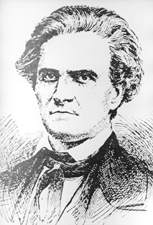
Historical · U.S. Senate · Georgia
Walter Colquitt
Former U.S. Senator from Georgia · 1843–1849 · Democratic · Class 3
Walter Colquitt represented Georgia in the United States Senate (1843–1849) for the Democratic party. The page below collects sourced biographical facts, term history, committee roles, and provenance for Colquitt.
Bioguide ID: C000648
Key facts
- Full name
- Walter Colquitt
- State
- Georgia
- Party
- Democratic
- Senate class
- Class III
- Senate service
- 1843–1849
- First Senate term
- 1843
- Status
- Left office
- Current term ends
- —
- Born
- 1799
- Bioguide ID
- C000648
- Committee assignments
- —
- Dataset version
- 1.20260602
Biographical narrative
933 words · sourced from the Wikipedia REST extract
Walter Colquitt was a prominent American politician and lawyer who served as a United States Senator from Georgia. A member of the Democratic Party, Colquitt's political career spanned several decades, during which he was involved in significant legislative matters of his time. His tenure in the Senate lasted from 1843 until 1848, and he was known for his strong advocacy of states' rights and his involvement in the contentious issues surrounding slavery and territorial expansion.
Early life and career
Walter Colquitt was born on December 27, 1799, in Monroe, Halifax County, Virginia. He spent his early childhood in Virginia before relocating with his family to Mount Zion in Carroll County, Georgia. This move marked the beginning of his connection to Georgia, where he would later establish his career and political life. Colquitt pursued higher education at Princeton College, where he laid the groundwork for his future career in law. After completing his studies, he "read the law," a common practice of the time, and gained admission to the bar in 1820 at the age of 21.
Upon becoming a licensed attorney, Colquitt began his law practice in Sparta, Georgia. His legal career quickly progressed, and he was appointed as a brigadier general in the state militia the same year he began practicing law. Subsequently, he moved to Cowpens in Walton County, where he continued to build his legal practice. His political career took off when he was elected as the judge of the Chattahoochee circuit in 1826, a position he successfully retained through re-election three years later.
In addition to his legal work, Colquitt was also a licensed Methodist preacher, having been ordained in 1827. He became known as a circuit-riding preacher, gaining popularity in central and southern Georgia for his dynamic preaching style and strong advocacy for states' rights. This was a particularly contentious issue during a time when Georgia was grappling with the federal government's policies regarding Native American tribes. Colquitt's ability to engage in various roles—whether as a lawyer, preacher, or public speaker—earned him a reputation as a versatile and influential figure in his community.
Colquitt's political career continued to flourish as he was elected to the Georgia Senate in 1834 and again in 1837. His involvement in state politics paved the way for his subsequent election to the U.S. Congress.
Senate tenure
Walter Colquitt's national political career began when he was elected as a Whig to the Twenty-sixth Congress, serving from March 4, 1839, until his resignation on July 21, 1840. After changing his political affiliation to the Democratic Party, he was elected by the Georgia state legislature to the U.S. Senate in 1842. Colquitt officially took office on March 4, 1843, serving in the Senate until his resignation in February 1848.
During his time in the Senate, Colquitt was a member of the Twenty-ninth Congress, where he held significant positions, including chairman of the Committee on the District of Columbia and the Committee on Patents and Patent Office. His legislative focus often aligned with the interests of the Polk administration, particularly regarding the Oregon Territory. Colquitt was a vocal opponent of the Wilmot Proviso, which sought to ban slavery in territories acquired during the Mexican-American War. His stance on this issue reflected the broader national debate over slavery and its expansion into new territories.
Colquitt's tenure in the Senate was marked by the complexities of the political landscape of the time, as the nation grappled with the implications of territorial expansion and the contentious issue of slavery. His involvement in these debates positioned him as a key figure in the Democratic Party during a critical period in American history.
Legislative focus and committees
Throughout his Senate career, Walter Colquitt's legislative focus was primarily centered on issues related to states' rights, territorial expansion, and the governance of newly acquired lands. As chairman of the Committee on the District of Columbia, he played a role in shaping policies that affected the nation's capital, a position that required careful navigation of both local and national interests. His leadership in the Committee on Patents and Patent Office also indicated his interest in promoting innovation and protecting intellectual property, which were essential components of economic development during that era.
Colquitt's support for the Polk administration during the Oregon Territory controversy illustrated his alignment with the Democratic Party's expansionist agenda. This support was significant, as the debate over the Oregon Territory was emblematic of the larger national discourse on the future of slavery in the United States. Colquitt's opposition to the Wilmot Proviso further underscored his commitment to preserving the institution of slavery in the face of growing abolitionist sentiment.
After resigning from the Senate in 1848, Colquitt returned to his law practice and continued his involvement in public life. He participated in the Nashville Convention in 1850, where he argued for secession if slavery were restricted in any of the new territories being added to the United States. This position reflected the increasing tensions leading up to the Civil War and highlighted Colquitt's enduring commitment to the principles of states' rights and the protection of slavery.
Walter Colquitt passed away on May 7, 1855, during a trip from Columbus to Macon, Georgia. He was buried in Linwood Cemetery in Columbus, where he had spent his later years. His legacy is remembered in Georgia, with Colquitt County and the town of Colquitt named in his honor. His family continued his political legacy, with his son Alfred Holt Colquitt serving as a U.S. Representative and Senator, and another son, Peyton H. Colquitt, also serving as a Confederate officer during the Civil War.
Notable legislation
Sponsored and co-sponsored legislation for Walter Colquitt is pending operator curation. The biographical narrative above carries the same provenance trail until per-bill rows are written.
Sources
- [1]https://en.wikipedia.org/wiki/Walter_T._ColquittWikipedia · retrieved 2026-06-02
Notable quotes
Sourced quotes for Walter Colquitt are pending operator curation. Narrative-scope provenance remains attached below.
Sources
- [1]https://en.wikipedia.org/wiki/Walter_T._ColquittWikipedia · retrieved 2026-06-02
Key positions
Curated policy positions for Walter Colquitt are pending operator review. The biographical narrative above carries the same provenance trail until per-topic positions are written.
Sources
- [1]https://en.wikipedia.org/wiki/Walter_T._ColquittWikipedia · retrieved 2026-06-02
Terms served
- 1839–1841U.S. House · District -1 · Term 1 · Whig
- 1841–1843U.S. House · District -1 · Term 2 · Democratic
- 1843–1849U.S. Senate · Term 3 · Democratic · Class III
Sources & provenance
Every attributable claim above carries a per-section [N] marker that resolves to the corresponding URL below. Each entry records the upstream provider, the canonical URL, and the timestamp at which the source was retrieved by the ingest pipeline.
Key facts
- https://bioguide.congress.gov/search/bio/C000648bioguide · retrieved 2026-06-02
- https://www.govtrack.us/congress/members/402776govtrack · retrieved 2026-06-02
Biographical narrative
- https://en.wikipedia.org/wiki/Walter_T._Colquittwikipedia · retrieved 2026-06-02
Find your senator
Every U.S. state elects two senators. Browse Georgia’s delegation, the full former-senator roster, or explore the role and term length.
Related on The Candidate
- Preceded by Alfred CuthbertEarlier holder of the Georgia Class III Senate seat · Democratic.Open
- Succeeded by William DawsonLater holder of the Georgia Class III Senate seat · Whig.Open
- Abraham BaldwinFormer U.S. Senator from Georgia · RepublicanOpen
- Alexander ClayFormer U.S. Senator from Georgia · DemocraticOpen
- Alfred ColquittFormer U.S. Senator from Georgia · DemocraticOpen
- Democratic PartyFederal candidates and office holders on the Democratic line.Open