
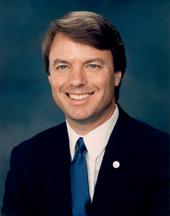
Historical · U.S. Senate · North Carolina
John Edwards
Former U.S. Senator from North Carolina · 1999–2005 · Democratic · Class 3
John Edwards represented North Carolina in the United States Senate (1999–2005) for the Democratic party. The page below collects sourced biographical facts, term history, committee roles, and provenance for Edwards.
Bioguide ID: E000286
Key facts
- Full name
- John Edwards
- State
- North Carolina
- Party
- Democratic
- Senate class
- Class III
- Senate service
- 1999–2005
- First Senate term
- 1999
- Status
- Left office
- Current term ends
- —
- Born
- 1953
- Bioguide ID
- E000286
- Committee assignments
- —
- Dataset version
- 1.20260602
Biographical narrative
875 words · sourced from the Wikipedia REST extract
John Edwards is a former United States Senator from North Carolina, representing the Democratic Party. He served in the Senate from 1999 until the conclusion of his term in January 2005. Edwards is known for his focus on issues such as poverty, healthcare, and education during his time in office. His political career also includes a notable run for the presidency in 2004, where he was a prominent candidate in the Democratic primaries.
Early life and career
John Edwards was born on June 10, 1953. He grew up in a modest environment that shaped his understanding of the challenges faced by many Americans. Edwards pursued higher education at North Carolina State University, where he earned a Bachelor of Arts degree in political science. He later attended the University of North Carolina School of Law, where he received his Juris Doctor degree. Following his graduation from law school, Edwards established a successful career as a trial lawyer, gaining recognition for his work in personal injury cases. His legal career not only provided him with financial success but also laid the groundwork for his future political ambitions.
Edwards entered politics in the late 1990s, leveraging his legal background and public speaking skills to connect with voters. He first ran for the U.S. Senate in 1998, successfully winning the Democratic primary and subsequently defeating his Republican opponent in the general election. His victory marked the beginning of his political career at the national level, where he sought to address various social issues and advocate for the underprivileged.
Senate tenure
John Edwards began his first term as a U.S. Senator from North Carolina in January 1999. During his tenure, he was part of the Senate Class 3, which is a designation that indicates the cycle in which senators are elected. Edwards's time in the Senate was characterized by his commitment to addressing issues that affected the lives of everyday Americans, particularly those living in poverty. He became known for his ability to articulate the struggles faced by low-income families and for advocating policies aimed at alleviating those challenges.
Throughout his Senate career, Edwards served on several committees that allowed him to influence legislation in key areas. His work on these committees provided him with a platform to address issues related to health care, education, and economic opportunity. Edwards's approach often emphasized the importance of creating a more equitable society, and he sought to bring attention to the needs of marginalized communities.
In addition to his legislative work, Edwards gained national recognition for his role in the Democratic Party. He was selected as the running mate for presidential candidate John Kerry in the 2004 election, which further elevated his profile within the party. Although the Kerry-Edwards ticket did not win the presidency, the campaign provided Edwards with valuable experience in national politics and solidified his position as a prominent figure within the Democratic Party.
Edwards's Senate career came to an end when he chose not to seek re-election in 2004, opting instead to focus on his presidential campaign. His decision to leave the Senate marked a significant transition in his political journey, as he sought to take his message of hope and change to a broader audience on the national stage.
Legislative focus and committees
During his time in the Senate, John Edwards's legislative focus was primarily on issues that impacted working families and individuals living in poverty. He was a vocal advocate for healthcare reform, emphasizing the need for accessible and affordable healthcare for all Americans. Edwards's commitment to healthcare was informed by his experiences as a trial lawyer, where he witnessed firsthand the challenges faced by individuals who struggled to access necessary medical care.
In addition to healthcare, Edwards was deeply concerned with education and its role in providing opportunities for upward mobility. He championed initiatives aimed at improving public education, particularly in underserved communities. His advocacy for education reform included efforts to increase funding for schools and to support programs that aimed to enhance educational outcomes for students.
Edwards also served on several Senate committees that were integral to his legislative work. These committees included those focused on health, education, labor, and pensions, among others. His participation in these committees allowed him to engage in discussions and debates that shaped important legislation. Through his committee work, Edwards sought to influence policies that would benefit the most vulnerable populations in society.
Overall, John Edwards's Senate tenure was marked by a commitment to addressing the needs of working families and advocating for social justice. His legislative efforts reflected a broader vision of a more equitable society, where everyone had the opportunity to succeed regardless of their background. Although his time in the Senate was relatively brief, the impact of his work and the issues he championed continue to resonate in contemporary political discourse.
In summary, John Edwards's career as a U.S. Senator from North Carolina was characterized by his dedication to social issues, particularly those affecting low-income individuals and families. His early life experiences and legal background informed his legislative priorities, which included healthcare reform and education advocacy. Edwards's involvement in national politics extended beyond the Senate, as he sought the presidency in 2004, further solidifying his role as a significant figure within the Democratic Party.
Notable legislation
Sponsored and co-sponsored legislation for John Edwards is pending operator curation. The biographical narrative above carries the same provenance trail until per-bill rows are written.
Sources
- [1]https://en.wikipedia.org/wiki/John_EdwardsWikipedia · retrieved 2026-06-02
Notable quotes
Sourced quotes for John Edwards are pending operator curation. Narrative-scope provenance remains attached below.
Sources
- [1]https://en.wikipedia.org/wiki/John_EdwardsWikipedia · retrieved 2026-06-02
Key positions
Curated policy positions for John Edwards are pending operator review. The biographical narrative above carries the same provenance trail until per-topic positions are written.
Sources
- [1]https://en.wikipedia.org/wiki/John_EdwardsWikipedia · retrieved 2026-06-02
Terms served
- 1999–2005U.S. Senate · Term 1 · Democratic · Class III
Sources & provenance
Every attributable claim above carries a per-section [N] marker that resolves to the corresponding URL below. Each entry records the upstream provider, the canonical URL, and the timestamp at which the source was retrieved by the ingest pipeline.
Key facts
- https://bioguide.congress.gov/search/bio/E000286bioguide · retrieved 2026-06-02
- http://edwards.senate.gov/senate.gov · retrieved 2026-06-02
Biographical narrative
- https://en.wikipedia.org/wiki/John_Edwardswikipedia · retrieved 2026-06-02
Find your senator
Every U.S. state elects two senators. Browse North Carolina’s delegation, the full former-senator roster, or explore the role and term length.
Related on The Candidate
- Preceded by Lauch FairclothEarlier holder of the North Carolina Class III Senate seat · Republican.Open
- Succeeded by Richard BurrLater holder of the North Carolina Class III Senate seat · Republican.Open
- Alexander MartinFormer U.S. Senator from North Carolina · RepublicanOpen
- Alton LennonFormer U.S. Senator from North Carolina · DemocraticOpen
- Asa BiggsFormer U.S. Senator from North Carolina · DemocraticOpen
- Augustus MerrimonFormer U.S. Senator from North Carolina · DemocraticOpen