
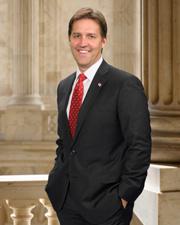
Historical · U.S. Senate · Nebraska
Ben Sasse
Former U.S. Senator from Nebraska · 2015–2023 · Republican · Class 2
Ben Sasse represented Nebraska in the United States Senate (2015–2023) for the Republican party. The page below collects sourced biographical facts, term history, committee roles, and provenance for Sasse.
Bioguide ID: S001197
Key facts
- Full name
- Ben Sasse
- State
- Nebraska
- Party
- Republican
- Senate class
- Class II
- Senate service
- 2015–2023
- First Senate term
- 2015
- Status
- Left office
- Current term ends
- —
- Born
- 1972
- Bioguide ID
- S001197
- Committee assignments
- —
- Dataset version
- 1.20260601-3
Biographical narrative
1,016 words · sourced from the Wikipedia REST extract
Benjamin Eric Sasse is an American politician and academic administrator who served as a U.S. Senator from Nebraska from 2015 until his resignation in January 2023. A member of the Republican Party, Sasse's tenure in the Senate was marked by his critical stance toward former President Donald Trump, notably voting to convict Trump during his second impeachment trial. Prior to his political career, Sasse held various academic and administrative positions, including serving as the president of Midland University in Nebraska. Following his Senate career, he transitioned to academia as the president of the University of Florida.
Early life and career
Ben Sasse was born on February 22, 1972, in Plainview, Nebraska. He is the son of Gary Lynn Sasse, a high school teacher and football coach, and Linda Sasse. Sasse completed his secondary education at Fremont Senior High School, where he graduated as the valedictorian of his class in 1990. His academic journey continued at Harvard College, where he earned a bachelor's degree in government in 1994. During his undergraduate studies, Sasse participated in a junior-year-abroad program at the University of Oxford in 1992.
Sasse's pursuit of higher education continued with a Master of Arts in liberal studies from St. John's College in 1998. He further advanced his academic credentials at Yale University, where he obtained a Master of Arts, a Master of Philosophy, and a PhD in history by 2004. His doctoral dissertation, which examined the intersection of secular and religious movements in American politics, received accolades, including the Theron Rockwell Field and George Washington Egleston Prizes.
Sasse's early career included a variety of roles in consulting and academia. He began as an associate consultant at the Boston Consulting Group from 1994 to 1995, followed by a position as executive director for Christians United For Reformation (CURE). After a brief tenure at CURE, he became the executive director of the Alliance of Confessing Evangelicals in California. Sasse's involvement in public policy began in earnest when he served as chief of staff for the Justice Department's Office of Legal Policy from 2004 to 2005, while also teaching as a part-time assistant professor at the University of Texas at Austin.
In 2005, Sasse briefly worked as chief of staff to Representative Jeff Fortenberry before advising the Department of Homeland Security on national security issues. He returned to academia full-time at the University of Texas from 2005 to 2006. His government service continued when he became counselor to the secretary at the U.S. Department of Health and Human Services (HHS) in 2006. In 2007, he was nominated by President George W. Bush to serve as assistant secretary for planning and evaluation at HHS, a position he held until the end of the Bush administration in 2009.
After leaving HHS, Sasse returned to academia and engaged in consulting work, advising private equity clients and health care investors while teaching at the University of Texas. His critical stance on healthcare policy during this period included opposition to proposals for expanding public health care programs, which he viewed as steps toward a single-payer system.
In 2010, Sasse was appointed as the 15th president of Midland University in Fremont, Nebraska. At the time of his appointment, the university faced significant financial and enrollment challenges. Sasse implemented various reforms, including rebranding the institution and enhancing fundraising efforts, which ultimately led to a substantial increase in student enrollment.
Senate tenure
Sasse's political career began in earnest when he announced his candidacy for the U.S. Senate in 2013. He won the Republican primary and was subsequently elected to the Senate in 2014. Sasse's first term in the Senate commenced in January 2015, and he was re-elected in 2020. Throughout his tenure, he was known for his independent approach and willingness to critique members of his own party, particularly former President Trump.
During his time in the Senate, Sasse served on several committees, where he engaged in various legislative initiatives and discussions. His tenure was characterized by a focus on issues such as healthcare, education, and national security. Sasse was also recognized for his willingness to cross party lines on certain issues, most notably during Trump's second impeachment trial, where he was one of the few Republican senators to vote for conviction.
In January 2023, Sasse resigned from the Senate to assume the presidency of the University of Florida. His departure from the Senate marked the end of a significant chapter in his political career, during which he had established himself as a prominent voice within the Republican Party, particularly on matters of governance and policy.
Legislative focus and committees
Throughout his Senate career, Sasse was involved in a range of legislative issues, with a particular emphasis on healthcare reform, education policy, and national security. His background in academia and public policy informed his approach to these topics, as he often advocated for reforms aimed at improving access and efficiency within these sectors.
Sasse served on various Senate committees, where he contributed to discussions and decisions on key legislative matters. His focus on healthcare included advocating for policies that aimed to reduce costs and improve access to care, reflecting his earlier criticisms of public health initiatives. He also engaged in debates surrounding education reform, emphasizing the importance of higher education and vocational training in preparing the workforce for a rapidly changing economy.
In addition to his legislative work, Sasse was known for his public speaking and writings, where he articulated his views on the role of government and the responsibilities of citizenship. His tenure in the Senate was marked by a commitment to addressing the challenges facing American society, often drawing from his academic background to inform his policy positions.
After resigning from the Senate, Sasse transitioned to a leadership role in higher education as the president of the University of Florida. This move signified a return to his roots in academia, where he had previously made significant contributions as an educator and administrator. His resignation from the Senate and subsequent appointment reflected his ongoing commitment to public service and education, even as he faced personal health challenges in the years that followed.
Notable legislation
Sponsored and co-sponsored legislation for Ben Sasse is pending operator curation. The biographical narrative above carries the same provenance trail until per-bill rows are written.
Sources
- [1]https://en.wikipedia.org/wiki/Ben_SasseWikipedia · retrieved 2026-06-01
Notable quotes
Sourced quotes for Ben Sasse are pending operator curation. Narrative-scope provenance remains attached below.
Sources
- [1]https://en.wikipedia.org/wiki/Ben_SasseWikipedia · retrieved 2026-06-01
Key positions
Curated policy positions for Ben Sasse are pending operator review. The biographical narrative above carries the same provenance trail until per-topic positions are written.
Sources
- [1]https://en.wikipedia.org/wiki/Ben_SasseWikipedia · retrieved 2026-06-01
Terms served
- 2015–2021U.S. Senate · Term 1 · Republican · Class II
- 2021–2023U.S. Senate · Term 2 · Republican · Class II
Sources & provenance
Every attributable claim above carries a per-section [N] marker that resolves to the corresponding URL below. Each entry records the upstream provider, the canonical URL, and the timestamp at which the source was retrieved by the ingest pipeline.
Key facts
- https://bioguide.congress.gov/search/bio/S001197bioguide · retrieved 2026-06-01
- https://www.sasse.senate.gov/publicsenate.gov · retrieved 2026-06-01
Biographical narrative
- https://en.wikipedia.org/wiki/Ben_Sassewikipedia · retrieved 2026-06-01
Find your senator
Every U.S. state elects two senators. Browse Nebraska’s delegation, the full former-senator roster, or explore the role and term length.
Related on The Candidate
- Preceded by Mike JohannsEarlier holder of the Nebraska Class II Senate seat · Republican.Open
- Algernon PaddockFormer U.S. Senator from Nebraska · RepublicanOpen
- Alvin SaundersFormer U.S. Senator from Nebraska · RepublicanOpen
- Ben NelsonFormer U.S. Senator from Nebraska · DemocraticOpen
- Carl CurtisFormer U.S. Senator from Nebraska · RepublicanOpen
- Republican PartyFederal candidates and office holders on the Republican line.Open