
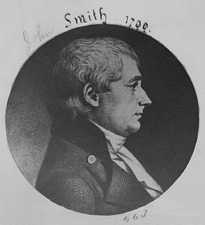
Historical · U.S. Senate · New York
John Smith
Former U.S. Senator from New York · 1804–1813 · Republican · Class 3
John Smith represented New York in the United States Senate (1804–1813) for the Republican party. The page below collects sourced biographical facts, term history, committee roles, and provenance for Smith.
Bioguide ID: S000566
Key facts
- Full name
- John Smith
- State
- New York
- Party
- Republican
- Senate class
- Class III
- Senate service
- 1804–1813
- First Senate term
- 1804
- Status
- Left office
- Current term ends
- —
- Born
- 1752
- Bioguide ID
- S000566
- Committee assignments
- —
- Dataset version
- 1.20260602
Biographical narrative
828 words · sourced from the Wikipedia REST extract
John Smith was a prominent American politician who served as a United States Senator from New York from 1804 to 1813. A member of the Democratic-Republican Party, he previously held the position of U.S. Representative for New York's 1st congressional district from 1800 to 1804. His political career spanned several years and included significant contributions to the early legislative framework of the United States.
Early life and career
John Smith was born on February 12, 1752, in Mastic Beach, which was part of the Province of New York during British colonial rule. He was the son of William Smith, a New York State Senator, and Mary Smith. His lineage can be traced back to Chief Justice William "Tangier" Smith, indicating a family deeply rooted in the political and social fabric of early New York. Tragically, Smith's mother passed away shortly after giving birth to a sibling, leaving him to grow up in a household marked by loss. He spent his early years at Manor St. George in Mastic Beach, Suffolk County.
In 1762, following the death of his mother, his father remarried, bringing Ruth Woodhull into the family. This union produced six half-siblings for John. His early education and upbringing in a politically active family likely influenced his later career in public service.
Smith's political career began in the New York State Assembly, where he represented Suffolk County. His tenure in the Assembly spanned multiple sessions, specifically from 1784 to 1785, again from 1787 to 1794, and finally from 1798 to 1800. His experience in the Assembly provided him with a foundation in legislative processes and governance.
In 1800, Smith was elected to the 6th United States Congress, filling a vacancy left by the death of Jonathan N. Havens. He took his seat on February 27, 1800, and was subsequently re-elected to the 7th and 8th Congresses, serving until February 23, 1804. His time in the House of Representatives allowed him to gain valuable experience in national politics, setting the stage for his transition to the Senate.
Senate tenure
In February 1804, John Smith was elected to the United States Senate as a member of the Democratic-Republican Party. He filled the vacancy created by the resignation of DeWitt Clinton, succeeding the temporarily appointed John Armstrong. Smith's election to the Senate marked a significant advancement in his political career, as he transitioned from the House of Representatives to the upper chamber of Congress.
During his time in the Senate, Smith was re-elected in 1807, allowing him to serve until March 4, 1813. His tenure in the Senate coincided with a period of significant political and social change in the United States, including the War of 1812 and the expansion of the nation’s borders. Although specific details of his legislative activities during this time are not recorded, senators of this era were often involved in debates surrounding issues such as national defense, trade, and the rights of states versus federal authority.
Smith's service in the Senate was characterized by his commitment to the principles of the Democratic-Republican Party, which advocated for agrarian interests, states' rights, and a limited federal government. His role as a senator placed him at the center of discussions that would shape the future of the United States.
Legislative focus and committees
While specific legislative initiatives or committee assignments during John Smith's Senate career are not detailed in the available records, it can be inferred that as a member of the Democratic-Republican Party, he likely focused on issues pertinent to his constituents in New York and the broader national interest. Senators during this period often engaged in discussions regarding economic policy, military preparedness, and the expansion of the United States.
Smith's background in the New York State Assembly and the House of Representatives would have equipped him with the necessary skills to navigate the complexities of Senate proceedings. His experience in state and federal legislatures would have informed his approach to legislation and governance, emphasizing the importance of collaboration and negotiation among his peers.
After serving two terms in the Senate, John Smith's congressional career came to an end on March 3, 1813. His departure from the Senate marked the conclusion of a significant chapter in his political life, during which he contributed to the early development of the United States legislative framework.
Following his Senate tenure, Smith returned to private life, where he continued to reside in Mastic Beach until his death on August 12, 1816. He was interred in the family cemetery on Smiths Point, New York, leaving behind a legacy that reflects the early political landscape of the United States.
In summary, John Smith's political career spanned several key roles, from the New York State Assembly to the U.S. Congress. His contributions during a formative period in American history underscore the importance of local and national governance in shaping the nation. Through his service, he played a role in the establishment of legislative practices that would influence future generations of lawmakers.
Notable legislation
Sponsored and co-sponsored legislation for John Smith is pending operator curation. The biographical narrative above carries the same provenance trail until per-bill rows are written.
Sources
- [1]https://en.wikipedia.org/wiki/John_Smith_(New_York_politician%2C_born_1752)Wikipedia · retrieved 2026-06-02
Notable quotes
Sourced quotes for John Smith are pending operator curation. Narrative-scope provenance remains attached below.
Sources
- [1]https://en.wikipedia.org/wiki/John_Smith_(New_York_politician%2C_born_1752)Wikipedia · retrieved 2026-06-02
Key positions
Curated policy positions for John Smith are pending operator review. The biographical narrative above carries the same provenance trail until per-topic positions are written.
Sources
- [1]https://en.wikipedia.org/wiki/John_Smith_(New_York_politician%2C_born_1752)Wikipedia · retrieved 2026-06-02
Terms served
- 1799–1801U.S. House · District 1 · Term 1 · Republican
- 1801–1803U.S. House · District 1 · Term 2 · Republican
- 1804–1807U.S. Senate · Term 3 · Republican · Class III
- 1807–1813U.S. Senate · Term 4 · Republican · Class III
Sources & provenance
Every attributable claim above carries a per-section [N] marker that resolves to the corresponding URL below. Each entry records the upstream provider, the canonical URL, and the timestamp at which the source was retrieved by the ingest pipeline.
Key facts
- https://bioguide.congress.gov/search/bio/S000566bioguide · retrieved 2026-06-02
- https://www.govtrack.us/congress/members/410046govtrack · retrieved 2026-06-02
Biographical narrative
- https://en.wikipedia.org/wiki/John_Smith_(New_York_politician%2C_born_1752)wikipedia · retrieved 2026-06-02
Find your senator
Every U.S. state elects two senators. Browse New York’s delegation, the full former-senator roster, or explore the role and term length.
Related on The Candidate
- Preceded by De ClintonEarlier holder of the New York Class III Senate seat · Republican.Open
- Succeeded by Nathan SanfordLater holder of the New York Class III Senate seat · Adams.Open
- Aaron BurrFormer U.S. Senator from New York · RepublicanOpen
- Alfonse D’AmatoFormer U.S. Senator from New York · RepublicanOpen
- Charles DudleyFormer U.S. Senator from New York · JacksonOpen
- Charles GoodellFormer U.S. Senator from New York · RepublicanOpen