
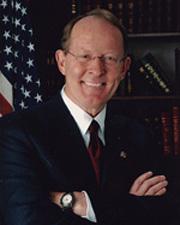
Historical · U.S. Senate · Tennessee
Lamar Alexander
Former U.S. Senator from Tennessee · 2003–2021 · Republican · Class 2
Lamar Alexander represented Tennessee in the United States Senate (2003–2021) for the Republican party. The page below collects sourced biographical facts, term history, committee roles, and provenance for Alexander.
Bioguide ID: A000360
Key facts
- Full name
- Lamar Alexander
- State
- Tennessee
- Party
- Republican
- Senate class
- Class II
- Senate service
- 2003–2021
- First Senate term
- 2003
- Status
- Left office
- Current term ends
- —
- Born
- 1940
- Bioguide ID
- A000360
- Committee assignments
- —
- Dataset version
- 1.20260601-3
Biographical narrative
979 words · sourced from the Wikipedia REST extract
Andrew Lamar Alexander Jr. is a former U.S. Senator from Tennessee, who served in the Senate from 2003 until 2021. A member of the Republican Party, Alexander has had a diverse career in politics, education, and law. Prior to his tenure in the Senate, he held significant positions including the 45th governor of Tennessee and the 5th United States Secretary of Education. His political career is marked by a focus on education reform and a commitment to public service, reflecting his long-standing engagement in various governmental roles.
Early life and career
Lamar Alexander was born on July 3, 1940, in Maryville, Tennessee. He is the son of Genevra Floreine, a preschool teacher, and Andrew Lamar Alexander, a high school principal. His family has Scotch-Irish roots, which contributed to his deep connection to Tennessee and its communities. Alexander attended Maryville High School, where he was active in student leadership, serving as class president and being elected governor of Tennessee Boys State, a program designed to educate young people about government and civic responsibility.
In 1962, Alexander graduated from Vanderbilt University with a Bachelor of Arts degree in Latin American studies, achieving the distinction of Phi Beta Kappa. While at Vanderbilt, he was involved in various extracurricular activities, including serving as the editor of The Vanderbilt Hustler, the university's student newspaper, where he advocated for the open admission of African Americans. He also participated in track and field. Following his undergraduate education, he attended the New York University School of Law, earning his Juris Doctor in 1965.
After completing his law degree, Alexander began his professional career by clerking for Judge John Minor Wisdom on the United States Court of Appeals for the Fifth Circuit from 1965 to 1966. This experience provided him with valuable insights into the judicial process. In 1967, he transitioned into politics, working as a legislative assistant for Senator Howard Baker. During this time, he developed connections that would later influence his political trajectory, including meeting his future wife at a staff event.
In 1970, Alexander returned to Tennessee to serve as the campaign manager for Winfield Dunn, a dentist who successfully ran for governor, marking a significant Republican victory in the state after a 50-year absence from the governorship. Following this campaign, Alexander co-founded a law firm in Nashville, Dearborn and Ewing, where he practiced law while remaining active in political circles.
In 1974, Alexander sought the Republican nomination for governor but was defeated by Democrat Ray Blanton in the general election. Despite this setback, he continued to build his political career and was appointed as the president of the University of Tennessee from 1988 to 1991. His leadership at the university was marked by efforts to enhance educational standards and institutional effectiveness.
Senate tenure
Lamar Alexander's journey to the U.S. Senate began in 2002 when he ran for the seat vacated by retiring Senator Fred Thompson. He successfully secured the Republican nomination by defeating Congressman Ed Bryant and subsequently won the general election against Democratic Congressman Bob Clement. Alexander was sworn into the Senate in 2003 and served in the Senate Class 2 until January 3, 2021.
During his time in the Senate, Alexander held several leadership roles, including serving as the Chairman of the Senate Republican Conference from 2007 to 2012. His influence in the Senate was further solidified when he became the chairman of the Senate Health, Education, Labor and Pensions Committee from 2015 to 2021. In this capacity, he played a crucial role in shaping legislation related to education and healthcare, focusing on bipartisan solutions.
One of Alexander's notable legislative achievements was the introduction of the Every Student Succeeds Act in 2015, which replaced the No Child Left Behind Act. This legislation aimed to provide states with more flexibility in education policy while maintaining accountability for student outcomes. His commitment to education reform was a consistent theme throughout his Senate career, reflecting his background as an educator and administrator.
In December 2018, Alexander announced that he would not seek a fourth term in the Senate, signaling the end of his long-standing political career. His decision not to run again was influenced by a desire to step back from public life after nearly two decades in the Senate.
Legislative focus and committees
Throughout his Senate tenure, Lamar Alexander was known for his focus on education, healthcare, and labor issues. As chairman of the Senate Health, Education, Labor and Pensions Committee, he prioritized legislation that aimed to improve educational outcomes and expand access to healthcare. His work on the committee involved collaborating with both Republican and Democratic colleagues to find common ground on critical issues affecting American families.
Alexander's commitment to education reform was evident in his advocacy for policies that supported teachers and students alike. He championed initiatives that aimed to enhance the quality of education in public schools and increase funding for educational programs. His efforts to replace the No Child Left Behind Act with the Every Student Succeeds Act marked a significant shift in federal education policy, emphasizing state control and local decision-making.
In addition to his work on education, Alexander was involved in various other legislative initiatives that addressed healthcare and labor issues. He sought to improve access to healthcare services and reduce costs for American families, reflecting his broader commitment to public service and community welfare.
Alexander's legislative focus was characterized by a willingness to engage in bipartisan discussions, which often led to successful collaborations with colleagues across the aisle. His ability to navigate complex political landscapes and build consensus was a hallmark of his approach to governance.
As of January 2021, Alexander concluded his tenure in the Senate, leaving behind a legacy of public service that spanned decades. His contributions to education and healthcare policy continue to influence discussions in these critical areas, underscoring the impact of his work on the lives of many Americans.
Notable legislation
Sponsored and co-sponsored legislation for Lamar Alexander is pending operator curation. The biographical narrative above carries the same provenance trail until per-bill rows are written.
Sources
- [1]https://en.wikipedia.org/wiki/Lamar_AlexanderWikipedia · retrieved 2026-06-01
Notable quotes
Sourced quotes for Lamar Alexander are pending operator curation. Narrative-scope provenance remains attached below.
Sources
- [1]https://en.wikipedia.org/wiki/Lamar_AlexanderWikipedia · retrieved 2026-06-01
Key positions
Curated policy positions for Lamar Alexander are pending operator review. The biographical narrative above carries the same provenance trail until per-topic positions are written.
Sources
- [1]https://en.wikipedia.org/wiki/Lamar_AlexanderWikipedia · retrieved 2026-06-01
Terms served
- 2003–2009U.S. Senate · Term 1 · Republican · Class II
- 2009–2015U.S. Senate · Term 2 · Republican · Class II
- 2015–2021U.S. Senate · Term 3 · Republican · Class II
Sources & provenance
Every attributable claim above carries a per-section [N] marker that resolves to the corresponding URL below. Each entry records the upstream provider, the canonical URL, and the timestamp at which the source was retrieved by the ingest pipeline.
Key facts
- https://bioguide.congress.gov/search/bio/A000360bioguide · retrieved 2026-06-01
- https://www.alexander.senate.gov/publicsenate.gov · retrieved 2026-06-01
Biographical narrative
- https://en.wikipedia.org/wiki/Lamar_Alexanderwikipedia · retrieved 2026-06-01
Find your senator
Every U.S. state elects two senators. Browse Tennessee’s delegation, the full former-senator roster, or explore the role and term length.
Related on The Candidate
- Preceded by Fred ThompsonEarlier holder of the Tennessee Class II Senate seat · Republican.Open
- Albert GoreFormer U.S. Senator from Tennessee · DemocraticOpen
- Albert Gore Jr.Former U.S. Senator from Tennessee · DemocraticOpen
- Alexander AndersonFormer U.S. Senator from Tennessee · DemocraticOpen
- Alfred NicholsonFormer U.S. Senator from Tennessee · DemocraticOpen
- Republican PartyFederal candidates and office holders on the Republican line.Open