
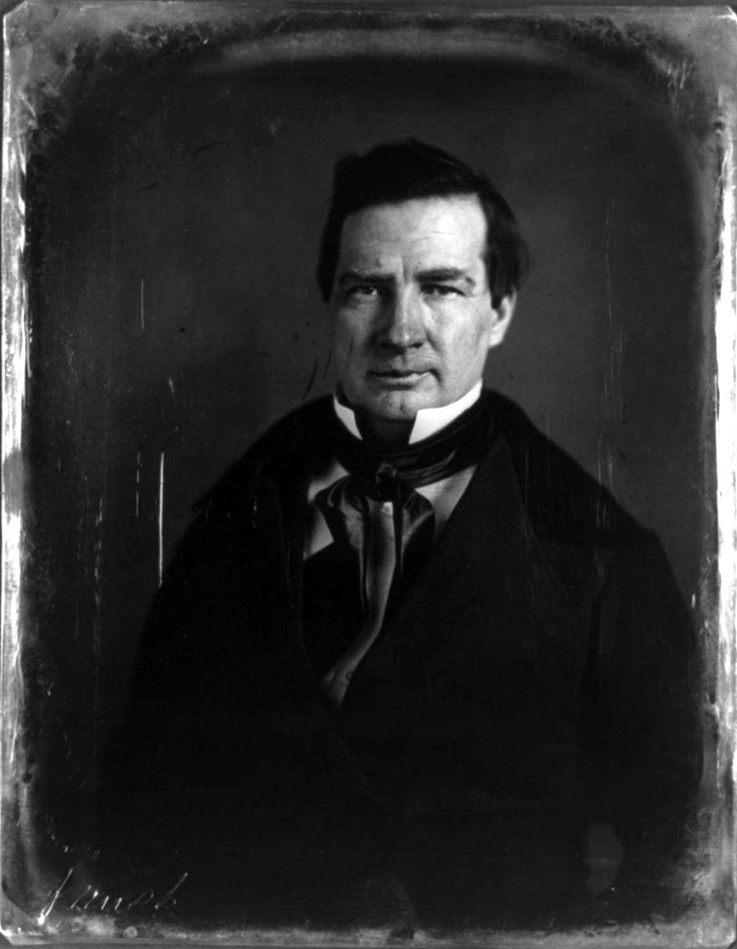
Historical · U.S. Senate · Texas
Thomas Rusk
Former U.S. Senator from Texas · 1846–1857 · Democratic · Class 1
Thomas Rusk represented Texas in the United States Senate (1846–1857) for the Democratic party. The page below collects sourced biographical facts, term history, committee roles, and provenance for Rusk.
Bioguide ID: R000518
Key facts
- Full name
- Thomas Rusk
- State
- Texas
- Party
- Democratic
- Senate class
- Class I
- Senate service
- 1846–1857
- First Senate term
- 1846
- Status
- Left office
- Current term ends
- —
- Born
- 1803
- Bioguide ID
- R000518
- Committee assignments
- —
- Dataset version
- 1.20260602
Biographical narrative
1,009 words · sourced from the Wikipedia REST extract
Thomas Rusk was a prominent political and military figure in the early history of Texas, serving as a U.S. Senator from Texas from 1846 until his death in 1857. A member of the Democratic Party, Rusk played a significant role in the Republic of Texas, notably as its first Secretary of War and as a general during the pivotal Battle of San Jacinto. His tenure in the U.S. Senate was marked by his involvement in key legislative issues of the time, including territorial claims and infrastructure development.
Early life and career
Thomas Rusk was born on December 5, 1803, in Pendleton, South Carolina. He was the son of John Rusk, a stonemason, and Sterritt Rusk. Rusk pursued a legal career and was admitted to the bar in 1825, subsequently establishing his law practice in Clarkesville, Georgia. In 1827, he married Mary F. Cleveland, the daughter of General Benjamin Cleveland, a notable figure in the American Revolutionary War. Following his marriage, Rusk became a business partner with his father-in-law and engaged in mining ventures in the gold-rich regions of Georgia. However, his investments were adversely affected in 1834 when the managers of the company he had invested in embezzled funds and fled to Mexican Texas. Rusk attempted to recover his losses by pursuing the culprits to Nacogdoches, but he was ultimately unsuccessful.
Rusk's decision to remain in Texas was influenced by his growing involvement in the independence movement against Mexican rule. He became a citizen of Mexico in 1835 and sought a headright in David G. Burnet's colony. His political engagement deepened as he participated in local discussions denouncing the Mexican government's actions. Rusk organized volunteers from Nacogdoches and joined Stephen F. Austin's army to prevent the Mexican forces from seizing artillery at Gonzales. Although he left the army before the Siege of Béxar, his commitment to the Texan cause was evident.
During the Texas Revolution, Rusk was appointed inspector general of the army in the Nacogdoches District and served as a delegate to the Convention of 1836, where he signed the Texas Declaration of Independence and chaired the committee responsible for revising the constitution of the Republic of Texas. Following the fall of the Alamo and the massacre at Goliad, Rusk played a crucial role in advising General Sam Houston to prepare for a decisive confrontation with Mexican forces. He demonstrated his military leadership during the Battle of San Jacinto on April 21, 1836, where he fought bravely and contributed to the Texan victory.
After the war, Rusk held various positions in the Republic of Texas government. Initially appointed as Secretary of War, he later resigned to address domestic issues but returned to public service as a representative from Nacogdoches in the Second Congress of the Republic. He was active in military affairs, commanding the militia during the Córdova Rebellion and later serving as chief justice of the Republic's Supreme Court. Rusk's legal career continued to flourish as he formed a law partnership with J. Pinckney Henderson in 1841.
Senate tenure
Rusk's political career advanced significantly with the annexation of Texas to the United States. He was a strong supporter of this movement and served as president of the Convention of 1845, which accepted the terms of annexation. Following the establishment of Texas as a state, Rusk was elected to the United States Senate in February 1846, where he served in Senate Class 1. His initial term in the Senate began that same year, and he was re-elected to continue serving until his death in 1857.
During his time in the Senate, Rusk worked closely with fellow Texan Senator Sam Houston to address various issues, including the southwest boundary question, which involved Texas' claim to the Rio Grande. Rusk was an advocate for the Mexican-American War and supported President James K. Polk's policies aimed at expanding U.S. territory, including the acquisition of California. His legislative efforts also included defending Texas' claims to land that would later contribute to the formation of the New Mexico Territory, where he argued for financial compensation for Texas.
Rusk's Senate career was marked by his involvement in significant national debates, including the Compromise of 1850. He opposed the idea of secession that was proposed by some Southern congressmen and sought to find a middle ground on contentious issues. His support for infrastructure development was evident in his advocacy for a transcontinental railroad through Texas, where he made speeches to promote a southern route. Additionally, Rusk supported the Gadsden Purchase, which aimed to facilitate railroad construction in the southern United States.
Legislative focus and committees
Throughout his Senate tenure, Rusk was involved in various legislative initiatives and served on several committees that shaped policy during a transformative period in American history. His focus on infrastructure development, particularly the transcontinental railroad, highlighted his commitment to enhancing transportation and communication across the expanding nation. Rusk's support for the Gadsden Purchase illustrated his belief in the importance of facilitating trade and connectivity in the southern regions of the United States.
Rusk's engagement in debates surrounding territorial expansion was consistent with his earlier military and political experiences in Texas. His advocacy for the Mexican-American War aligned with the broader national sentiment of Manifest Destiny, which sought to expand U.S. territory across North America. Rusk's legislative actions reflected his understanding of the complexities involved in balancing state and national interests, particularly in relation to the contentious issues of slavery and territorial governance.
In addition to his legislative work, Rusk held the position of president pro tempore of the United States Senate in 1857, a role that underscored his prominence within the Senate. His leadership in this capacity demonstrated his influence and respect among his peers, as well as his commitment to the legislative process.
Rusk's life came to an end on July 29, 1857, shortly after his Senate term concluded. His contributions to the Republic of Texas and the United States Senate remain a significant part of Texas history, reflecting the complexities of governance and the challenges faced during a period of rapid change in the nation.
Notable legislation
Sponsored and co-sponsored legislation for Thomas Rusk is pending operator curation. The biographical narrative above carries the same provenance trail until per-bill rows are written.
Sources
- [1]https://en.wikipedia.org/wiki/Thomas_Jefferson_RuskWikipedia · retrieved 2026-06-02
Notable quotes
Sourced quotes for Thomas Rusk are pending operator curation. Narrative-scope provenance remains attached below.
Sources
- [1]https://en.wikipedia.org/wiki/Thomas_Jefferson_RuskWikipedia · retrieved 2026-06-02
Key positions
Curated policy positions for Thomas Rusk are pending operator review. The biographical narrative above carries the same provenance trail until per-topic positions are written.
Sources
- [1]https://en.wikipedia.org/wiki/Thomas_Jefferson_RuskWikipedia · retrieved 2026-06-02
Terms served
- 1846–1851U.S. Senate · Term 1 · Democratic · Class I
- 1851–1857U.S. Senate · Term 2 · Democratic · Class I
Sources & provenance
Every attributable claim above carries a per-section [N] marker that resolves to the corresponding URL below. Each entry records the upstream provider, the canonical URL, and the timestamp at which the source was retrieved by the ingest pipeline.
Key facts
- https://bioguide.congress.gov/search/bio/R000518bioguide · retrieved 2026-06-02
- https://www.govtrack.us/congress/members/409476govtrack · retrieved 2026-06-02
Biographical narrative
- https://en.wikipedia.org/wiki/Thomas_Jefferson_Ruskwikipedia · retrieved 2026-06-02
Find your senator
Every U.S. state elects two senators. Browse Texas’s delegation, the full former-senator roster, or explore the role and term length.
Related on The Candidate
- Succeeded by James HendersonLater holder of the Texas Class I Senate seat · Democratic.Open
- Andrew HoustonFormer U.S. Senator from Texas · DemocraticOpen
- Charles CulbersonFormer U.S. Senator from Texas · DemocraticOpen
- Earle MayfieldFormer U.S. Senator from Texas · DemocraticOpen
- Horace ChiltonFormer U.S. Senator from Texas · DemocraticOpen
- Democratic PartyFederal candidates and office holders on the Democratic line.Open