
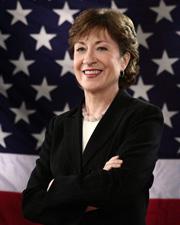
Serving · U.S. Senate · Maine
Susan Collins
U.S. Senator from Maine · 1997–present · Republican · Class 2
Susan Collins represents Maine in the United States Senate (1997–present) for the Republican party. The page below collects sourced biographical facts, term history, committee roles, and provenance for Collins.
Bioguide ID: C001035
Key facts
- Full name
- Susan Collins
- State
- Maine
- Party
- Republican
- Senate class
- Class II
- Senate service
- 1997–present
- First Senate term
- 1997
- Status
- Currently serving
- Current term ends
- 2027
- Born
- 1952
- Bioguide ID
- C001035
- Committee assignments
- 3
- Dataset version
- 1.20260601-4
Biographical narrative
1,061 words · sourced from the Wikipedia REST extract
Susan M. Collins is an American politician currently serving as the senior United States senator from Maine, a position she has held since 1997. As a member of the Republican Party, she is recognized as Maine's longest-serving member of Congress and the longest-serving Republican woman in the history of the Senate. Collins has played a significant role in various legislative matters and has held leadership positions within the Senate, including her current role as chair of the Senate Appropriations Committee, which she assumed in 2025.
Early life and career
Born on December 7, 1952, in Caribou, Maine, Susan Collins is one of six children in her family. Her family's roots in the region run deep, as they have operated a lumber business established by her great-great-great-grandfather in 1844. Collins's parents, Patricia and Donald Collins, were both active in local politics, each serving as mayor of Caribou. Donald Collins, a decorated veteran of World War II, also had a political career in the Maine legislature, serving one term in the House and four in the Senate. Additionally, her uncle, Samuel W. Collins Jr., was a member of the Maine Senate and later served on the Maine Supreme Judicial Court.
Collins attended Caribou High School, where she was involved in student leadership, serving as president of the student council. During her senior year, she participated in the U.S. Senate Youth Program, which provided her with an opportunity to visit Washington, D.C., and engage in discussions with prominent political figures, including Maine's first female U.S. Senator, Margaret Chase Smith. This experience left a lasting impression on Collins and is notable as she later became the first delegate from the program to be elected to the Senate, succeeding Smith in the role.
After graduating from high school, Collins pursued higher education at St. Lawrence University in Canton, New York. She excelled academically, graduating magna cum laude with a bachelor's degree in government in 1975. During her time at university, she was elected to the Phi Beta Kappa national academic honor society, reflecting her academic achievements.
Collins began her political career shortly after graduation, working as a legislative assistant to U.S. Representative William Cohen, who later became a U.S. Senator. She served in this capacity from 1975 until 1987, during which she gained valuable experience in legislative processes. In 1981, she became the staff director of the Oversight of Government Management Subcommittee of the Senate Committee on Governmental Affairs, further enhancing her understanding of government operations.
In 1987, Collins was appointed by Governor John R. McKernan Jr. as the commissioner of the Maine Department of Professional and Financial Regulation. This role marked her entry into state-level administration. Subsequently, in 1992, she was appointed by President George H. W. Bush as the regional director for the Small Business Administration in New England. After a brief tenure in this position, she returned to Massachusetts, where she served as the Deputy State Treasurer under Joe Malone in 1993.
Collins returned to Maine in 1994 and entered the political arena as the Republican nominee for governor in that year's general election. Her candidacy was historic, as she was the first woman to be nominated by a major party for the governorship of Maine. Despite her efforts, she finished third in a competitive four-way race, securing approximately 23% of the vote. Following this campaign, Collins became the founding director of the Center for Family Business at Husson University in Bangor, Maine, where she contributed to the development of resources for family-owned businesses.
Senate tenure
Collins was first elected to the U.S. Senate in 1996, marking the beginning of her long-standing tenure in Congress. She has been re-elected multiple times since then, maintaining her position as a prominent figure in Maine's political landscape. As of January 3, 2027, she is expected to continue serving in the Senate, having secured her current term through the electoral process.
Throughout her Senate career, Collins has held various leadership roles and committee assignments. Notably, she chaired the Senate Special Committee on Aging from 2015 to 2021 and led the Senate Committee on Homeland Security and Governmental Affairs from 2003 to 2007. Her leadership in these committees has allowed her to influence key legislative discussions and initiatives.
Collins is recognized as the dean of Maine's congressional delegation and is notable for being the only Republican from New England in the Senate during several recent Congresses. Her position as a moderate Republican has often placed her in a pivotal role, where her votes can significantly impact legislative outcomes. She has been involved in several high-profile votes, including those related to the Affordable Care Act and Supreme Court nominations.
Legislative focus and committees
In her legislative work, Collins has developed a reputation as a moderate Republican, often advocating for bipartisan cooperation. She has been involved in various significant votes, including opposing a partial repeal of the Affordable Care Act and being the sole Republican to vote against the confirmation of Justice Amy Coney Barrett. Additionally, she has supported the confirmation of other justices, including Ketanji Brown Jackson, demonstrating her willingness to cross party lines on judicial matters.
Collins's stance on reproductive rights is also notable; she identifies as a pro-choice Republican. Her vote to confirm Justice Brett Kavanaugh drew scrutiny due to Kavanaugh's role in the Supreme Court's decision in Dobbs v. Jackson Women's Health Organization, which overturned Roe v. Wade. She opposed the Women's Health Protection Act, reflecting her complex position on reproductive issues.
In procedural matters, Collins has consistently supported the 60-vote threshold in the Senate, advocating for the preservation of the filibuster and emphasizing the importance of bipartisan compromise in legislative processes. Her approach has often positioned her as a key vote in contentious issues, including tax reform and impeachment trials.
During the impeachment trial of President Bill Clinton, Collins voted to acquit him on both charges, and she similarly joined most Senate Republicans in voting to acquit President Donald Trump during his first impeachment trial. However, during Trump's second impeachment trial, she was one of seven Republicans who voted to convict him for incitement of insurrection, highlighting her willingness to take a stand on issues of principle.
Overall, Collins's long-standing service in the Senate, her leadership roles, and her moderate approach to governance have established her as a significant figure in American politics, particularly within the context of Maine's representation in Congress.
Committees & roles
- Senate Committee on AppropriationsChair · since 2025
- Senate Committee on Health, Education, Labor, and PensionsMember · since 2025
- Senate Select Committee on IntelligenceMember · since 2025
Notable legislation
Sponsored and co-sponsored legislation for Susan Collins is pending operator curation. The biographical narrative above carries the same provenance trail until per-bill rows are written.
Sources
- [1]https://en.wikipedia.org/wiki/Susan_CollinsWikipedia · retrieved 2026-06-01
Notable quotes
Sourced quotes for Susan Collins are pending operator curation. Narrative-scope provenance remains attached below.
Sources
- [1]https://en.wikipedia.org/wiki/Susan_CollinsWikipedia · retrieved 2026-06-01
Key positions
Curated policy positions for Susan Collins are pending operator review. The biographical narrative above carries the same provenance trail until per-topic positions are written.
Sources
- [1]https://en.wikipedia.org/wiki/Susan_CollinsWikipedia · retrieved 2026-06-01
Terms served
- 1997–2003U.S. Senate · Term 1 · Republican · Class II
- 2003–2009U.S. Senate · Term 2 · Republican · Class II
- 2009–2015U.S. Senate · Term 3 · Republican · Class II
- 2015–2021U.S. Senate · Term 4 · Republican · Class II
- 2021–2027U.S. Senate · Term 5 · Republican · Class II
Sources & provenance
Every attributable claim above carries a per-section [N] marker that resolves to the corresponding URL below. Each entry records the upstream provider, the canonical URL, and the timestamp at which the source was retrieved by the ingest pipeline.
Key facts
- https://bioguide.congress.gov/search/bio/C001035bioguide · retrieved 2026-06-01
- https://www.collins.senate.govsenate.gov · retrieved 2026-06-01
Biographical narrative
- https://en.wikipedia.org/wiki/Susan_Collinswikipedia · retrieved 2026-06-01
Find your senator
Every U.S. state elects two senators. Browse Maine’s delegation, the full currently-serving-senator roster, or explore the role and term length.
Related on The Candidate
- Angus King Jr.Serving U.S. Senator from Maine · IndependentOpen
- Republican PartyFederal candidates and office holders on the Republican line.Open
- Senators from MaineEvery currently-serving U.S. Senator who has represented Maine.Open
- All serving senatorsEvery individual currently serving in the United States Senate, grouped by state.Open
- U.S. SenateRole, term length, qualifications, and the full Senate candidate directory.Open