
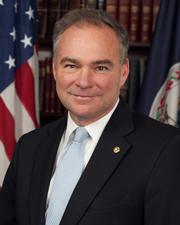
Serving · U.S. Senate · Virginia
Tim Kaine
U.S. Senator from Virginia · 2013–present · Democratic · Class 1
Tim Kaine represents Virginia in the United States Senate (2013–present) for the Democratic party. The page below collects sourced biographical facts, term history, committee roles, and provenance for Kaine.
Bioguide ID: K000384
Key facts
- Full name
- Tim Kaine
- State
- Virginia
- Party
- Democratic
- Senate class
- Class I
- Senate service
- 2013–present
- First Senate term
- 2013
- Status
- Currently serving
- Current term ends
- 2031
- Born
- 1958
- Bioguide ID
- K000384
- Committee assignments
- 4
- Dataset version
- 1.20260601-4
Biographical narrative
994 words · sourced from the Wikipedia REST extract
Tim Kaine is an American lawyer and politician currently serving as the junior United States senator from Virginia, a position he has held since 2013. A member of the Democratic Party, Kaine's political career has included serving as the 70th governor of Virginia from 2006 to 2010 and as the 38th lieutenant governor of Virginia from 2002 to 2006. He was also the Democratic vice presidential nominee in the 2016 presidential election, running alongside Hillary Clinton. Throughout his career, Kaine has been involved in various aspects of public service and law, demonstrating a commitment to issues such as fair housing and education.
Early life and career
Tim Kaine was born on February 26, 1958, at Saint Joseph's Hospital in Saint Paul, Minnesota. He is the eldest of three sons born to Mary Kathleen, a home economics teacher, and Albert Alexander Kaine Jr., a welder and small business owner. Raised in a Catholic household, Kaine's family moved to Overland Park, Kansas, when he was two years old, where he spent his formative years in the Kansas City area. He attended Rockhurst High School, a Jesuit all-boys preparatory school in Kansas City, graduating in 1976. During his time at Rockhurst, Kaine was active in extracurricular activities, including serving as student body president and participating on the debate team.
Kaine pursued higher education at the University of Missouri, where he earned a Bachelor of Arts degree in economics in 1979, completing his studies in three years and graduating with honors. He was recognized as a member of Omicron Delta Kappa, a national leadership honor society. In 1979, he entered Harvard Law School, where he continued his education in law. During his first year, Kaine took a hiatus to work in Honduras for nine months, assisting Jesuit missionaries at a Catholic school in El Progreso. His work included running a vocational center and increasing school enrollment, experiences that contributed to his fluency in Spanish.
After returning to the United States, Kaine graduated from Harvard Law School with a Juris Doctor degree in 1983. He and his future wife, Anne Holton, who was also a first-year law student at Harvard, relocated to Richmond, Virginia, where Kaine was admitted to the Virginia bar in 1984. Kaine began his legal career as a law clerk for Judge R. Lanier Anderson III of the United States Court of Appeals for the Eleventh Circuit before joining the Richmond law firm of Little, Parsley & Cluverius, P.C. He later became a director at the law firm of Mezzullo & McCandlish, P.C., where he practiced law for 17 years, focusing on fair housing law and advocating for clients facing discrimination based on race or disability.
In addition to his legal practice, Kaine was actively involved in pro bono work and served on the board of the Virginia chapter of Housing Opportunities Made Equal. He represented the organization in a significant discrimination lawsuit against Nationwide Mutual Insurance Co., which resulted in a substantial verdict, although it was later overturned on appeal. Kaine also contributed to academia by teaching legal ethics as an adjunct professor at the University of Richmond School of Law for six years.
Kaine's interest in politics developed later in life, influenced by his wife's family and his experiences attending Richmond city council meetings. In 1994, he was elected to the Richmond city council, representing the 2nd district. He won the election by a narrow margin against the incumbent city councilor and served on the council until 2001, during which he was elected mayor of Richmond in 1998.
Senate tenure
Tim Kaine was elected to the United States Senate in 2012, defeating former Virginia governor and senator George Allen. He took office in January 2013 and has since been serving as a member of the Democratic Party. Kaine's tenure in the Senate has included a focus on various legislative issues and a commitment to representing the interests of Virginia constituents. He was re-elected to a second term in 2018, winning by a significant margin against his Republican opponent, Corey Stewart. Kaine is currently serving his third term, which is set to end in January 2031.
As a senator, Kaine has participated in numerous debates and discussions on key national issues, advocating for policies that align with his party's platform. His experience as governor and lieutenant governor has informed his approach to governance and legislative priorities. Kaine's role in the Senate has also included participation in various committees, where he has worked on issues ranging from education to foreign relations.
Legislative focus and committees
Throughout his Senate career, Tim Kaine has concentrated on a range of legislative issues, reflecting his background in law and public service. His work has often emphasized education, housing, and civil rights, areas where he has considerable experience. Kaine has been an advocate for policies aimed at improving access to quality education and ensuring fair housing practices.
In addition to his legislative priorities, Kaine has served on several Senate committees, where he has contributed to discussions and decisions on critical issues. His committee assignments have allowed him to engage with a variety of topics, including foreign relations, which is particularly relevant given his experience in international matters during his time in Honduras. Kaine's involvement in these committees has enabled him to play a significant role in shaping legislation and policy at the national level.
Kaine's legislative focus is also informed by his commitment to bipartisanship and collaboration. He has worked with colleagues across the aisle to address pressing issues facing the nation, seeking to find common ground on various matters. His approach reflects a belief in the importance of dialogue and cooperation in achieving effective governance.
In summary, Tim Kaine's career has been marked by a dedication to public service, legal advocacy, and a commitment to addressing the needs of his constituents in Virginia. His experiences in various levels of government have shaped his approach to legislation and policy, making him a prominent figure in contemporary American politics.
Committees & roles
- Senate Committee on Armed ServicesMember · since 2025
- Senate Committee on Foreign RelationsMember · since 2025
- Senate Committee on Health, Education, Labor, and PensionsMember · since 2025
- Senate Committee on the BudgetMember · since 2025
Notable legislation
Sponsored and co-sponsored legislation for Tim Kaine is pending operator curation. The biographical narrative above carries the same provenance trail until per-bill rows are written.
Sources
- [1]https://en.wikipedia.org/wiki/Tim_KaineWikipedia · retrieved 2026-06-01
Notable quotes
Sourced quotes for Tim Kaine are pending operator curation. Narrative-scope provenance remains attached below.
Sources
- [1]https://en.wikipedia.org/wiki/Tim_KaineWikipedia · retrieved 2026-06-01
Key positions
Curated policy positions for Tim Kaine are pending operator review. The biographical narrative above carries the same provenance trail until per-topic positions are written.
Sources
- [1]https://en.wikipedia.org/wiki/Tim_KaineWikipedia · retrieved 2026-06-01
Terms served
- 2013–2019U.S. Senate · Term 1 · Democratic · Class I
- 2019–2025U.S. Senate · Term 2 · Democratic · Class I
- 2025–2031U.S. Senate · Term 3 · Democratic · Class I
Sources & provenance
Every attributable claim above carries a per-section [N] marker that resolves to the corresponding URL below. Each entry records the upstream provider, the canonical URL, and the timestamp at which the source was retrieved by the ingest pipeline.
Key facts
- https://bioguide.congress.gov/search/bio/K000384bioguide · retrieved 2026-06-01
- https://www.kaine.senate.gov/senate.gov · retrieved 2026-06-01
Biographical narrative
- https://en.wikipedia.org/wiki/Tim_Kainewikipedia · retrieved 2026-06-01
Find your senator
Every U.S. state elects two senators. Browse Virginia’s delegation, the full currently-serving-senator roster, or explore the role and term length.
Related on The Candidate
- Mark WarnerServing U.S. Senator from Virginia · DemocraticOpen
- Democratic PartyFederal candidates and office holders on the Democratic line.Open
- Senators from VirginiaEvery currently-serving U.S. Senator who has represented Virginia.Open
- All serving senatorsEvery individual currently serving in the United States Senate, grouped by state.Open
- U.S. SenateRole, term length, qualifications, and the full Senate candidate directory.Open