
Historical · U.S. House · Alabama · District 1
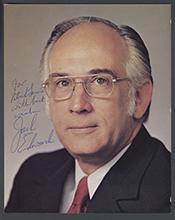
Jack Edwards
Former U.S. Representative · Alabama District 1 · 1965–1985 · Republican
Jack Edwards represented Alabama's District 1 in the United States House of Representatives (1965–1985) for the Republican party. The page below collects sourced biographical facts, term history, committee roles, and provenance for Edwards.
Bioguide ID: E000084
Key facts
- Full name
- Jack Edwards
- State
- Alabama
- District
- District 1
- Party
- Republican
- House service
- 1965–1985
- First House term
- 1965
- Status
- Left office
- Current term ends
- —
- Born
- 1928
- Bioguide ID
- E000084
- Committee assignments
- —
- Dataset version
- 1.20260605
Biographical narrative
1,010 words · sourced from the Wikipedia REST extract
William Jackson "Jack" Edwards III was an American lawyer and politician who served as a U.S. Representative for Alabama's 1st congressional district from 1965 until 1985. A member of the Republican Party, Edwards was first elected to Congress during a significant political shift in Alabama, coinciding with the presidential campaign of Barry Goldwater. Over his two decades in the House, he became known for his work on defense appropriations and environmental conservation, while also gaining recognition for his leadership within the Republican Party during the Reagan administration.
Early life and career
Jack Edwards was born on September 20, 1928, near Birmingham, Alabama. He was raised in Homewood, Alabama, during the Great Depression, in a family with deep roots in the region. His father, William Jackson Edwards Jr., worked for the Rural Electrification Administration and held various positions until he became the head of the engineering department. Edwards had a sister named Julia Caroline Edwards Brock and was influenced by a lineage of family members, including his great-grandfather Perry Jackson Edwards, who served as the chief inspector of the Louisville and Nashville Railroad.
At the age of 17, Edwards enlisted in the U.S. Marine Corps, serving until 1951, just as the Korean War began. His commitment to public service was evident early on, and he later pursued higher education at the University of Alabama. There, he became the president of the Student Government Association, showcasing his leadership abilities. Following his undergraduate studies, he attended the University of Alabama School of Law and graduated in 1954, subsequently becoming a member of the Alabama Bar.
After establishing a law practice in Point Clear, a suburb of Mobile, Edwards became actively involved in local civic organizations. He served as president of the Mobile Area Jaycees and was recognized as one of the Outstanding Young Men in America by the national Jaycees organization in 1961. Additionally, he held leadership roles in various local events, including the Alabama Deep Sea Fishing Rodeo and America's Junior Miss Pageant. His involvement with the Mobile Planning Commission's Transportation Policy Committee began in 1960, further demonstrating his commitment to community development.
House tenure
Edwards entered Congress in November 1964 after defeating Democrat John M. Tyson Sr. and Mobile activist Noble Beasley in a competitive election. His victory came during a period of political transformation in Alabama, as the state had recently lost one of its congressional seats due to the 1960 federal census. The previous Democratic incumbent, Frank W. Boykin, had been implicated in a corruption scandal and was redistricted out of office. Edwards' election was part of a broader trend, as he was one of five Republicans elected to the House from Alabama that year, coinciding with Barry Goldwater's presidential campaign, which resonated with voters in the state.
Edwards quickly established himself as a prominent figure in Congress, winning reelection nine times and serving alongside five different presidents during his tenure. His popularity in Alabama's 1st congressional district was notable, as he consistently garnered substantial support from voters. The district had historically leaned Democratic, but following the passage of the Civil Rights Act of 1964, many voters began to shift their allegiances. Edwards' appeal was further bolstered by Goldwater's significant victory in the district, where he received over 70 percent of the vote.
Throughout his congressional career, Edwards focused on various initiatives, including the development of the Tennessee–Tombigbee Waterway. He served on the House Appropriations Committee and became the ranking Republican on the Defense subcommittee, where he gained recognition as an expert in national defense matters. His leadership within the Republican Party grew during the presidency of Ronald Reagan, as he became the vice chairman of the House Republican conference leadership. Edwards was also involved in efforts to establish important environmental protections, including the Bon Secour National Wildlife Refuge and the Weeks Bay National Estuarine Research Reserve.
In addition to his legislative work, Edwards co-hosted the Gulf Coast Congressional Report, a television program that aired on WKRG-TV in Mobile from 1973 to 1985. His commitment to his constituents was evident in his active engagement with local issues, including overseeing funding for the reconstruction of Alabama's Dauphin Island Bridge after it was damaged by a hurricane in 1979.
Legislative focus and committees
During his time in the House, Edwards was particularly noted for his involvement in defense appropriations and environmental conservation. As a member of the House Appropriations Committee, he played a significant role in shaping budgetary decisions related to national defense. His position as the ranking Republican on the Defense subcommittee allowed him to influence funding allocations and policy decisions during a critical period in U.S. military history, particularly during the Reagan administration, which emphasized military buildup and national security.
Edwards' legislative focus extended beyond defense; he was also an advocate for environmental issues. His efforts to establish the Bon Secour National Wildlife Refuge and the Weeks Bay National Estuarine Research Reserve reflected his commitment to preserving Alabama's natural resources and promoting environmental stewardship. These initiatives were part of a broader trend in which Edwards sought to balance economic development with ecological conservation.
In his role as a legislator, Edwards maintained a strong connection to his constituents, often addressing local concerns and advocating for projects that would benefit the Alabama Gulf Coast region. His work on the Tennessee–Tombigbee Waterway exemplified his dedication to infrastructure development and economic growth in his district.
After announcing his decision not to seek reelection in 1984, Edwards concluded his congressional career on January 3, 1985. Following his departure from the House, he joined the Hand Arendall law firm, where he continued to practice law for two decades. In 1988, he chaired the Base Realignment and Closure Commission, further contributing to public service and civic engagement in his later years.
Edwards' legacy includes his significant contributions to both national defense and environmental conservation, as well as his role in shaping the political landscape of Alabama during a transformative period in American history. His tenure in Congress marked a notable chapter in the state's political evolution, reflecting broader national trends and local dynamics.
Notable legislation
Sponsored and co-sponsored legislation for Jack Edwards is pending operator curation. The biographical narrative above carries the same provenance trail until per-bill rows are written.
Sources
- [1]https://en.wikipedia.org/wiki/Jack_Edwards_(American_politician)Wikipedia · retrieved 2026-06-05
Notable quotes
Sourced quotes for Jack Edwards are pending operator curation. Narrative-scope provenance remains attached below.
Sources
- [1]https://en.wikipedia.org/wiki/Jack_Edwards_(American_politician)Wikipedia · retrieved 2026-06-05
Key positions
Curated policy positions for Jack Edwards are pending operator review. The biographical narrative above carries the same provenance trail until per-topic positions are written.
Sources
- [1]https://en.wikipedia.org/wiki/Jack_Edwards_(American_politician)Wikipedia · retrieved 2026-06-05
Terms served
- 1965–1967U.S. House · Term 1 · Republican
- 1967–1969U.S. House · Term 2 · Republican
- 1969–1971U.S. House · Term 3 · Republican
- 1971–1973U.S. House · Term 4 · Republican
- 1973–1975U.S. House · Term 5 · Republican
- 1975–1977U.S. House · Term 6 · Republican
- 1977–1979U.S. House · Term 7 · Republican
- 1979–1981U.S. House · Term 8 · Republican
- 1981–1983U.S. House · Term 9 · Republican
- 1983–1985U.S. House · Term 10 · Republican
Sources & provenance
Every attributable claim above carries a per-section [N] marker that resolves to the corresponding URL below. Each entry records the upstream provider, the canonical URL, and the timestamp at which the source was retrieved by the ingest pipeline.
Key facts
- https://bioguide.congress.gov/search/bio/E000084bioguide · retrieved 2026-06-05
- https://www.govtrack.us/congress/members/403777govtrack · retrieved 2026-06-05
Biographical narrative
- https://en.wikipedia.org/wiki/Jack_Edwards_(American_politician)wikipedia · retrieved 2026-06-05
Find your representative
Every U.S. state elects representatives by district. Browse Alabama’s delegation, the full former-representative roster, or explore the role and term length.
Related on The Candidate
- Preceded by Frank BoykinEarlier holder of the Alabama District 1 House seat · Democratic.Open
- Succeeded by H. CallahanLater holder of the Alabama District 1 House seat · Republican.Open
- Alfred BuckFormer U.S. Representative · Alabama District 1 · RepublicanOpen
- Benjamin TurnerFormer U.S. Representative · Alabama District 1 · RepublicanOpen
- Bradley ByrneFormer U.S. Representative · Alabama District 1 · RepublicanOpen
- Edmund DarganFormer U.S. Representative · Alabama District 1 · DemocraticOpen