
Historical · U.S. House · Alabama · District 3
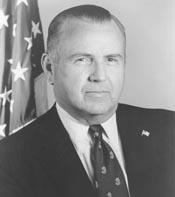
William Nichols
Former U.S. Representative · Alabama District 3 · 1967–1989 · Democratic
William Nichols represented Alabama's District 3 in the United States House of Representatives (1967–1989) for the Democratic party. The page below collects sourced biographical facts, term history, committee roles, and provenance for Nichols.
Bioguide ID: N000095
Key facts
- Full name
- William Nichols
- State
- Alabama
- District
- District 3
- Party
- Democratic
- House service
- 1967–1989
- First House term
- 1967
- Status
- Left office
- Current term ends
- —
- Born
- 1918
- Bioguide ID
- N000095
- Committee assignments
- —
- Dataset version
- 1.20260605
Biographical narrative
857 words · sourced from the Wikipedia REST extract
William Flynt Nichols was an American politician and member of the Democratic Party who served as a U.S. Representative for Alabama's 4th congressional district from 1967 to 1973 and for Alabama's 3rd congressional district from 1973 until his death in 1988. Over his extensive political career, Nichols was known for his commitment to public service, having been elected to Congress eleven times. His legislative contributions included significant involvement in defense reorganization and cultural resource management.
Early life and career
Bill Nichols was born on October 16, 1918. He pursued higher education at the Alabama Polytechnic Institute, now known as Auburn University, where he earned a bachelor's degree in Agriculture in 1939 and a master's degree in Agronomy in 1941. His academic background laid the foundation for his later involvement in agricultural policy and rural development.
In 1942, Nichols enlisted in the United States Army, where he served in the European Theatre during World War II. His military service was marked by bravery; he was wounded during the Battle of Hürtgen Forest, resulting in the loss of a leg due to a land mine explosion. For his service, he received the Bronze Star Medal and the Purple Heart, and he retired with the rank of Captain in 1947. Following his military career, Nichols settled in Sylacauga, Alabama, where he became active in local business and community affairs.
After returning from military service, Nichols worked for the Parker Fertilizer Company and eventually became president of the associated Parker Gin Company. His business experience, combined with his agricultural education, positioned him well for a future in politics. Nichols's initial foray into public service began in 1958 when he was elected to the Alabama House of Representatives. He later served in the Alabama Senate, where he was involved in legislative matters for over eight years before transitioning to national politics.
House tenure
Nichols's congressional career began when he was elected to the U.S. House of Representatives in 1966. He represented Alabama's 4th congressional district until 1973, after which he served Alabama's 3rd congressional district until his death in 1988. Throughout his tenure, Nichols was re-elected consistently, demonstrating a strong connection with his constituents and a commitment to addressing their needs.
During his time in Congress, Nichols was involved in various legislative initiatives and worked on issues pertinent to his district and the nation. His long service in the House, spanning over two decades, allowed him to build significant experience and influence within the legislative process. Nichols's dedication to his role was evident in his active participation in numerous committees and his engagement with both local and national issues.
Nichols's congressional career was marked by a focus on defense and military matters, reflecting his background as a veteran. In 1986, he co-authored the Goldwater–Nichols Act alongside retiring Republican U.S. Senator Barry Goldwater. This legislation was a significant reorganization of the United States Department of Defense command structure, aimed at improving military efficiency and effectiveness. The act represented a bipartisan effort to enhance national security and streamline military operations.
Nichols's legislative activity also included support for cultural and historical preservation. He voted in favor of the Abandoned Shipwrecks Act of 1987, which aimed to assert U.S. title to certain abandoned shipwrecks and empower states to manage these resources. This legislation was designed to protect cultural heritage and prevent damage from treasure hunters and salvagers. The act was signed into law by President Ronald Reagan in April 1988.
Legislative focus and committees
Throughout his time in the House, Bill Nichols served on various committees that reflected his interests and expertise. His work on these committees allowed him to influence legislation in areas such as agriculture, defense, and veterans' affairs. Nichols's background in agronomy and his experience in the agricultural sector informed his contributions to agricultural policy, where he advocated for the interests of farmers and rural communities in Alabama.
Nichols's military service also shaped his legislative priorities, particularly in defense matters. His involvement in the Goldwater–Nichols Act underscored his commitment to improving the effectiveness of the military and ensuring that the armed forces were adequately prepared to meet national security challenges. His ability to work across party lines on such significant legislation highlighted his dedication to the welfare of the nation.
In addition to his work on defense and agricultural issues, Nichols was known for his engagement with local constituents and his responsiveness to their concerns. He maintained a strong presence in his district, often addressing the needs of his constituents through various initiatives and outreach efforts. His long tenure in Congress allowed him to build lasting relationships with community leaders and organizations, further enhancing his ability to represent the interests of Alabama's 3rd congressional district.
Bill Nichols's life and career were characterized by a commitment to public service, shaped by his experiences as a soldier, businessman, and legislator. His contributions to the U.S. House of Representatives and his advocacy for the people of Alabama left a lasting impact on the state and the nation. Nichols passed away on December 13, 1988, from a heart attack, leaving behind a legacy of dedication to his constituents and the principles of public service.
Notable legislation
Sponsored and co-sponsored legislation for William Nichols is pending operator curation. The biographical narrative above carries the same provenance trail until per-bill rows are written.
Sources
- [1]https://en.wikipedia.org/wiki/Bill_Nichols_(politician)Wikipedia · retrieved 2026-06-05
Notable quotes
Sourced quotes for William Nichols are pending operator curation. Narrative-scope provenance remains attached below.
Sources
- [1]https://en.wikipedia.org/wiki/Bill_Nichols_(politician)Wikipedia · retrieved 2026-06-05
Key positions
Curated policy positions for William Nichols are pending operator review. The biographical narrative above carries the same provenance trail until per-topic positions are written.
Sources
- [1]https://en.wikipedia.org/wiki/Bill_Nichols_(politician)Wikipedia · retrieved 2026-06-05
Terms served
- 1967–1969U.S. House · Term 1 · Democratic
- 1969–1971U.S. House · Term 2 · Democratic
- 1971–1973U.S. House · Term 3 · Democratic
- 1973–1975U.S. House · Term 4 · Democratic
- 1975–1977U.S. House · Term 5 · Democratic
- 1977–1979U.S. House · Term 6 · Democratic
- 1979–1981U.S. House · Term 7 · Democratic
- 1981–1983U.S. House · Term 8 · Democratic
- 1983–1985U.S. House · Term 9 · Democratic
- 1985–1987U.S. House · Term 10 · Democratic
- 1987–1989U.S. House · Term 11 · Democratic
Sources & provenance
Every attributable claim above carries a per-section [N] marker that resolves to the corresponding URL below. Each entry records the upstream provider, the canonical URL, and the timestamp at which the source was retrieved by the ingest pipeline.
Key facts
- https://bioguide.congress.gov/search/bio/N000095bioguide · retrieved 2026-06-05
- https://www.govtrack.us/congress/members/408180govtrack · retrieved 2026-06-05
Biographical narrative
- https://en.wikipedia.org/wiki/Bill_Nichols_(politician)wikipedia · retrieved 2026-06-05
Find your representative
Every U.S. state elects representatives by district. Browse Alabama’s delegation, the full former-representative roster, or explore the role and term length.
Related on The Candidate
- Preceded by Henry SteagallEarlier holder of the Alabama District 3 House seat · Democratic.Open
- Succeeded by John BrowderLater holder of the Alabama District 3 House seat · Democratic.Open
- Alfred BuckFormer U.S. Representative · Alabama District 1 · RepublicanOpen
- Benjamin TurnerFormer U.S. Representative · Alabama District 1 · RepublicanOpen
- Bradley ByrneFormer U.S. Representative · Alabama District 1 · RepublicanOpen
- Edmund DarganFormer U.S. Representative · Alabama District 1 · DemocraticOpen