
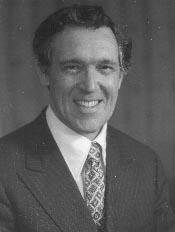
Historical · U.S. House · Alabama · District 6
John Buchanan Jr.
Former U.S. Representative · Alabama District 6 · 1965–1981 · Republican
John Buchanan Jr. represented Alabama's District 6 in the United States House of Representatives (1965–1981) for the Republican party. The page below collects sourced biographical facts, term history, committee roles, and provenance for Jr..
Bioguide ID: B001008
Key facts
- Full name
- John Buchanan Jr.
- State
- Alabama
- District
- District 6
- Party
- Republican
- House service
- 1965–1981
- First House term
- 1965
- Status
- Left office
- Current term ends
- —
- Born
- 1928
- Bioguide ID
- B001008
- Committee assignments
- —
- Dataset version
- 1.20260605
Biographical narrative
982 words · sourced from the Wikipedia REST extract
John Buchanan was an American politician who served as a Republican member of the U.S. House of Representatives from Alabama's 6th congressional district from 1965 until 1981. His tenure in Congress was marked by significant legislative contributions, particularly in the areas of civil rights and education, as well as a notable evolution in his political views over the years. Buchanan's career spanned eight terms in the House, during which he navigated the complexities of a changing political landscape in Alabama and the nation.
Early life and career
John Buchanan was born on March 19, 1928, in Paris, Tennessee. He began his journey in public service as a member of the United States Navy, where he served from 1945 to 1946. Following his military service, Buchanan moved to Alabama to pursue higher education. He attended Samford University in Birmingham, graduating in 1949. He furthered his studies at the University of Virginia in Charlottesville before transferring to the Southern Baptist Theological Seminary in Louisville, Kentucky, where he graduated in 1957.
After completing his theological education, Buchanan took on the role of pastor in various churches across Tennessee, Alabama, and Virginia. His involvement in the church laid the foundation for his later political career, as he became an influential figure within his community. In 1962, while still serving as a pastor in Birmingham, Buchanan entered the political arena by running for a congressional seat. He was one of three Republican candidates in a statewide election, which proved challenging due to the political dynamics of the time. The election coincided with significant civil rights events, including the admission of James Meredith to the University of Mississippi, which heightened the political stakes.
Despite leading the Republican field in votes during the 1962 election, Buchanan was unable to secure a seat in Congress, finishing behind the Democratic incumbent. Undeterred, he continued his political involvement and served as the finance director for the Alabama Republican Party. In 1964, he successfully ran for Congress, defeating the long-serving Democratic incumbent George Huddleston Jr. by a substantial margin. This victory was particularly noteworthy given the historical context, as Alabama had not elected a Republican to Congress for nearly eight decades.
House tenure
Buchanan's congressional career began in 1965, and he quickly established himself as a conservative Republican. Initially, he opposed significant legislation such as Medicare, the Voting Rights Act of 1965, and the Civil Rights Act of 1968. However, he also demonstrated a willingness to collaborate with Democrats on certain issues, notably working alongside Congressman Charles Weltner to investigate the Ku Klux Klan. Their efforts were recognized by the FBI, which credited them with reducing KKK membership to its lowest levels since World War II.
As his career progressed, Buchanan's views began to shift, influenced in part by his experiences attending an integrated church in Washington, D.C. This exposure led him to reevaluate his stance on social issues. He became more supportive of civil rights and took steps to promote diversity within his congressional staff, being the first member of the Alabama delegation to nominate African Americans for military service academies.
Buchanan's legislative focus included significant contributions to education and labor issues. As a senior member of the House Committee on Education and Labor, he played a pivotal role in advocating for the Education Act, Title IX, which mandated gender equality in educational programs and athletics. He served as the ranking Republican on the Equal Rights Subcommittee and was involved in various initiatives related to the arts.
In addition to his work on education, Buchanan was a long-standing member of the Foreign Affairs Committee, where he championed the rights of oppressed groups, including Jewish and Christian dissidents behind the Iron Curtain, as well as advocating for the rights of black majorities in Southern Rhodesia and South Africa. His commitment to international human rights was further demonstrated through his participation in U.S. delegations to the United Nations and various international conferences.
Buchanan's evolving political stance, particularly his support for civil rights and women's rights, resonated with many constituents in his district. Despite the predominance of Democrats in local offices, he maintained a strong following and was reelected seven times, often without facing significant opposition. However, he encountered a challenge in the 1978 primary from a more conservative Republican, which highlighted the shifting dynamics within the party.
Legislative focus and committees
Throughout his time in Congress, Buchanan's legislative focus encompassed a range of issues, reflecting both his conservative roots and his evolving views. His early opposition to key civil rights legislation gave way to a more progressive stance, particularly as he engaged with diverse communities and recognized the importance of inclusivity in governance. His work on the Education Act and Title IX was particularly impactful, as it laid the groundwork for greater equality in educational institutions across the country.
Buchanan's role on the Foreign Affairs Committee allowed him to engage with international issues, where he advocated for human rights and supported policies that aligned with his commitment to social justice. His involvement in the U.N. Human Rights Commission and the Commission on Security and Cooperation in Europe demonstrated his dedication to addressing global challenges and promoting democratic values.
As a member of Congress, Buchanan was recognized for his contributions to women's rights, receiving awards for his commitment to advancing women's roles within the Foreign Service community. His support for the creation of a Martin Luther King Jr. statue in the Capitol further illustrated his dedication to civil rights and recognition of influential figures in American history.
Buchanan's tenure in the House of Representatives concluded on January 3, 1981. His legacy is characterized by his ability to adapt to changing social dynamics while maintaining a focus on civil rights, education, and international human rights. His career reflects the complexities of American politics during a transformative era, and his contributions continue to be recognized in discussions of legislative history and civil rights advocacy.
Notable legislation
Sponsored and co-sponsored legislation for John Buchanan Jr. is pending operator curation. The biographical narrative above carries the same provenance trail until per-bill rows are written.
Sources
- [1]https://en.wikipedia.org/wiki/John_H._Buchanan_Jr.Wikipedia · retrieved 2026-06-05
Notable quotes
Sourced quotes for John Buchanan Jr. are pending operator curation. Narrative-scope provenance remains attached below.
Sources
- [1]https://en.wikipedia.org/wiki/John_H._Buchanan_Jr.Wikipedia · retrieved 2026-06-05
Key positions
Curated policy positions for John Buchanan Jr. are pending operator review. The biographical narrative above carries the same provenance trail until per-topic positions are written.
Sources
- [1]https://en.wikipedia.org/wiki/John_H._Buchanan_Jr.Wikipedia · retrieved 2026-06-05
Terms served
- 1965–1967U.S. House · Term 1 · Republican
- 1967–1969U.S. House · Term 2 · Republican
- 1969–1971U.S. House · Term 3 · Republican
- 1971–1973U.S. House · Term 4 · Republican
- 1973–1975U.S. House · Term 5 · Republican
- 1975–1977U.S. House · Term 6 · Republican
- 1977–1979U.S. House · Term 7 · Republican
- 1979–1981U.S. House · Term 8 · Republican
Sources & provenance
Every attributable claim above carries a per-section [N] marker that resolves to the corresponding URL below. Each entry records the upstream provider, the canonical URL, and the timestamp at which the source was retrieved by the ingest pipeline.
Key facts
- https://bioguide.congress.gov/search/bio/B001008bioguide · retrieved 2026-06-05
- https://www.govtrack.us/congress/members/401958govtrack · retrieved 2026-06-05
Biographical narrative
- https://en.wikipedia.org/wiki/John_H._Buchanan_Jr.wikipedia · retrieved 2026-06-05
Find your representative
Every U.S. state elects representatives by district. Browse Alabama’s delegation, the full former-representative roster, or explore the role and term length.
Related on The Candidate
- Preceded by Edward deGraffenriedEarlier holder of the Alabama District 6 House seat · Democratic.Open
- Succeeded by Albert Smith Jr.Later holder of the Alabama District 6 House seat · Republican.Open
- Alfred BuckFormer U.S. Representative · Alabama District 1 · RepublicanOpen
- Benjamin TurnerFormer U.S. Representative · Alabama District 1 · RepublicanOpen
- Bradley ByrneFormer U.S. Representative · Alabama District 1 · RepublicanOpen
- Edmund DarganFormer U.S. Representative · Alabama District 1 · DemocraticOpen