
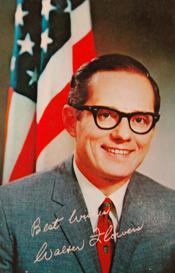
Historical · U.S. House · Alabama · District 7
Walter Flowers
Former U.S. Representative · Alabama District 7 · 1969–1979 · Democratic
Walter Flowers represented Alabama's District 7 in the United States House of Representatives (1969–1979) for the Democratic party. The page below collects sourced biographical facts, term history, committee roles, and provenance for Flowers.
Bioguide ID: F000218
Key facts
- Full name
- Walter Flowers
- State
- Alabama
- District
- District 7
- Party
- Democratic
- House service
- 1969–1979
- First House term
- 1969
- Status
- Left office
- Current term ends
- —
- Born
- 1933
- Bioguide ID
- F000218
- Committee assignments
- —
- Dataset version
- 1.20260605
Biographical narrative
811 words · sourced from the Wikipedia REST extract
Walter Flowers was an American politician who served as a Democratic member of the United States House of Representatives, representing Alabama's 5th and 7th congressional districts from January 1969 until January 1979. Over the course of his political career, he was known for his involvement in significant legislative matters, including his participation in the Watergate hearings. Flowers was born on April 12, 1933, in Greenville, Alabama, and he passed away on his fifty-first birthday, April 12, 1984, in McLean, Virginia.
Early life and career
Walter Flowers was born in Butler County, Alabama, and spent his formative years in Greenville. He attended public schools in Tuscaloosa, where he laid the groundwork for his future academic and professional pursuits. Flowers enrolled at the University of Alabama, where he earned his undergraduate degrees in 1955 and 1957. Following his graduation, he pursued further education in international law at the University of London from 1957 to 1958, which provided him with a broader perspective on legal issues and international relations.
In addition to his academic achievements, Flowers served in the U.S. Army as a Reserve Lieutenant Officer in Military Intelligence. This military experience contributed to his leadership skills and understanding of national security matters. After completing his military service, he returned to Alabama, where he practiced law, establishing a foundation for his future political career.
Flowers's entry into politics began with his election to the U.S. House of Representatives in November 1968. His legal background and military experience likely informed his approach to governance and public service. He was elected to represent Alabama's 5th congressional district, a position he held until the district was redrawn, after which he continued to serve Alabama's 7th congressional district.
House tenure
Walter Flowers's tenure in the U.S. House of Representatives spanned a decade, beginning in January 1969 and concluding in January 1979. During this time, he was elected to five consecutive terms, reflecting a degree of support from his constituents. His political career coincided with a period of significant national change, including the civil rights movement, the Vietnam War, and the Watergate scandal, all of which influenced the legislative landscape of the time.
In 1974, Flowers served on the House Judiciary Committee, which played a crucial role in the impeachment process of President Richard Nixon. This committee was responsible for investigating the Watergate scandal, which ultimately led to Nixon's resignation. Flowers's position on the committee placed him at the center of one of the most consequential political events in American history. Initially, he was considered a conservative Democrat who might lean against the impeachment vote. However, after considerable deliberation, he ultimately voted in favor of impeachment, citing the importance of upholding ethical standards in the highest office of the nation.
In 1978, Flowers sought the Democratic nomination for the United States Senate. However, he lost the primary election to Howell Heflin, who subsequently served three terms in the Senate. Following this electoral defeat, Flowers chose not to pursue further political office, marking the end of his active political career.
Legislative focus and committees
Throughout his time in Congress, Walter Flowers was involved in various legislative initiatives and served on several committees that shaped his contributions to national policy. His participation in the House Judiciary Committee during the Watergate hearings was particularly significant, as it highlighted his commitment to accountability and ethical governance. Flowers's decision to support impeachment was influenced by his belief in the necessity of addressing misconduct at the presidential level, reflecting a broader concern for maintaining the integrity of American democratic institutions.
In addition to his work on the Judiciary Committee, Flowers's legislative focus included issues pertinent to his constituents in Alabama. While specific details regarding the bills he sponsored or supported are not provided, it can be inferred that his legal background and military experience informed his approach to a range of topics, including civil rights, defense, and economic development.
Flowers's political career was also marked by his association with prominent figures in Alabama politics, including former Governor George C. Wallace. Flowers campaigned for Wallace and served as his national campaign chairman during Wallace's 1972 presidential run. This relationship illustrates the complex dynamics of Southern politics during this era, as Flowers navigated his own political identity while being influenced by Wallace's populist approach.
After leaving Congress, Flowers retired from politics and moved to McLean, Virginia. He passed away on April 12, 1984, from a heart attack while playing tennis. His burial took place at Arlington National Cemetery, a site reserved for those who have served the nation, underscoring his military service and contributions to public life.
Walter Flowers's legacy is characterized by his decade-long service in the U.S. House of Representatives and his involvement in pivotal moments in American political history, particularly during the Watergate scandal. His commitment to public service and the rule of law remains a notable aspect of his biography.
Notable legislation
Sponsored and co-sponsored legislation for Walter Flowers is pending operator curation. The biographical narrative above carries the same provenance trail until per-bill rows are written.
Sources
- [1]https://en.wikipedia.org/wiki/Walter_FlowersWikipedia · retrieved 2026-06-05
Notable quotes
Sourced quotes for Walter Flowers are pending operator curation. Narrative-scope provenance remains attached below.
Sources
- [1]https://en.wikipedia.org/wiki/Walter_FlowersWikipedia · retrieved 2026-06-05
Key positions
Curated policy positions for Walter Flowers are pending operator review. The biographical narrative above carries the same provenance trail until per-topic positions are written.
Sources
- [1]https://en.wikipedia.org/wiki/Walter_FlowersWikipedia · retrieved 2026-06-05
Terms served
- 1969–1971U.S. House · Term 1 · Democratic
- 1971–1973U.S. House · Term 2 · Democratic
- 1973–1975U.S. House · Term 3 · Democratic
- 1975–1977U.S. House · Term 4 · Democratic
- 1977–1979U.S. House · Term 5 · Democratic
Sources & provenance
Every attributable claim above carries a per-section [N] marker that resolves to the corresponding URL below. Each entry records the upstream provider, the canonical URL, and the timestamp at which the source was retrieved by the ingest pipeline.
Key facts
- https://bioguide.congress.gov/search/bio/F000218bioguide · retrieved 2026-06-05
- https://www.govtrack.us/congress/members/404173govtrack · retrieved 2026-06-05
Biographical narrative
- https://en.wikipedia.org/wiki/Walter_Flowerswikipedia · retrieved 2026-06-05
Find your representative
Every U.S. state elects representatives by district. Browse Alabama’s delegation, the full former-representative roster, or explore the role and term length.
Related on The Candidate
- Preceded by James MartinEarlier holder of the Alabama District 7 House seat · Republican.Open
- Succeeded by Claude Harris Jr.Later holder of the Alabama District 7 House seat · Democratic.Open
- Alfred BuckFormer U.S. Representative · Alabama District 1 · RepublicanOpen
- Benjamin TurnerFormer U.S. Representative · Alabama District 1 · RepublicanOpen
- Bradley ByrneFormer U.S. Representative · Alabama District 1 · RepublicanOpen
- Edmund DarganFormer U.S. Representative · Alabama District 1 · DemocraticOpen