
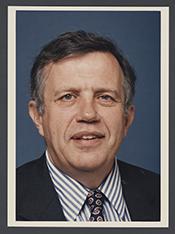
Historical · U.S. House · Arkansas · District 4
Jay Dickey
Former U.S. Representative · Arkansas District 4 · 1993–2001 · Republican
Jay Dickey represented Arkansas's District 4 in the United States House of Representatives (1993–2001) for the Republican party. The page below collects sourced biographical facts, term history, committee roles, and provenance for Dickey.
Bioguide ID: D000312
Key facts
- Full name
- Jay Dickey
- State
- Arkansas
- District
- District 4
- Party
- Republican
- House service
- 1993–2001
- First House term
- 1993
- Status
- Left office
- Current term ends
- —
- Born
- 1939
- Bioguide ID
- D000312
- Committee assignments
- —
- Dataset version
- 1.20260605
Biographical narrative
833 words · sourced from the Wikipedia REST extract
Jay Dickey was an American politician and a member of the Republican Party who served as the U.S. Representative for Arkansas's 4th congressional district from 1993 until 2001. Known for his conservative views, particularly regarding Second Amendment rights, Dickey's legislative actions included the introduction of amendments that significantly influenced federal funding for research related to gun violence. His political career was marked by both electoral success and challenges, culminating in a notable defeat in 2000. After leaving Congress, he engaged in lobbying and consulting, and later expressed a shift in his views on gun violence research.
Early life and career
Jay Dickey was born on December 14, 1939, in Pine Bluff, Arkansas. He completed his secondary education at Pine Bluff High School, graduating in 1957. Following high school, Dickey pursued higher education at Hendrix College in Conway, Arkansas, before transferring to the University of Arkansas at Fayetteville, where he earned a Bachelor of Arts degree in 1961. His academic journey continued at the University of Arkansas School of Law, where he obtained his Juris Doctor in 1963.
Dickey began his professional career in the legal field, initially working in private practice. His legal expertise led him to serve as the city attorney for Pine Bluff from 1968 to 1970. In 1988, he was appointed by then-Governor Bill Clinton as a special justice for a case before the Arkansas Supreme Court, marking his entry into the intersection of law and politics.
House tenure
Dickey's political career in the U.S. House of Representatives began when he was elected on November 3, 1992, coinciding with Bill Clinton's election as President. He won his seat by defeating William J. "Bill" McCuen, who was the Arkansas Secretary of State and had been embroiled in scandals. This victory made Dickey the first Republican to represent Arkansas's 4th congressional district. His tenure in Congress lasted from 1993 until 2001, during which he was re-elected three times.
Throughout his time in the House, Dickey served on the U.S. House Committee on Appropriations, which is responsible for setting specific expenditures of money by the government. He participated in five subcommittees, focusing on areas such as agriculture, national security, energy and water, transportation and labor, as well as health and human services and education. His involvement in these committees allowed him to influence a wide range of legislative issues.
Dickey's legislative record included a strong advocacy for Second Amendment rights. In 1996, he responded to concerns regarding perceived bias in research conducted by the National Center for Injury Prevention and Control at the Centers for Disease Control and Prevention (CDC). He introduced an amendment that eliminated $2.6 million from the CDC budget, which corresponded to the amount the agency had previously allocated for gun-related research. This action was seen as a significant move to limit federal funding for studies that could be interpreted as promoting gun control.
Despite his initial electoral successes, Dickey's popularity began to wane in his district, which was considered moderate. In the 2000 election, he faced a challenging race against Democratic candidate Mike Ross. The campaign was marked by significant support for Ross from President Clinton and other Democratic figures, which contributed to Dickey's defeat. Following this loss, Dickey attempted to reclaim his seat in the 2002 election but was unsuccessful, losing to Ross again by a substantial margin.
Legislative focus and committees
During his time in Congress, Dickey's legislative focus was heavily influenced by his conservative ideology and advocacy for Second Amendment rights. His actions, particularly the introduction of the Dickey Amendment, reflected his commitment to limiting federal involvement in gun-related research. This amendment has had a lasting impact on the landscape of gun violence research in the United States, effectively restricting funding for studies that might advocate for gun control measures.
In addition to his work on gun-related issues, Dickey's role on the Appropriations Committee allowed him to engage with a variety of important topics, including national security, health care, and education. His participation in multiple subcommittees provided him with a platform to address the needs and concerns of his constituents in Arkansas, particularly in areas such as agriculture and infrastructure.
After leaving Congress, Dickey transitioned into a consulting role, founding JD Consulting, a firm that focused on lobbying for various interests, including children's health care and homeland security. His experience in Congress and his legal background positioned him well to advocate for clients' interests in these areas.
In a notable shift in perspective, following the mass shooting in Aurora, Colorado, Dickey publicly acknowledged the need for scientific research into gun violence. He expressed regret for having previously positioned himself as an opponent of such research, recognizing the importance of valid studies in informing public policy on gun safety and violence prevention.
Dickey passed away on April 20, 2017, after a prolonged battle with Parkinson's disease. His legacy includes his contributions to the legislative process during his time in office, as well as the ongoing discussions surrounding gun violence research and Second Amendment rights.
Notable legislation
Sponsored and co-sponsored legislation for Jay Dickey is pending operator curation. The biographical narrative above carries the same provenance trail until per-bill rows are written.
Sources
- [1]https://en.wikipedia.org/wiki/Jay_DickeyWikipedia · retrieved 2026-06-05
Notable quotes
Sourced quotes for Jay Dickey are pending operator curation. Narrative-scope provenance remains attached below.
Sources
- [1]https://en.wikipedia.org/wiki/Jay_DickeyWikipedia · retrieved 2026-06-05
Key positions
Curated policy positions for Jay Dickey are pending operator review. The biographical narrative above carries the same provenance trail until per-topic positions are written.
Sources
- [1]https://en.wikipedia.org/wiki/Jay_DickeyWikipedia · retrieved 2026-06-05
Terms served
- 1993–1995U.S. House · Term 1 · Republican
- 1995–1997U.S. House · Term 2 · Republican
- 1997–1999U.S. House · Term 3 · Republican
- 1999–2001U.S. House · Term 4 · Republican
Sources & provenance
Every attributable claim above carries a per-section [N] marker that resolves to the corresponding URL below. Each entry records the upstream provider, the canonical URL, and the timestamp at which the source was retrieved by the ingest pipeline.
Key facts
- https://bioguide.congress.gov/search/bio/D000312bioguide · retrieved 2026-06-05
- https://www.govtrack.us/congress/members/400579govtrack · retrieved 2026-06-05
Biographical narrative
- https://en.wikipedia.org/wiki/Jay_Dickeywikipedia · retrieved 2026-06-05
Find your representative
Every U.S. state elects representatives by district. Browse Arkansas’s delegation, the full former-representative roster, or explore the role and term length.
Related on The Candidate
- Preceded by Beryl Anthony Jr.Earlier holder of the Arkansas District 4 House seat · Democratic.Open
- Succeeded by Mike RossLater holder of the Arkansas District 4 House seat · Democratic.Open
- Alfred GreenwoodFormer U.S. Representative · Arkansas District 1 · DemocraticOpen
- Archibald YellFormer U.S. Representative · Arkansas District 1 · DemocraticOpen
- Asa HodgesFormer U.S. Representative · Arkansas District 1 · RepublicanOpen
- Bill Alexander Jr.Former U.S. Representative · Arkansas District 1 · DemocraticOpen