
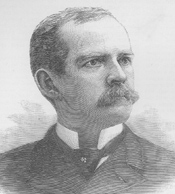
Historical · U.S. House · Arkansas · District 4
John Rogers
Former U.S. Representative · Arkansas District 4 · 1883–1891 · Democratic
John Rogers represented Arkansas's District 4 in the United States House of Representatives (1883–1891) for the Democratic party. The page below collects sourced biographical facts, term history, committee roles, and provenance for Rogers.
Bioguide ID: R000399
Key facts
- Full name
- John Rogers
- State
- Arkansas
- District
- District 4
- Party
- Democratic
- House service
- 1883–1891
- First House term
- 1883
- Status
- Left office
- Current term ends
- —
- Born
- 1845
- Bioguide ID
- R000399
- Committee assignments
- —
- Dataset version
- 1.20260606
Biographical narrative
818 words · sourced from the Wikipedia REST extract
John Rogers was a prominent American politician and jurist who served as a U.S. Representative from Arkansas. A member of the Democratic Party, he represented the state in the House of Representatives for four consecutive terms from 1883 to 1891. Following his congressional service, Rogers was appointed as a district judge for the Western District of Arkansas, where he continued to influence the legal landscape until his death in 1911.
Early life and career
John Rogers was born on October 9, 1845, in Roxobel, Bertie County, North Carolina. In 1852, his family relocated to Mississippi, settling near Madison Station, which is now known as Madison. During his formative years, Rogers attended local common schools, where he received a basic education that would later serve as a foundation for his future endeavors.
At the age of seventeen, in March 1862, Rogers enlisted in the Confederate Army, joining the Ninth Mississippi Volunteer Regiment. His military service was marked by bravery; he was wounded twice during the conflict and was promoted to the rank of first lieutenant due to his gallantry at the Battle of Franklin in Tennessee. After the Civil War concluded in May 1865, Rogers undertook a challenging journey, walking nearly a thousand miles back to his home in Mississippi.
After the war, Rogers pursued higher education, attending Centre College before earning a Bachelor of Arts degree from the University of Mississippi in 1868. Following his graduation, he was admitted to the bar and began his legal career in Canton, Mississippi, where he practiced law for a brief period before moving to Fort Smith, Arkansas. In Fort Smith, he continued his private practice from 1869 until 1877. His legal career progressed when he was appointed as a Judge of the Circuit Court for Pulaski County, a position he held from 1877 to 1882. After serving as a judge, Rogers returned to private legal practice in Fort Smith from 1882 until he entered Congress in 1883.
House tenure
Rogers's political career began in earnest when he was elected as a Democrat to represent Arkansas's 3rd congressional district in the U.S. House of Representatives. He served in this capacity from March 4, 1883, until March 3, 1891, spanning four consecutive terms in the 48th through the 51st Congresses. During his time in the House, Rogers was involved in various legislative activities and served on several committees, most notably as Chairman of the Committee on Mileage during the 50th Congress.
His tenure in Congress was characterized by a commitment to the interests of his constituents in Arkansas. Rogers's legislative work included addressing issues pertinent to the state and the broader national landscape during a period of significant change in American society. However, he chose not to seek renomination after his fourth term, opting instead to return to private practice in Fort Smith, where he continued to engage in legal work until 1896.
Legislative focus and committees
Throughout his congressional career, Rogers was involved in a range of legislative matters, reflecting the diverse needs of his constituents and the evolving political landscape of the late 19th century. His role as Chairman of the Committee on Mileage during the 50th Congress indicates his involvement in administrative and logistical aspects of congressional operations, which were crucial for the functioning of the House.
Rogers's legislative focus likely included issues relevant to his district and the state of Arkansas, which was undergoing economic and social transformations during this period. However, specific details regarding the bills he sponsored or the debates he participated in are not extensively documented. His decision to step away from Congress after four terms suggests a strategic choice to focus on his legal career and other pursuits.
After concluding his congressional service, Rogers remained active in public life. He participated in the Democratic state convention in 1892 and served as a delegate to the 1892 Democratic National Convention, further solidifying his involvement in the political processes of his time.
In 1896, Rogers transitioned from legislative service to the judiciary when he received a recess appointment from President Grover Cleveland to the United States District Court for the Western District of Arkansas. This appointment marked a significant shift in his career, allowing him to influence the judicial system directly. He was later nominated for the same position by President Cleveland and confirmed by the Senate in December 1896. Rogers served on the federal bench until his death on April 17, 1911, in Little Rock, Arkansas, where he passed away from an apparent heart attack.
Rogers's contributions to both the legislative and judicial branches of government reflect a career dedicated to public service. He was interred in Oak Cemetery in Fort Smith, Arkansas, leaving behind a legacy that included his wife, Mary Gray Rogers, and their four children. His life and career exemplify the multifaceted roles that individuals can play in shaping the legal and political landscape of their communities and the nation.
Notable legislation
Sponsored and co-sponsored legislation for John Rogers is pending operator curation. The biographical narrative above carries the same provenance trail until per-bill rows are written.
Sources
- [1]https://en.wikipedia.org/wiki/John_Henry_RogersWikipedia · retrieved 2026-06-06
Notable quotes
Sourced quotes for John Rogers are pending operator curation. Narrative-scope provenance remains attached below.
Sources
- [1]https://en.wikipedia.org/wiki/John_Henry_RogersWikipedia · retrieved 2026-06-06
Key positions
Curated policy positions for John Rogers are pending operator review. The biographical narrative above carries the same provenance trail until per-topic positions are written.
Sources
- [1]https://en.wikipedia.org/wiki/John_Henry_RogersWikipedia · retrieved 2026-06-06
Terms served
- 1883–1885U.S. House · Term 1 · Democratic
- 1885–1887U.S. House · Term 2 · Democratic
- 1887–1889U.S. House · Term 3 · Democratic
- 1889–1891U.S. House · Term 4 · Democratic
Sources & provenance
Every attributable claim above carries a per-section [N] marker that resolves to the corresponding URL below. Each entry records the upstream provider, the canonical URL, and the timestamp at which the source was retrieved by the ingest pipeline.
Key facts
- https://bioguide.congress.gov/search/bio/R000399bioguide · retrieved 2026-06-06
- https://www.govtrack.us/congress/members/409366govtrack · retrieved 2026-06-06
Biographical narrative
- https://en.wikipedia.org/wiki/John_Henry_Rogerswikipedia · retrieved 2026-06-06
Find your representative
Every U.S. state elects representatives by district. Browse Arkansas’s delegation, the full former-representative roster, or explore the role and term length.
Related on The Candidate
- Preceded by Thomas GunterEarlier holder of the Arkansas District 4 House seat · Democratic.Open
- Succeeded by William TerryLater holder of the Arkansas District 4 House seat · Democratic.Open
- Alfred GreenwoodFormer U.S. Representative · Arkansas District 1 · DemocraticOpen
- Archibald YellFormer U.S. Representative · Arkansas District 1 · DemocraticOpen
- Asa HodgesFormer U.S. Representative · Arkansas District 1 · RepublicanOpen
- Bill Alexander Jr.Former U.S. Representative · Arkansas District 1 · DemocraticOpen