
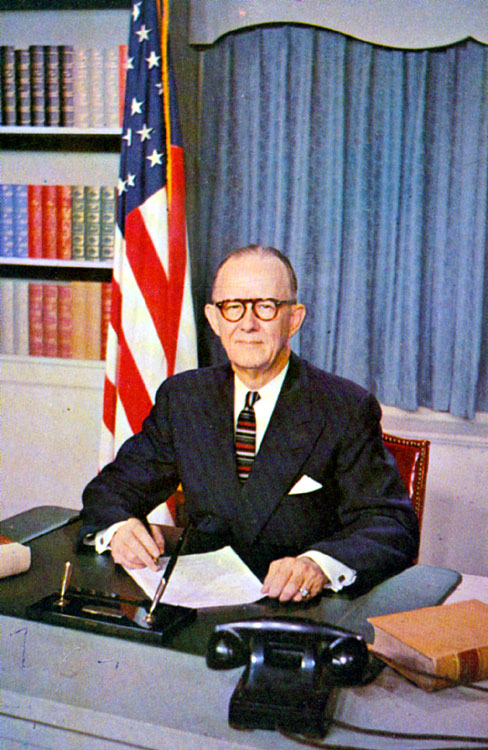
Historical · U.S. House · Arkansas · District 5
Lawrence Hays
Former U.S. Representative · Arkansas District 5 · 1943–1959 · Democratic
Lawrence Hays represented Arkansas's District 5 in the United States House of Representatives (1943–1959) for the Democratic party. The page below collects sourced biographical facts, term history, committee roles, and provenance for Hays.
Bioguide ID: H000405
Key facts
- Full name
- Lawrence Hays
- State
- Arkansas
- District
- District 5
- Party
- Democratic
- House service
- 1943–1959
- First House term
- 1943
- Status
- Left office
- Current term ends
- —
- Born
- 1898
- Bioguide ID
- H000405
- Committee assignments
- —
- Dataset version
- 1.20260605
Biographical narrative
931 words · sourced from the Wikipedia REST extract
Lawrence Hays was an American lawyer and politician who served as a Democratic member of the United States House of Representatives from Arkansas's 5th congressional district for eight terms, spanning from 1943 until 1959. Hays was also known for his leadership role within the Southern Baptist Convention, reflecting his deep involvement in both politics and religious affairs throughout his life.
Early life and career
Lawrence Brooks Hays was born on August 9, 1898, in London, Arkansas, located in Pope County. He received his early education in the public schools of Russellville, Arkansas. Following his schooling, Hays served in the United States Army during World War I in 1918. After his military service, he pursued higher education at the University of Arkansas at Fayetteville, where he earned his degree in 1919. He then attended law school at George Washington University, graduating with a law degree in 1922. During his time in law school, Hays became a member of the Sigma Chi fraternity.
After completing his education, Hays returned to Russellville and established a private law practice. His early career in public service began when he was appointed as the assistant attorney general of Arkansas, a position he held from 1925 to 1927. Hays sought the Democratic gubernatorial nomination in Arkansas in both 1928 and 1930 but was unsuccessful in his attempts. From 1932 to 1939, he served as a Democratic National committeeman for Arkansas, further solidifying his political connections and influence.
With the onset of the New Deal, Hays was appointed as a labor compliance officer for the National Recovery Administration in Arkansas in 1934. He continued to advance in his career, serving as an assistant to the administrator of resettlement in 1935 and holding various administrative and legal roles within the Farm Security Administration from 1936 until 1942. These positions provided him with valuable experience in government operations and policy-making.
House tenure
Hays's political career took a significant turn when he ran for a seat in the United States House of Representatives. He was elected to the Seventy-eighth Congress, marking the beginning of his tenure in the House on January 3, 1943. Over the course of his eight terms, Hays was re-elected seven times, serving until January 3, 1959. His time in Congress coincided with a period of significant national change, including the aftermath of World War II and the early years of the Civil Rights Movement.
During his congressional career, Hays was involved in various legislative initiatives and was known for his engagement with issues of national importance. In 1953, he sponsored House Resolution 60, which aimed to create a designated space within the Capitol building for prayer. This initiative was part of a broader trend during the era that included the establishment of the National Day of Prayer and the incorporation of religious phrases into national symbols, reflecting the intertwining of faith and governance during that period.
Hays's congressional tenure was also marked by his involvement in the contentious issue of school desegregation. In 1958, he faced significant challenges during the election season, particularly in the wake of President Dwight D. Eisenhower's decision to send federal troops to Little Rock, Arkansas, to enforce school integration. While Hays did not identify as an integrationist and had previously signed the Southern Manifesto, which opposed desegregation, he attempted to mediate between the federal government and Arkansas Governor Orval Faubus. This position, however, drew criticism from segregationist factions within the state, leading to a contentious primary election. Hays ultimately won the primary but faced a surprising defeat in the general election to a write-in candidate, marking a significant shift in his political fortunes.
Legislative focus and committees
Throughout his time in the House, Hays was involved in various legislative committees and initiatives that reflected his interests and the priorities of his constituents. His work often intersected with issues of civil rights, labor, and religious affairs, showcasing his multifaceted approach to governance. Hays's efforts to promote prayer and religious observance within the legislative context highlighted his commitment to integrating his faith into public life.
In addition to his legislative responsibilities, Hays's leadership extended beyond Congress. In 1957, he was elected president of the Southern Baptist Convention, a prominent religious organization. This role allowed him to engage with religious leaders and communities on a national scale, further intertwining his political and religious endeavors. During his presidency, he participated in a peace mission to Moscow alongside other religious leaders, reflecting his interest in international relations and diplomacy.
After leaving Congress in 1959, Hays continued to be active in public service and academia. He served on the board of directors of the Tennessee Valley Authority and held positions in the Kennedy administration, including Assistant Secretary of State for congressional relations and Special Assistant to the President. His post-congressional career also included academic roles, where he taught political science at the Eagleton Institute at Rutgers University and served as a visiting professor at the University of Massachusetts Amherst.
Hays remained engaged in political and civic life throughout his later years, running for the Democratic gubernatorial nomination in Arkansas in 1966 and serving in various leadership roles within civic organizations. His contributions to public service and his involvement in both political and religious spheres left a lasting impact on his community and beyond.
Lawrence Hays passed away on October 11, 1981, in Chevy Chase, Maryland, concluding a life marked by significant contributions to American politics and society. His legacy is characterized by his commitment to public service, his engagement with religious communities, and his involvement in the evolving landscape of American governance during a transformative era.
Notable legislation
Sponsored and co-sponsored legislation for Lawrence Hays is pending operator curation. The biographical narrative above carries the same provenance trail until per-bill rows are written.
Sources
- [1]https://en.wikipedia.org/wiki/Brooks_HaysWikipedia · retrieved 2026-06-05
Notable quotes
Sourced quotes for Lawrence Hays are pending operator curation. Narrative-scope provenance remains attached below.
Sources
- [1]https://en.wikipedia.org/wiki/Brooks_HaysWikipedia · retrieved 2026-06-05
Key positions
Curated policy positions for Lawrence Hays are pending operator review. The biographical narrative above carries the same provenance trail until per-topic positions are written.
Sources
- [1]https://en.wikipedia.org/wiki/Brooks_HaysWikipedia · retrieved 2026-06-05
Terms served
- 1943–1945U.S. House · Term 1 · Democratic
- 1945–1947U.S. House · Term 2 · Democratic
- 1947–1949U.S. House · Term 3 · Democratic
- 1949–1951U.S. House · Term 4 · Democratic
- 1951–1953U.S. House · Term 5 · Democratic
- 1953–1955U.S. House · Term 6 · Democratic
- 1955–1957U.S. House · Term 7 · Democratic
- 1957–1959U.S. House · Term 8 · Democratic
Sources & provenance
Every attributable claim above carries a per-section [N] marker that resolves to the corresponding URL below. Each entry records the upstream provider, the canonical URL, and the timestamp at which the source was retrieved by the ingest pipeline.
Key facts
- https://bioguide.congress.gov/search/bio/H000405bioguide · retrieved 2026-06-05
- https://www.govtrack.us/congress/members/405272govtrack · retrieved 2026-06-05
Biographical narrative
- https://en.wikipedia.org/wiki/Brooks_Hayswikipedia · retrieved 2026-06-05
Find your representative
Every U.S. state elects representatives by district. Browse Arkansas’s delegation, the full former-representative roster, or explore the role and term length.
Related on The Candidate
- Preceded by David TerryEarlier holder of the Arkansas District 5 House seat · Democratic.Open
- Succeeded by Thomas AlfordLater holder of the Arkansas District 5 House seat · Democratic.Open
- Alfred GreenwoodFormer U.S. Representative · Arkansas District 1 · DemocraticOpen
- Archibald YellFormer U.S. Representative · Arkansas District 1 · DemocraticOpen
- Asa HodgesFormer U.S. Representative · Arkansas District 1 · RepublicanOpen
- Bill Alexander Jr.Former U.S. Representative · Arkansas District 1 · DemocraticOpen