
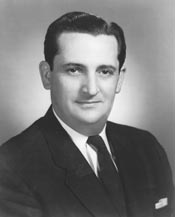
Historical · U.S. House · Arkansas · District 5
Thomas Alford
Former U.S. Representative · Arkansas District 5 · 1959–1963 · Democratic
Thomas Alford represented Arkansas's District 5 in the United States House of Representatives (1959–1963) for the Democratic party. The page below collects sourced biographical facts, term history, committee roles, and provenance for Alford.
Bioguide ID: A000105
Key facts
- Full name
- Thomas Alford
- State
- Arkansas
- District
- District 5
- Party
- Democratic
- House service
- 1959–1963
- First House term
- 1959
- Status
- Left office
- Current term ends
- —
- Born
- 1916
- Bioguide ID
- A000105
- Committee assignments
- —
- Dataset version
- 1.20260605
Biographical narrative
830 words · sourced from the Wikipedia REST extract
Thomas Alford was an American ophthalmologist and politician who served as a Democratic member of the United States House of Representatives from Arkansas's 5th congressional district from 1959 to 1963. Known for his conservative stance, Alford was a significant figure in the political landscape of Arkansas during a period marked by social and political upheaval, particularly in relation to civil rights and school integration.
Early life and career
Thomas Alford was born on January 28, 1916, in Newhope, a small community near Murfreesboro in Pike County, Arkansas. He was the son of Thomas H. Alford and Ida Womack. Alford's early education took place in public schools in Rector, located in Clay County in northeastern Arkansas. He demonstrated academic prowess, graduating from high school a year ahead of schedule in 1932.
Following high school, Alford pursued higher education at Arkansas State College in Jonesboro, and later at the Arkansas State Teachers College in Conway. He ultimately earned his medical degree from the University of Arkansas for Medical Sciences in Little Rock in 1939. This educational background laid the foundation for his future career in medicine.
Alford's service to his country began when he joined the United States Army Medical Corps during World War II. He served as a captain from 1940 to 1946, where he was actively involved as a surgeon in the European Theater. After the war, he transitioned to academia, taking on the role of assistant professor at Emory University School of Medicine in Atlanta, Georgia, from 1947 to 1948. His medical career was marked by a commitment to ophthalmology, contributing to his reputation as a respected physician.
House tenure
Alford's political career began in earnest when he entered the race for the U.S. House of Representatives in 1958. He emerged as a write-in candidate during a tumultuous period following the Little Rock Crisis, a pivotal moment in the civil rights movement that involved the integration of Little Rock Central High School. Alford's candidacy was notable as he became only the third write-in candidate in U.S. history to be elected to the House. His campaign was characterized by grassroots support, with his supporters distributing thousands of stickers bearing his name at polling places.
In the general election, Alford faced incumbent Brooks Hays, who had endorsed the integration of schools. The election was closely contested, with Alford ultimately winning by a narrow margin. Despite allegations of irregularities and fraud from Hays' supporters, a grand jury investigation concluded that the vote count was accurate. Alford's victory reflected a significant shift in voter sentiment in the 5th Congressional District, where many constituents opposed integration.
Alford was re-elected in 1960, securing a substantial majority against Republican challenger L. J. Churchill. His second term in Congress was marked by a solid electoral performance, where he garnered a significant percentage of the vote, reinforcing his position within the Democratic Party and his district.
However, Alford's congressional career faced challenges due to redistricting after the 1960 census. His district was merged with Arkansas's 2nd congressional district, which was represented by Wilbur D. Mills, a prominent figure in Arkansas politics. Rather than compete against Mills in the Democratic primary, Alford opted to challenge incumbent Governor Orval Faubus in the 1962 gubernatorial primary. Although he ran an active campaign, he finished third in a crowded field, with Faubus ultimately winning the primary.
Alford's political aspirations continued as he ran for governor again in 1966 but finished fourth in the primary. His attempts to regain a foothold in politics included a bid for the congressional seat in Central Arkansas's 2nd District in 1984, but he did not achieve significant support in that race.
Legislative focus and committees
During his time in the House of Representatives, Alford's legislative focus was shaped by the political climate of the era, particularly concerning issues related to civil rights and education. His conservative Democratic stance aligned with the views of many constituents in his district, who were apprehensive about the implications of school integration and civil rights reforms.
While specific details regarding the committees on which Alford served are not provided, it can be inferred that his medical background may have influenced his legislative interests, particularly in health-related issues. As a physician, he would have had insights into healthcare policies and public health initiatives, which were increasingly relevant during the 1960s.
Alford's tenure in Congress was relatively brief, concluding in January 1963. His departure from the House marked the end of a significant chapter in his political career, but he remained a notable figure in Arkansas politics for years to come.
After leaving Congress, Alford continued to engage in political activities and remained a recognizable name in Arkansas. He passed away on January 25, 2000, in Little Rock, just days before his eighty-third birthday. His life and career reflect a complex interplay of medicine and politics during a transformative period in American history, particularly in the context of civil rights and the evolving landscape of the Democratic Party in the South.
Notable legislation
Sponsored and co-sponsored legislation for Thomas Alford is pending operator curation. The biographical narrative above carries the same provenance trail until per-bill rows are written.
Sources
- [1]https://en.wikipedia.org/wiki/Dale_AlfordWikipedia · retrieved 2026-06-05
Notable quotes
Sourced quotes for Thomas Alford are pending operator curation. Narrative-scope provenance remains attached below.
Sources
- [1]https://en.wikipedia.org/wiki/Dale_AlfordWikipedia · retrieved 2026-06-05
Key positions
Curated policy positions for Thomas Alford are pending operator review. The biographical narrative above carries the same provenance trail until per-topic positions are written.
Sources
- [1]https://en.wikipedia.org/wiki/Dale_AlfordWikipedia · retrieved 2026-06-05
Terms served
- 1959–1961U.S. House · Term 1 · Ind. Democrat
- 1961–1963U.S. House · Term 2 · Democratic
Sources & provenance
Every attributable claim above carries a per-section [N] marker that resolves to the corresponding URL below. Each entry records the upstream provider, the canonical URL, and the timestamp at which the source was retrieved by the ingest pipeline.
Key facts
- https://bioguide.congress.gov/search/bio/A000105bioguide · retrieved 2026-06-05
- https://www.govtrack.us/congress/members/400763govtrack · retrieved 2026-06-05
Biographical narrative
- https://en.wikipedia.org/wiki/Dale_Alfordwikipedia · retrieved 2026-06-05
Find your representative
Every U.S. state elects representatives by district. Browse Arkansas’s delegation, the full former-representative roster, or explore the role and term length.
Related on The Candidate
- Preceded by Lawrence HaysEarlier holder of the Arkansas District 5 House seat · Democratic.Open
- Alfred GreenwoodFormer U.S. Representative · Arkansas District 1 · DemocraticOpen
- Archibald YellFormer U.S. Representative · Arkansas District 1 · DemocraticOpen
- Asa HodgesFormer U.S. Representative · Arkansas District 1 · RepublicanOpen
- Bill Alexander Jr.Former U.S. Representative · Arkansas District 1 · DemocraticOpen
- Democratic PartyFederal candidates and office holders on the Democratic line.Open