
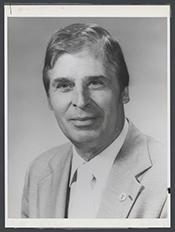
Historical · U.S. House · Arizona · District 4
Eldon Rudd
Former U.S. Representative · Arizona District 4 · 1977–1987 · Republican
Eldon Rudd represented Arizona's District 4 in the United States House of Representatives (1977–1987) for the Republican party. The page below collects sourced biographical facts, term history, committee roles, and provenance for Rudd.
Bioguide ID: R000495
Key facts
- Full name
- Eldon Rudd
- State
- Arizona
- District
- District 4
- Party
- Republican
- House service
- 1977–1987
- First House term
- 1977
- Status
- Left office
- Current term ends
- —
- Born
- 1920
- Bioguide ID
- R000495
- Committee assignments
- —
- Dataset version
- 1.20260605
Biographical narrative
904 words · sourced from the Wikipedia REST extract
Eldon D. Rudd was a Republican politician who served as a U.S. Representative for Arizona's 4th congressional district from 1977 until 1987. Born on July 15, 1920, in Camp Verde, Arizona, Rudd had a diverse career that included military service, law enforcement, and politics. His tenure in the U.S. House of Representatives was marked by a focus on fiscal conservatism and strong anticommunist policies, reflecting the political climate of the late 20th century.
Early life and career
Eldon Rudd was born in Camp Verde, Arizona, and completed his high school education at Clarkdale High School in 1939. Shortly after, he enlisted in the United States Marine Corps in 1942, where he served as a fighter pilot during World War II. Following his discharge in 1946, Rudd pursued higher education, attending Arizona State College, graduating in 1947, and subsequently enrolling at the University of Arizona Law School in Tucson.
After finishing his legal education, Rudd briefly practiced law before joining the Federal Bureau of Investigation (FBI) in 1950. His career in the FBI was notable, particularly for his role as a special agent. In 1954, he became the only FBI field agent in Washington, D.C., who was fluent in Spanish. This skill proved valuable during a significant incident involving Puerto Rican nationalists who attacked the U.S. House of Representatives that year. Rudd's work on this case garnered the attention of FBI Director J. Edgar Hoover, who subsequently offered him a prestigious assignment as the U.S. legal attaché at the U.S. Embassy in Mexico City, a position he held from 1960 to 1970.
Rudd's tenure in Mexico City included high-profile responsibilities, particularly in the wake of the assassination of President John F. Kennedy on November 22, 1963. Following the assassination, Hoover tasked Rudd with obtaining law enforcement and intelligence files from the Mexican government regarding Lee Harvey Oswald, the assassin. Rudd successfully acquired these documents and transported them back to Dallas, Texas, during a critical time in American history.
House tenure
After leaving the FBI in 1970, Rudd returned to Arizona, where he became actively involved in local politics. He was elected to the Maricopa County Board of Supervisors in 1972, which marked the beginning of his political career. In 1976, Rudd ran for a seat in the U.S. House of Representatives, successfully winning election to represent Arizona's 4th congressional district. This district, at that time, encompassed the northeastern part of Arizona, with a significant portion of its population located in the northern area of the Valley of the Sun.
Rudd's initial election to Congress was closely contested; he won by a narrow margin of 707 votes against Democrat Tony Mason. Although Mason secured victories in four of the district's five counties, Rudd's strong performance in Maricopa County, which had a larger population, ultimately led to his victory. Following this initial term, Rudd was re-elected four additional times, consistently receiving more than 60 percent of the vote in each election. In 1984, he ran unopposed, reflecting his solidified position within the district.
During his time in the House, Rudd was known for his fiscal conservatism. He served on the Appropriations Committee for five years, where he was involved in discussions and decisions regarding federal spending. Rudd was particularly vocal in his opposition to the use of federal taxpayer dollars for abortion services. His legislative focus also included a strong commitment to anticommunism, which was a significant aspect of U.S. foreign policy during the Cold War. Rudd was an advocate for U.S. efforts to combat communism in Central and South America, and he notably met with Nicaraguan President Anastasio Somoza Debayle shortly before Somoza's death.
Rudd's political career was not without controversy. During the 1980 presidential election, he was implicated in the Debategate scandal, where he allegedly provided the Reagan campaign with debate preparation documents intended for President Jimmy Carter. This incident highlighted the intertwining of politics and intelligence during a tumultuous period in American history.
Legislative focus and committees
Throughout his congressional career, Eldon Rudd maintained a focus on fiscal responsibility and national security. His membership on the Appropriations Committee allowed him to influence federal budgetary decisions, and he consistently advocated for conservative fiscal policies. Rudd's opposition to federal funding for abortion services was a significant aspect of his legislative agenda, aligning with the broader Republican stance on social issues during his time in office.
Rudd's commitment to anticommunism was evident in his support for U.S. interventions in Latin America, particularly in Nicaragua, where he was a vocal advocate for the U.S. government's efforts to support anti-communist regimes. His experiences as an FBI agent and legal attaché provided him with unique insights into international relations, which he leveraged in his legislative work.
After completing five terms in the House, Rudd chose not to seek re-election in 1986 and officially left office on January 3, 1987. Following his departure from Congress, he took a position with the Salt River Project, a utility company in Arizona. Rudd remained engaged in Republican politics, serving as the campaign manager for Doug Wead during Wead's unsuccessful bid for Arizona's 6th congressional district in 1992.
Eldon Rudd passed away on February 8, 2002, in Scottsdale, Arizona. His remains were cremated, and his ashes were interred at the National Memorial Cemetery of Arizona. Rudd's life and career reflect a period of significant political change in the United States, characterized by the complexities of Cold War politics and domestic policy debates.
Notable legislation
Sponsored and co-sponsored legislation for Eldon Rudd is pending operator curation. The biographical narrative above carries the same provenance trail until per-bill rows are written.
Sources
- [1]https://en.wikipedia.org/wiki/Eldon_RuddWikipedia · retrieved 2026-06-05
Notable quotes
Sourced quotes for Eldon Rudd are pending operator curation. Narrative-scope provenance remains attached below.
Sources
- [1]https://en.wikipedia.org/wiki/Eldon_RuddWikipedia · retrieved 2026-06-05
Key positions
Curated policy positions for Eldon Rudd are pending operator review. The biographical narrative above carries the same provenance trail until per-topic positions are written.
Sources
- [1]https://en.wikipedia.org/wiki/Eldon_RuddWikipedia · retrieved 2026-06-05
Terms served
- 1977–1979U.S. House · Term 1 · Republican
- 1979–1981U.S. House · Term 2 · Republican
- 1981–1983U.S. House · Term 3 · Republican
- 1983–1985U.S. House · Term 4 · Republican
- 1985–1987U.S. House · Term 5 · Republican
Sources & provenance
Every attributable claim above carries a per-section [N] marker that resolves to the corresponding URL below. Each entry records the upstream provider, the canonical URL, and the timestamp at which the source was retrieved by the ingest pipeline.
Key facts
- https://bioguide.congress.gov/search/bio/R000495bioguide · retrieved 2026-06-05
- https://www.govtrack.us/congress/members/409454govtrack · retrieved 2026-06-05
Biographical narrative
- https://en.wikipedia.org/wiki/Eldon_Ruddwikipedia · retrieved 2026-06-05
Find your representative
Every U.S. state elects representatives by district. Browse Arizona’s delegation, the full former-representative roster, or explore the role and term length.
Related on The Candidate
- Preceded by John ConlanEarlier holder of the Arizona District 4 House seat · Republican.Open
- John MurdockFormer U.S. Representative · Arizona District 1 · DemocraticOpen
- John RhodesFormer U.S. Representative · Arizona District 1 · RepublicanOpen
- John Rhodes IIIFormer U.S. Representative · Arizona District 1 · RepublicanOpen
- Rick RenziFormer U.S. Representative · Arizona District 1 · RepublicanOpen
- Republican PartyFederal candidates and office holders on the Republican line.Open