
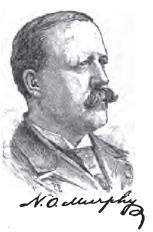
Historical · U.S. House · Arizona · At-Large
Nathan Murphy
Former U.S. Representative · Arizona At-Large · 1895–1897 · Republican
Nathan Murphy represented Arizona's At-Large in the United States House of Representatives (1895–1897) for the Republican party. The page below collects sourced biographical facts, term history, committee roles, and provenance for Murphy.
Bioguide ID: M001102
Key facts
- Full name
- Nathan Murphy
- State
- Arizona
- District
- At-Large
- Party
- Republican
- House service
- 1895–1897
- First House term
- 1895
- Status
- Left office
- Current term ends
- —
- Born
- 1849
- Bioguide ID
- M001102
- Committee assignments
- —
- Dataset version
- 1.20260606
Biographical narrative
836 words · sourced from the Wikipedia REST extract
Nathan Murphy was a prominent political figure in Arizona during the late 19th century, serving as a U.S. Representative for the state and holding various significant positions within the Arizona Territory. A member of the Republican Party, he was involved in the governance and development of Arizona, advocating for its statehood and contributing to its political landscape during a transformative period in American history.
Early life and career
Nathan Oakes Murphy was born on October 14, 1849, in Jefferson, Maine, to Benjamin F. Murphy and Lucy Oakes Murphy. His early education took place in public schools, where he laid the groundwork for his future endeavors. In 1856, the Murphy family relocated to Wisconsin, a move that would influence Nathan's formative years. From 1866 to 1869, he engaged in teaching, imparting knowledge to students in Wisconsin, which provided him with valuable experience in leadership and public service.
Seeking new opportunities, Murphy ventured westward, ultimately settling in Prescott, Arizona, in April 1883. In Prescott, he became involved in the mining and real estate sectors, which were crucial to the economic development of the region. His work in these industries not only contributed to his personal success but also positioned him as a significant player in the local economy. Murphy's political career began to take shape when he was appointed as the secretary to the Governor of the Arizona Territory in 1885. This role marked the beginning of his formal involvement in the governance of the territory.
On March 21, 1889, Murphy was appointed as the secretary of the Arizona Territory, further solidifying his political influence. His political engagement deepened when he served as a delegate to the Republican National Convention in 1892. His leadership skills and commitment to public service were recognized when he was appointed as the Governor of the Arizona Territory, a position he held from 1892 to 1894. During his governorship, Murphy focused on various initiatives aimed at improving the territory's governance and infrastructure.
House tenure
Murphy's tenure in the U.S. House of Representatives began when he was elected as a Republican to the Fifty-fourth Congress, serving from March 4, 1895, until March 3, 1897. His election to the House marked a significant milestone in his political career, as he represented the at-large district of Arizona, which was still a territory at the time. During his time in Congress, Murphy was involved in legislative discussions and decisions that would impact the future of Arizona, particularly in the context of its eventual statehood.
Despite his active participation in the House, Murphy did not seek renomination in 1896, concluding his single term in Congress. His decision not to run for re-election may have been influenced by various factors, including his prior experience as governor and his ongoing commitment to Arizona's development. Following his congressional term, Murphy returned to Arizona's political scene, where he continued to play a crucial role in the territory's governance.
Legislative focus and committees
Throughout his political career, Nathan Murphy demonstrated a strong commitment to the advancement of Arizona and its residents. As a governor and later as a U.S. Representative, he was a vocal advocate for Arizona's statehood, recognizing the importance of formal recognition and governance for the territory's growth. His tenure as governor was marked by efforts to enhance the legitimacy of Arizona as a territory through various initiatives, including the establishment of a territorial library in Phoenix and the promotion of mining operations.
Murphy's policies also reflected a focus on social issues, particularly concerning the indigenous populations in Arizona. He advocated for the reduction of Indian reservations and supported measures aimed at the prohibition of armed Indians, reflecting the complex dynamics of territorial governance during his time. His approach to these issues was indicative of the broader challenges faced by policymakers in the American West as they navigated relationships with Native American communities.
In addition to his legislative focus on statehood and social issues, Murphy's involvement in the establishment of a museum at the University of Arizona highlighted his commitment to education and cultural development in the territory. His efforts to promote educational institutions and resources were part of a broader vision for Arizona's future, emphasizing the importance of knowledge and cultural preservation in the region's growth.
After his congressional term, Murphy returned to the role of governor, serving from 1898 until 1902, when he resigned. His second governorship allowed him to continue advocating for Arizona's interests on a larger scale, although he faced challenges in his subsequent political endeavors, including an unsuccessful bid for the Fifty-seventh Congress in 1900.
Nathan Murphy passed away on August 22, 1908, in Coronado, California. His contributions to Arizona's political landscape and development were significant during a pivotal time in the territory's history. Initially interred in the Masonic Cemetery in San Diego, California, he was later reinterred at Rock Creek Cemetery in Washington, D.C., in December 1909. Murphy's legacy as a political leader and advocate for Arizona's statehood continues to be recognized as part of the historical narrative of the American West.
Notable legislation
Sponsored and co-sponsored legislation for Nathan Murphy is pending operator curation. The biographical narrative above carries the same provenance trail until per-bill rows are written.
Sources
- [1]https://en.wikipedia.org/wiki/Oakes_MurphyWikipedia · retrieved 2026-06-06
Notable quotes
Sourced quotes for Nathan Murphy are pending operator curation. Narrative-scope provenance remains attached below.
Sources
- [1]https://en.wikipedia.org/wiki/Oakes_MurphyWikipedia · retrieved 2026-06-06
Key positions
Curated policy positions for Nathan Murphy are pending operator review. The biographical narrative above carries the same provenance trail until per-topic positions are written.
Sources
- [1]https://en.wikipedia.org/wiki/Oakes_MurphyWikipedia · retrieved 2026-06-06
Terms served
- 1895–1897U.S. House · Term 1 · Republican
Sources & provenance
Every attributable claim above carries a per-section [N] marker that resolves to the corresponding URL below. Each entry records the upstream provider, the canonical URL, and the timestamp at which the source was retrieved by the ingest pipeline.
Key facts
- https://bioguide.congress.gov/search/bio/M001102bioguide · retrieved 2026-06-06
- https://www.govtrack.us/congress/members/408066govtrack · retrieved 2026-06-06
Biographical narrative
- https://en.wikipedia.org/wiki/Oakes_Murphywikipedia · retrieved 2026-06-06
Find your representative
Every U.S. state elects representatives by district. Browse Arizona’s delegation, the full former-representative roster, or explore the role and term length.
Related on The Candidate
- Preceded by Curtis BeanEarlier holder of the Arizona At-Large House seat · Republican.Open
- Succeeded by John WilsonLater holder of the Arizona At-Large House seat · Democratic.Open
- John MurdockFormer U.S. Representative · Arizona District 1 · DemocraticOpen
- John RhodesFormer U.S. Representative · Arizona District 1 · RepublicanOpen
- John Rhodes IIIFormer U.S. Representative · Arizona District 1 · RepublicanOpen
- Rick RenziFormer U.S. Representative · Arizona District 1 · RepublicanOpen