
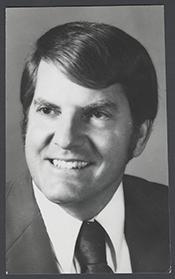
Historical · U.S. House · California · District 38
Jerry Patterson
Former U.S. Representative · California District 38 · 1975–1985 · Democratic
Jerry Patterson represented California's District 38 in the United States House of Representatives (1975–1985) for the Democratic party. The page below collects sourced biographical facts, term history, committee roles, and provenance for Patterson.
Bioguide ID: P000121
Key facts
- Full name
- Jerry Patterson
- State
- California
- District
- District 38
- Party
- Democratic
- House service
- 1975–1985
- First House term
- 1975
- Status
- Left office
- Current term ends
- —
- Born
- 1934
- Bioguide ID
- P000121
- Committee assignments
- —
- Dataset version
- 1.20260605
Biographical narrative
932 words · sourced from the Wikipedia REST extract
Jerry M. Patterson was an American lawyer, educator, and politician who served as a United States Representative for California's 38th congressional district from 1975 to 1985. A member of the Democratic Party, Patterson was notable for being the first Democrat elected to Congress from a district entirely within Orange County, California. His legislative work included significant contributions to banking transparency and refugee issues, particularly those affecting Vietnamese refugees following the Vietnam War. After leaving Congress, Patterson continued his career in law and education while remaining active in local politics and community service.
Early life and career
Jerry M. Patterson was born on October 25, 1934, in El Paso, Texas. He completed his secondary education at Tucson High School in Tucson, Arizona, graduating in 1952. Following high school, Patterson served in the United States Coast Guard from 1953 to 1957, an experience that would contribute to his understanding of public service and governance. After his military service, he pursued higher education, earning a Bachelor of Arts degree from California State University, Long Beach in 1960.
Patterson's academic journey continued with graduate studies at the University of Southern California, where he completed 30 units of coursework in public administration between 1961 and 1963. He later attended the UCLA School of Law, where he earned his Juris Doctor degree in 1966. Upon being admitted to the California bar in 1967, Patterson began his legal career in Santa Ana, California.
His entry into politics began at the local level, where he served on the Santa Ana City Council from 1969 to 1973. During this time, he also held the position of city attorney for Placentia while simultaneously serving as mayor of Santa Ana from 1973 to 1975. His local government experience laid a strong foundation for his subsequent congressional career, as he developed a keen understanding of the needs and concerns of his constituents.
House tenure
Patterson was elected to the United States House of Representatives in 1974, marking the beginning of his five terms in Congress that lasted from January 3, 1975, until January 3, 1985. He made history as the first Democrat to represent a district entirely within Orange County, a region that had traditionally leaned Republican. His election was significant not only for his party but also for the political landscape of the area.
During his time in Congress, Patterson took on various leadership roles. He served as the chairman of the Select Committee on Committee Reform from March 20, 1979, to April 30, 1980. This position allowed him to influence the internal workings of the House and advocate for reforms aimed at improving legislative processes. Additionally, he chaired the House Subcommittee on International Development Finance during the Ninety-seventh and Ninety-eighth Congresses, where he focused on issues related to international finance and development.
Patterson was also a member of the United States House Select Committee on Children, Youth, and Families, reflecting his commitment to addressing issues affecting younger populations. His legislative priorities included advocating for banking transparency, which aimed to enhance the accountability of financial institutions, and addressing refugee issues, particularly those concerning Vietnamese refugees who had resettled in the United States following the Vietnam War.
Despite his contributions, Patterson faced electoral challenges and ultimately lost his bid for reelection in 1984 to Republican candidate Bob Dornan. His defeat marked the end of his congressional career, but his influence in local and national politics continued in various capacities.
Legislative focus and committees
Throughout his tenure in the House of Representatives, Patterson's legislative focus was characterized by a commitment to transparency and humanitarian issues. His work on banking transparency aimed to ensure that financial institutions operated with greater accountability and integrity, addressing concerns that had emerged in the wake of economic challenges during the 1970s and early 1980s. This focus was part of a broader effort to protect consumers and promote fair practices within the banking industry.
In addition to banking issues, Patterson was particularly concerned with refugee matters, especially those affecting Vietnamese refugees who had fled their homeland due to the Vietnam War. His advocacy in this area highlighted the importance of providing support and resources to individuals and families who had experienced significant trauma and upheaval. Patterson's efforts contributed to the broader national discourse on immigration and refugee resettlement during a time of considerable change in U.S. immigration policy.
Patterson's leadership roles in various committees allowed him to shape discussions and influence legislation on a range of topics. His chairmanship of the Select Committee on Committee Reform was particularly notable, as it provided him with a platform to advocate for changes that could enhance the efficiency and effectiveness of congressional operations. His involvement in the House Subcommittee on International Development Finance also positioned him at the intersection of domestic and international policy, where he could address issues related to economic development and foreign aid.
After leaving Congress, Patterson continued to engage in public service and community involvement. He resumed his legal practice and took on various roles in education and local government, demonstrating a sustained commitment to serving his community. His experiences in Congress and local politics informed his subsequent work, allowing him to remain an active participant in civic life.
In summary, Jerry M. Patterson's career as a U.S. Representative was marked by significant contributions to legislative reform and advocacy for vulnerable populations. His focus on banking transparency and refugee issues reflected a dedication to public service that extended beyond his time in Congress. Through his continued involvement in law, education, and local governance, Patterson left a lasting impact on his community and the political landscape of California.
Notable legislation
Sponsored and co-sponsored legislation for Jerry Patterson is pending operator curation. The biographical narrative above carries the same provenance trail until per-bill rows are written.
Sources
- [1]https://en.wikipedia.org/wiki/Jerry_M._PattersonWikipedia · retrieved 2026-06-05
Notable quotes
Sourced quotes for Jerry Patterson are pending operator curation. Narrative-scope provenance remains attached below.
Sources
- [1]https://en.wikipedia.org/wiki/Jerry_M._PattersonWikipedia · retrieved 2026-06-05
Key positions
Curated policy positions for Jerry Patterson are pending operator review. The biographical narrative above carries the same provenance trail until per-topic positions are written.
Sources
- [1]https://en.wikipedia.org/wiki/Jerry_M._PattersonWikipedia · retrieved 2026-06-05
Terms served
- 1975–1977U.S. House · Term 1 · Democratic
- 1977–1979U.S. House · Term 2 · Democratic
- 1979–1981U.S. House · Term 3 · Democratic
- 1981–1983U.S. House · Term 4 · Democratic
- 1983–1985U.S. House · Term 5 · Democratic
Sources & provenance
Every attributable claim above carries a per-section [N] marker that resolves to the corresponding URL below. Each entry records the upstream provider, the canonical URL, and the timestamp at which the source was retrieved by the ingest pipeline.
Key facts
- https://bioguide.congress.gov/search/bio/P000121bioguide · retrieved 2026-06-05
- https://www.govtrack.us/congress/members/408529govtrack · retrieved 2026-06-05
Biographical narrative
- https://en.wikipedia.org/wiki/Jerry_M._Pattersonwikipedia · retrieved 2026-06-05
Find your representative
Every U.S. state elects representatives by district. Browse California’s delegation, the full former-representative roster, or explore the role and term length.
Related on The Candidate
- Preceded by Patrick MartinEarlier holder of the California District 38 House seat · Republican.Open
- Succeeded by Stephen HornLater holder of the California District 38 House seat · Republican.Open
- Barclay HenleyFormer U.S. Representative · California District 1 · DemocraticOpen
- Charles ClaytonFormer U.S. Representative · California District 1 · RepublicanOpen
- Clarence LeaFormer U.S. Representative · California District 1 · DemocraticOpen
- Clement MillerFormer U.S. Representative · California District 1 · DemocraticOpen