
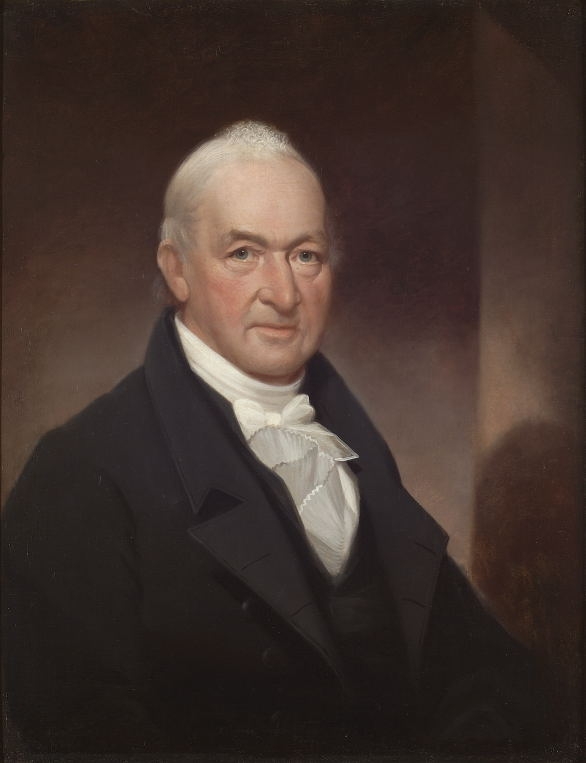
Historical · U.S. House · Connecticut · At-Large
Benjamin Tallmadge
Former U.S. Representative · Connecticut At-Large · 1801–1817 · Federalist
Benjamin Tallmadge represented Connecticut's At-Large in the United States House of Representatives (1801–1817) for the Federalist party. The page below collects sourced biographical facts, term history, committee roles, and provenance for Tallmadge.
Bioguide ID: T000029
Key facts
- Full name
- Benjamin Tallmadge
- State
- Connecticut
- District
- At-Large
- Party
- Federalist
- House service
- 1801–1817
- First House term
- 1801
- Status
- Left office
- Current term ends
- —
- Born
- 1754
- Bioguide ID
- T000029
- Committee assignments
- —
- Dataset version
- 1.20260606
Biographical narrative
878 words · sourced from the Wikipedia REST extract
Benjamin Tallmadge was an American military officer, spymaster, and politician who served as a U.S. Representative for Connecticut's at-large congressional district. A member of the Federalist Party, Tallmadge's political career spanned from 1801 until 1817, during which he was elected to the House of Representatives for eight consecutive terms. His earlier contributions to American history include significant roles during the American Revolutionary War, particularly as the leader of the Culper Ring, a network of spies that provided crucial intelligence to the Continental Army.
Early life and career
Born on February 25, 1754, in Setauket, New York, Benjamin Tallmadge was the son of Susannah Smith and Rev. Benjamin Tallmadge Sr., a local clergyman. He grew up in a community that was deeply affected by the events leading up to the American Revolutionary War. Tallmadge graduated from Yale College in 1773, where he was involved in the Brothers in Unity literary society. During his time at Yale, he formed a close friendship with Nathan Hale, who would later become a notable figure in American espionage.
Before the war, Tallmadge served as the superintendent of Wethersfield High School from 1773 until 1776. His educational background and leadership skills would later serve him well in military and political roles. As tensions escalated between the American colonies and Great Britain, Tallmadge enlisted in the Continental Army, where he quickly rose through the ranks. He was commissioned as a major in the 2nd Continental Light Dragoons on June 20, 1776.
Tallmadge's military career was marked by his appointment as the director of military intelligence by General George Washington. This position was critical during the war, as it involved gathering intelligence from British-held territories, particularly New York City. Tallmadge established the Culper Ring, a network of spies that included key figures such as Abraham Woodhull and Robert Townsend. This group played a vital role in uncovering British plans and was instrumental in the exposure of Benedict Arnold's treason.
In addition to his intelligence work, Tallmadge led a successful raid against British forces, notably the attack on Fort St. George, which demonstrated his military acumen. He served under Washington's command until the disbandment of the Continental Army in November 1783. Following the war, Tallmadge continued to be active in military and civic affairs, including his involvement with The Society of the Cincinnati, where he held various leadership positions over the years.
House tenure
Tallmadge's political career began in earnest when he was elected to the U.S. House of Representatives, taking office on March 4, 1801. He succeeded William Edmond and represented Connecticut's at-large congressional district as a member of the Federalist Party. This marked his second attempt at securing a congressional seat, having previously run in 1798 without success. Over the course of his tenure, Tallmadge was re-elected multiple times, serving a total of eight terms in the House until March 3, 1817, when he was succeeded by Thomas Scott Williams.
During his time in Congress, Tallmadge was involved in various legislative matters and was part of the Federalist Party, which was known for its support of a strong central government and its opposition to the Democratic-Republican Party. His political activities included defending fellow Federalist Uriah Tracy against accusations related to a supposed secessionist movement in New England, showcasing his commitment to party loyalty and defense of Federalist principles.
Tallmadge's congressional career coincided with a period of significant political change in the United States, as the Federalist Party began to decline in influence. Despite this, he maintained a consistent presence in the House, contributing to debates and discussions that shaped early American policy.
Legislative focus and committees
Throughout his congressional career, Benjamin Tallmadge focused on various issues that were pertinent to his constituents and the nation. While specific details about the legislation he sponsored or voted on are not extensively documented, as a member of the Federalist Party, it can be inferred that he supported policies that aligned with the party's principles, such as federal authority, economic development, and national security.
Tallmadge's experience as a military officer likely influenced his perspectives on defense and foreign policy, particularly in the context of the ongoing challenges faced by the young nation. His background in intelligence gathering during the Revolutionary War may have also informed his views on national security and the importance of a well-prepared military.
In addition to his legislative duties, Tallmadge served on various committees during his time in the House. These committees would have provided him with platforms to advocate for the interests of his constituents and to engage in the legislative process. His long tenure in Congress allowed him to build relationships with fellow lawmakers and to navigate the complexities of early American governance.
After leaving Congress in 1817, Tallmadge continued to be active in public life, including his role as the first president of the Phoenix Branch Bank from 1814 to 1826. His contributions to both military and civic life reflect a commitment to service that extended beyond his time in the House of Representatives.
Benjamin Tallmadge passed away on March 7, 1835, in Litchfield, Connecticut. His legacy as a military leader and politician remains a part of American history, particularly for his contributions during the Revolutionary War and his service in the early years of the United States government.
Notable legislation
Sponsored and co-sponsored legislation for Benjamin Tallmadge is pending operator curation. The biographical narrative above carries the same provenance trail until per-bill rows are written.
Sources
- [1]https://en.wikipedia.org/wiki/Benjamin_TallmadgeWikipedia · retrieved 2026-06-06
Notable quotes
Sourced quotes for Benjamin Tallmadge are pending operator curation. Narrative-scope provenance remains attached below.
Sources
- [1]https://en.wikipedia.org/wiki/Benjamin_TallmadgeWikipedia · retrieved 2026-06-06
Key positions
Curated policy positions for Benjamin Tallmadge are pending operator review. The biographical narrative above carries the same provenance trail until per-topic positions are written.
Sources
- [1]https://en.wikipedia.org/wiki/Benjamin_TallmadgeWikipedia · retrieved 2026-06-06
Terms served
- 1801–1803U.S. House · Term 1 · Federalist
- 1803–1805U.S. House · Term 2 · Federalist
- 1805–1807U.S. House · Term 3 · Federalist
- 1807–1809U.S. House · Term 4 · Federalist
- 1809–1811U.S. House · Term 5 · Federalist
- 1811–1813U.S. House · Term 6 · Federalist
- 1813–1815U.S. House · Term 7 · Federalist
- 1815–1817U.S. House · Term 8 · Federalist
Sources & provenance
Every attributable claim above carries a per-section [N] marker that resolves to the corresponding URL below. Each entry records the upstream provider, the canonical URL, and the timestamp at which the source was retrieved by the ingest pipeline.
Key facts
- https://bioguide.congress.gov/search/bio/T000029bioguide · retrieved 2026-06-06
- https://www.govtrack.us/congress/members/410618govtrack · retrieved 2026-06-06
Biographical narrative
- https://en.wikipedia.org/wiki/Benjamin_Tallmadgewikipedia · retrieved 2026-06-06
Find your representative
Every U.S. state elects representatives by district. Browse Connecticut’s delegation, the full former-representative roster, or explore the role and term length.
Related on The Candidate
- Preceded by Elizur GoodrichEarlier holder of the Connecticut At-Large House seat · Federalist.Open
- Succeeded by Nathaniel TerryLater holder of the Connecticut At-Large House seat · Federalist.Open
- Barbara KennellyFormer U.S. Representative · Connecticut District 1 · DemocraticOpen
- Charles ChapmanFormer U.S. Representative · Connecticut District 1 · WhigOpen
- Dwight LoomisFormer U.S. Representative · Connecticut District 1 · RepublicanOpen
- Edward FennFormer U.S. Representative · Connecticut District 1 · RepublicanOpen