
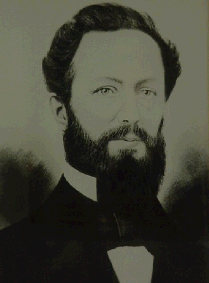
Historical · U.S. House · Delaware · At-Large
William Temple
Former U.S. Representative · Delaware At-Large · 1863–1865 · Democratic
William Temple represented Delaware's At-Large in the United States House of Representatives (1863–1865) for the Democratic party. The page below collects sourced biographical facts, term history, committee roles, and provenance for Temple.
Bioguide ID: T000120
Key facts
- Full name
- William Temple
- State
- Delaware
- District
- At-Large
- Party
- Democratic
- House service
- 1863–1865
- First House term
- 1863
- Status
- Left office
- Current term ends
- —
- Born
- 1814
- Bioguide ID
- T000120
- Committee assignments
- —
- Dataset version
- 1.20260606
Biographical narrative
1,008 words · sourced from the Wikipedia REST extract
William Temple was an American merchant and politician who served as a U.S. Representative for Delaware's at-large congressional district. He was affiliated with the Democratic Party and had previously been a member of the Whig Party. His political career included serving as the Governor of Delaware and as a member of the Delaware General Assembly. Temple's tenure in the U.S. House of Representatives was brief, as he passed away shortly after being elected, making him a notable figure in Delaware's political history.
Early life and career
William Temple was born on February 28, 1814, in Queen Anne's County, Maryland. He was the son of George Temple, and his family had deep roots in the region, having resided there since the mid-18th century. The Temple family is believed to have inspired the naming of Templeville, a locality situated near the Maryland-Delaware border. William Temple was one of six children, having five brothers and a sister. At the age of 18, he relocated to Smyrna, Delaware, where he began his career as a merchant.
In 1838, Temple married Sarah Ann Ringgold, the daughter of William Ringgold of Kenton. The couple had three children together: Sarah Louisa, Emma Frances, and William George. Tragically, both of his daughters died in infancy, and his wife passed away in 1851 at the age of 33. During their life in Smyrna, the Temple family was active in their community, attending St. Peter's Episcopal Church, and they resided at the northeast corner of Main and Mt. Vernon Streets.
Temple's entry into politics began in the mid-19th century, a time when Delaware's political landscape was characterized by a conservative agrarian majority, primarily located in the southern part of the state. This majority was often in opposition to the industrial interests concentrated in Wilmington. Initially, Temple aligned with the Whig Party, which was prominent in Delaware politics during this period. However, as the Whig Party began to fracture over issues related to slavery, many members, including Temple, transitioned to the Democratic Party, which was more aligned with their conservative views.
House tenure
William Temple's political career advanced significantly when he was elected to the Delaware House of Representatives in the fall of 1844. His leadership abilities were recognized early on, as he became Speaker of the House in January 1846. Following a series of unfortunate events that led to the deaths of the elected governor, Thomas Stockton, and the Speaker of the State Senate, Joseph Maull, Temple unexpectedly ascended to the governorship on May 6, 1846. At just 32 years old, he became the youngest individual to hold the office of Governor of Delaware.
During his brief tenure as governor, which lasted until January 19, 1847, Temple faced significant challenges, including a call from President James K. Polk to raise troops for the Mexican-American War. His time in office was marked by these pressing national issues, which shaped his political outlook and future decisions.
After serving as governor, Temple continued his political career by being elected to the Delaware Senate, where he served from the 1849-1850 session through the 1853-1854 session. His political affiliations shifted as the national landscape changed, particularly with the rise of sectional tensions leading up to the Civil War. Temple found himself in a complex position, as he was too conservative to support the agenda of prominent figures like Stephen A. Douglas, yet he was also apprehensive about the disunion and the Republican Party's stance on slavery.
In the election of 1860, Temple attempted to navigate the political turmoil by aligning with the Constitutional Union Party, which sought to maintain the Union while allowing states to decide the issue of slavery. However, following the election of Abraham Lincoln and the subsequent secession of Southern states, Temple's political stance evolved. He opposed the enforced restoration of the Union and officially joined the Democratic Party.
Temple's candidacy for the U.S. House of Representatives came during the contentious 1862 election. He ran against the incumbent Republican George P. Fisher, who had previously served as Secretary of State during Temple's governorship. The election was marked by allegations of electoral manipulation, with Fisher requesting federal troops to oversee polling places. Despite these challenges, Temple was elected to the House of Representatives, officially taking office on March 4, 1863. However, he passed away before the House convened in December of that year, resulting in a brief congressional tenure.
Legislative focus and committees
Although William Temple's time in the U.S. House of Representatives was cut short by his untimely death, his political career reflected the complexities of 19th-century American politics, particularly in Delaware. His alignment with the Democratic Party during a time of national strife indicated his commitment to the prevailing conservative values of his constituency, which were often at odds with the more industrial and progressive views held by the Republican minority.
Temple's legislative focus during his brief time in office is not extensively documented, as he did not have the opportunity to serve in the House for an extended period. However, his earlier roles in the Delaware General Assembly and as governor suggest that he was concerned with issues pertinent to his constituents, including economic development, state rights, and the implications of national policies on local governance.
His involvement in the Delaware Senate and as Speaker of the House demonstrated his leadership capabilities and his ability to navigate the political landscape of his time. Temple's participation in the Constitutional Union Party and his subsequent alignment with the Democratic Party highlight his attempts to find a political middle ground during a period of intense national division.
William Temple's legacy is marked by his contributions to Delaware politics, his role as a young governor, and his brief tenure in the U.S. House of Representatives. He died on May 28, 1863, in Smyrna, Delaware, and was buried in the cemetery of St. Peter's Episcopal Church. His grave remained unmarked until 1979, when a stone was placed to commemorate his life and service. Temple's family continued his legacy, with his grandson becoming an ordained priest in the Roman Catholic Church.
Notable legislation
Sponsored and co-sponsored legislation for William Temple is pending operator curation. The biographical narrative above carries the same provenance trail until per-bill rows are written.
Sources
- [1]https://en.wikipedia.org/wiki/William_Temple_(politician)Wikipedia · retrieved 2026-06-06
Notable quotes
Sourced quotes for William Temple are pending operator curation. Narrative-scope provenance remains attached below.
Sources
- [1]https://en.wikipedia.org/wiki/William_Temple_(politician)Wikipedia · retrieved 2026-06-06
Key positions
Curated policy positions for William Temple are pending operator review. The biographical narrative above carries the same provenance trail until per-topic positions are written.
Sources
- [1]https://en.wikipedia.org/wiki/William_Temple_(politician)Wikipedia · retrieved 2026-06-06
Terms served
- 1863–1865U.S. House · Term 1 · Democratic
Sources & provenance
Every attributable claim above carries a per-section [N] marker that resolves to the corresponding URL below. Each entry records the upstream provider, the canonical URL, and the timestamp at which the source was retrieved by the ingest pipeline.
Key facts
- https://bioguide.congress.gov/search/bio/T000120bioguide · retrieved 2026-06-06
- https://www.govtrack.us/congress/members/410702govtrack · retrieved 2026-06-06
Biographical narrative
- https://en.wikipedia.org/wiki/William_Temple_(politician)wikipedia · retrieved 2026-06-06
Find your representative
Every U.S. state elects representatives by district. Browse Delaware’s delegation, the full former-representative roster, or explore the role and term length.
Related on The Candidate
- Preceded by George FisherEarlier holder of the Delaware At-Large House seat · Unionist.Open
- Succeeded by John NicholsonLater holder of the Delaware At-Large House seat · Democratic.Open
- Albert PolkFormer U.S. Representative · Delaware At-Large · DemocraticOpen
- Benjamin BiggsFormer U.S. Representative · Delaware At-Large · DemocraticOpen
- Caleb LaytonFormer U.S. Representative · Delaware At-Large · RepublicanOpen
- Charles LoreFormer U.S. Representative · Delaware At-Large · DemocraticOpen