
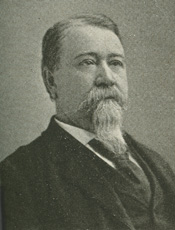
Historical · U.S. House · Georgia · District 10
James Black
Former U.S. Representative · Georgia District 10 · 1893–1897 · Democratic
James Black represented Georgia's District 10 in the United States House of Representatives (1893–1897) for the Democratic party. The page below collects sourced biographical facts, term history, committee roles, and provenance for Black.
Bioguide ID: B000502
Key facts
- Full name
- James Black
- State
- Georgia
- District
- District 10
- Party
- Democratic
- House service
- 1893–1897
- First House term
- 1893
- Status
- Left office
- Current term ends
- —
- Born
- 1842
- Bioguide ID
- B000502
- Committee assignments
- —
- Dataset version
- 1.20260606
Biographical narrative
884 words · sourced from the Wikipedia REST extract
James Black was a prominent American politician and lawyer who served as a U.S. Representative for Georgia's 10th congressional district during the late 19th century. A member of the Democratic Party, Black's political career was marked by his election to the House of Representatives in 1892, where he served two terms until 1897. His tenure was characterized by a notable electoral rivalry with Populist incumbent Tom Watson. Prior to his congressional service, Black had a diverse career that included roles in local government and law, reflecting his deep engagement in the civic life of Augusta, Georgia, where he spent much of his adult life.
Early life and career
James Black was born on May 9, 1842, in Stamping Ground, Kentucky. His early education took place in common schools, where he developed a foundational knowledge that would serve him throughout his life. He later attended high school in New Castle, Kentucky, and graduated from Georgetown College in 1862. This educational background provided him with the tools necessary for a career in law and public service.
During the American Civil War, Black enlisted as a private in Company A of the 9th Kentucky Cavalry, serving in the Confederate Army. His military service during this tumultuous period in American history likely influenced his perspectives on governance and civic duty. After the war concluded, Black relocated to Augusta, Georgia, in 1865. There, he pursued legal studies and was admitted to the bar in 1866, marking the beginning of his professional career as a lawyer. He commenced his legal practice in Augusta, establishing himself within the local legal community.
In addition to his legal career, Black became actively involved in politics and public service. He served in the Georgia House of Representatives from 1873 to 1877, where he contributed to state legislation and governance. His commitment to community welfare was further demonstrated through his role as president of the Augusta Orphan Asylum from 1879 to 1886, where he oversaw the care and support of vulnerable children. Black also held positions on the Augusta city council and served as the city attorney, which allowed him to influence local governance and legal matters directly.
House tenure
James Black's entry into the U.S. House of Representatives began with his election in 1892, when he successfully defeated the incumbent Populist representative, Tom Watson. This election was significant, as it marked a shift in political power within the district. Black's victory was indicative of the Democratic Party's strength in Georgia during this period, as well as the waning influence of the Populist movement.
Black's first term in the House commenced in 1893. His time in Congress was marked by a contentious relationship with Watson, who challenged the legitimacy of Black's election. In the subsequent election of 1894, Black was declared the winner again, but Watson alleged that the vote had been fraudulent. In a notable move, Black agreed to resign his seat shortly after the opening of the 54th Congress, allowing for a special election to resolve the dispute over his legitimacy. This decision reflects a willingness to prioritize electoral integrity and public trust over personal political ambition.
The special election held in October 1895 saw Black reclaim his seat, defeating Watson once more. This victory reaffirmed his position in Congress and allowed him to continue his legislative work until the end of his term in 1897. However, after serving two terms, Black chose not to seek renomination in 1896, signaling a shift in his career focus. Following his congressional tenure, he returned to his legal practice in Augusta, where he continued to contribute to the community until his passing.
Legislative focus and committees
During his time in the House of Representatives, James Black's legislative focus and committee assignments are not extensively documented in the available records. However, as a member of the Democratic Party during a period of significant political and social change in the United States, it can be inferred that his legislative interests likely aligned with the broader goals of his party, which included issues such as economic development, civil rights, and social welfare.
Black's background as a lawyer and his experience in local governance would have provided him with insights into the legal and social issues facing his constituents. His work in the Georgia House of Representatives and various local positions likely informed his approach to federal legislation, emphasizing the importance of community needs and local governance.
After concluding his congressional service, Black returned to Augusta, where he continued to practice law until his death on October 1, 1928. His contributions to the legal field and local governance left a lasting impact on the community. He was interred in Magnolia Cemetery in Augusta, marking the end of a life dedicated to public service and civic engagement.
James Black's career reflects the complexities of American politics in the late 19th century, a time characterized by shifting political alliances and the emergence of new social movements. His journey from a soldier in the Civil War to a state legislator and then a U.S. Representative illustrates the diverse pathways individuals can take in their pursuit of public service. Through his various roles, Black demonstrated a commitment to his community and to the principles of democracy, leaving a legacy that continues to be recognized in the historical narrative of Georgia politics.
Notable legislation
Sponsored and co-sponsored legislation for James Black is pending operator curation. The biographical narrative above carries the same provenance trail until per-bill rows are written.
Sources
- [1]https://en.wikipedia.org/wiki/James_C._C._BlackWikipedia · retrieved 2026-06-06
Notable quotes
Sourced quotes for James Black are pending operator curation. Narrative-scope provenance remains attached below.
Sources
- [1]https://en.wikipedia.org/wiki/James_C._C._BlackWikipedia · retrieved 2026-06-06
Key positions
Curated policy positions for James Black are pending operator review. The biographical narrative above carries the same provenance trail until per-topic positions are written.
Sources
- [1]https://en.wikipedia.org/wiki/James_C._C._BlackWikipedia · retrieved 2026-06-06
Terms served
- 1893–1895U.S. House · Term 1 · Democratic
- 1895–1897U.S. House · Term 2 · Democratic
Sources & provenance
Every attributable claim above carries a per-section [N] marker that resolves to the corresponding URL below. Each entry records the upstream provider, the canonical URL, and the timestamp at which the source was retrieved by the ingest pipeline.
Key facts
- https://bioguide.congress.gov/search/bio/B000502bioguide · retrieved 2026-06-06
- https://www.govtrack.us/congress/members/401482govtrack · retrieved 2026-06-06
Biographical narrative
- https://en.wikipedia.org/wiki/James_C._C._Blackwikipedia · retrieved 2026-06-06
Find your representative
Every U.S. state elects representatives by district. Browse Georgia’s delegation, the full former-representative roster, or explore the role and term length.
Related on The Candidate
- Preceded by George BarnesEarlier holder of the Georgia District 10 House seat · Democratic.Open
- Succeeded by William FlemingLater holder of the Georgia District 10 House seat · Democratic.Open
- Andrew SloanFormer U.S. Representative · Georgia District 1 · RepublicanOpen
- Anthony WayneFormer U.S. Representative · Georgia District 1Open
- Archibald MacIntyreFormer U.S. Representative · Georgia District 1 · DemocraticOpen
- Bo GinnFormer U.S. Representative · Georgia District 1 · DemocraticOpen