
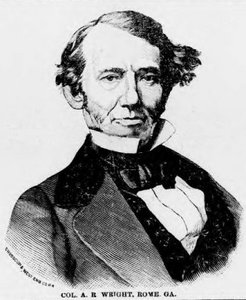
Historical · U.S. House · Georgia · District 5
Augustus Wright
Former U.S. Representative · Georgia District 5 · 1857–1859 · Democratic
Augustus Wright represented Georgia's District 5 in the United States House of Representatives (1857–1859) for the Democratic party. The page below collects sourced biographical facts, term history, committee roles, and provenance for Wright.
Bioguide ID: W000755
Key facts
- Full name
- Augustus Wright
- State
- Georgia
- District
- District 5
- Party
- Democratic
- House service
- 1857–1859
- First House term
- 1857
- Status
- Left office
- Current term ends
- —
- Born
- 1813
- Bioguide ID
- W000755
- Committee assignments
- —
- Dataset version
- 1.20260606
Biographical narrative
831 words · sourced from the Wikipedia REST extract
Augustus Wright was an American politician and lawyer who served as a U.S. Representative for Georgia's 5th congressional district from 1857 to 1859. A member of the Democratic Party, Wright's political career was marked by his involvement in the events leading up to and during the American Civil War, including his service in the Confederate Congress and as a colonel in the Confederate Army. His legal career began in the mid-1830s, and he held various judicial positions before entering national politics. Wright's life spanned significant periods of American history, and he remained active in public affairs until his later years.
Early life and career
Augustus Wright was born on June 16, 1813, in Wrightsboro, Georgia. He received his early education in public schools located in Appling, Georgia. Demonstrating an interest in higher education, Wright attended the Franklin College of Arts and Sciences, which is part of the University of Georgia in Athens. During his time at the university, he became a member of the Phi Kappa Literary Society, a notable organization that fostered debate and literary skills among its members.
After completing his studies, Wright pursued a career in law. He attended the Litchfield Law School in Connecticut, a prestigious institution known for training many prominent lawyers of the time. Upon returning to Georgia, he was admitted to the State Bar in 1835, marking the beginning of his legal practice in Crawfordville, Georgia. His legal career flourished, and he gained recognition in the legal community.
Wright's judicial career began in 1842 when he was appointed as a judge of the superior court of the Cherokee circuit, a position he held until 1849. His judicial responsibilities provided him with significant experience in the legal system and contributed to his reputation as a capable legal mind. Following his tenure in the Cherokee circuit, he served as a judge of the superior court of Georgia from 1855 to 1857. Throughout his life, Wright was known to have owned slaves, reflecting the socio-economic context of his time and region.
House tenure
In 1856, Augustus Wright entered the political arena when he was elected to represent Georgia's 5th congressional district in the U.S. House of Representatives. His term began in 1857 and lasted until 1859. As a member of the Democratic Party, Wright's political views were aligned with the prevailing sentiments of his constituents, particularly regarding issues related to states' rights and slavery.
During his time in Congress, Wright was involved in the debates and legislative discussions that characterized the period leading up to the Civil War. His tenure was marked by the growing tensions between the Northern and Southern states over issues such as slavery, secession, and states' rights. However, his time in the House was relatively brief, as he served only one term before leaving office in March 1859.
Following his congressional service, Wright continued to engage in the political landscape of Georgia. He ran as an anti-secession delegate for a seat at the Georgia Secession Convention but was unsuccessful, losing to his son-in-law, Francis Shropshire. Despite this setback, Wright remained an influential figure in Georgia politics.
Legislative focus and committees
During his time in the U.S. House of Representatives, Augustus Wright's legislative focus was influenced by the political climate of the era. As a member of the Democratic Party, he supported the party's platform, which included a strong emphasis on states' rights and the protection of slavery as an institution. The political landscape of the late 1850s was fraught with conflict, as debates over the expansion of slavery into new territories and states intensified.
Wright's involvement in the political process extended beyond his congressional term. In 1861, he was one of ten Georgia delegates to the Confederate Constitution Convention held in Montgomery, Alabama, where he contributed to the formation of the Confederate government. His commitment to the Confederate cause was further demonstrated by his service in the First Confederate Congress.
In addition to his legislative work, Wright organized "Wright’s Legion," a group of Georgia volunteers that became part of the Confederate Army. He held the rank of colonel in the Georgia 38th Infantry Regiment, serving in the Army of Northern Virginia during the Civil War. His military service was a significant aspect of his life during this tumultuous period in American history.
After the Civil War, Augustus Wright continued to play a role in Georgia's political landscape. He was a member of the Georgia constitutional convention in 1877, where he participated in discussions regarding the reconstruction and reorganization of the state following the war. His involvement in these efforts reflected his ongoing commitment to public service and his interest in shaping the future of Georgia.
Wright's life came to an end on March 31, 1891, at his home near Rome, Georgia. He was laid to rest in Myrtle Hill Cemetery in Rome. His legacy is intertwined with the complex history of the United States during the 19th century, particularly regarding the issues of slavery, states' rights, and the Civil War.
Notable legislation
Sponsored and co-sponsored legislation for Augustus Wright is pending operator curation. The biographical narrative above carries the same provenance trail until per-bill rows are written.
Sources
- [1]https://en.wikipedia.org/wiki/Augustus_R._WrightWikipedia · retrieved 2026-06-06
Notable quotes
Sourced quotes for Augustus Wright are pending operator curation. Narrative-scope provenance remains attached below.
Sources
- [1]https://en.wikipedia.org/wiki/Augustus_R._WrightWikipedia · retrieved 2026-06-06
Key positions
Curated policy positions for Augustus Wright are pending operator review. The biographical narrative above carries the same provenance trail until per-topic positions are written.
Sources
- [1]https://en.wikipedia.org/wiki/Augustus_R._WrightWikipedia · retrieved 2026-06-06
Terms served
- 1857–1859U.S. House · Term 1 · Democratic
Sources & provenance
Every attributable claim above carries a per-section [N] marker that resolves to the corresponding URL below. Each entry records the upstream provider, the canonical URL, and the timestamp at which the source was retrieved by the ingest pipeline.
Key facts
- https://bioguide.congress.gov/search/bio/W000755bioguide · retrieved 2026-06-06
- https://www.govtrack.us/congress/members/411904govtrack · retrieved 2026-06-06
Biographical narrative
- https://en.wikipedia.org/wiki/Augustus_R._Wrightwikipedia · retrieved 2026-06-06
Find your representative
Every U.S. state elects representatives by district. Browse Georgia’s delegation, the full former-representative roster, or explore the role and term length.
Related on The Candidate
- Preceded by John LumpkinEarlier holder of the Georgia District 5 House seat · Democratic.Open
- Succeeded by John UnderwoodLater holder of the Georgia District 5 House seat · Democratic.Open
- Andrew SloanFormer U.S. Representative · Georgia District 1 · RepublicanOpen
- Anthony WayneFormer U.S. Representative · Georgia District 1Open
- Archibald MacIntyreFormer U.S. Representative · Georgia District 1 · DemocraticOpen
- Bo GinnFormer U.S. Representative · Georgia District 1 · DemocraticOpen