
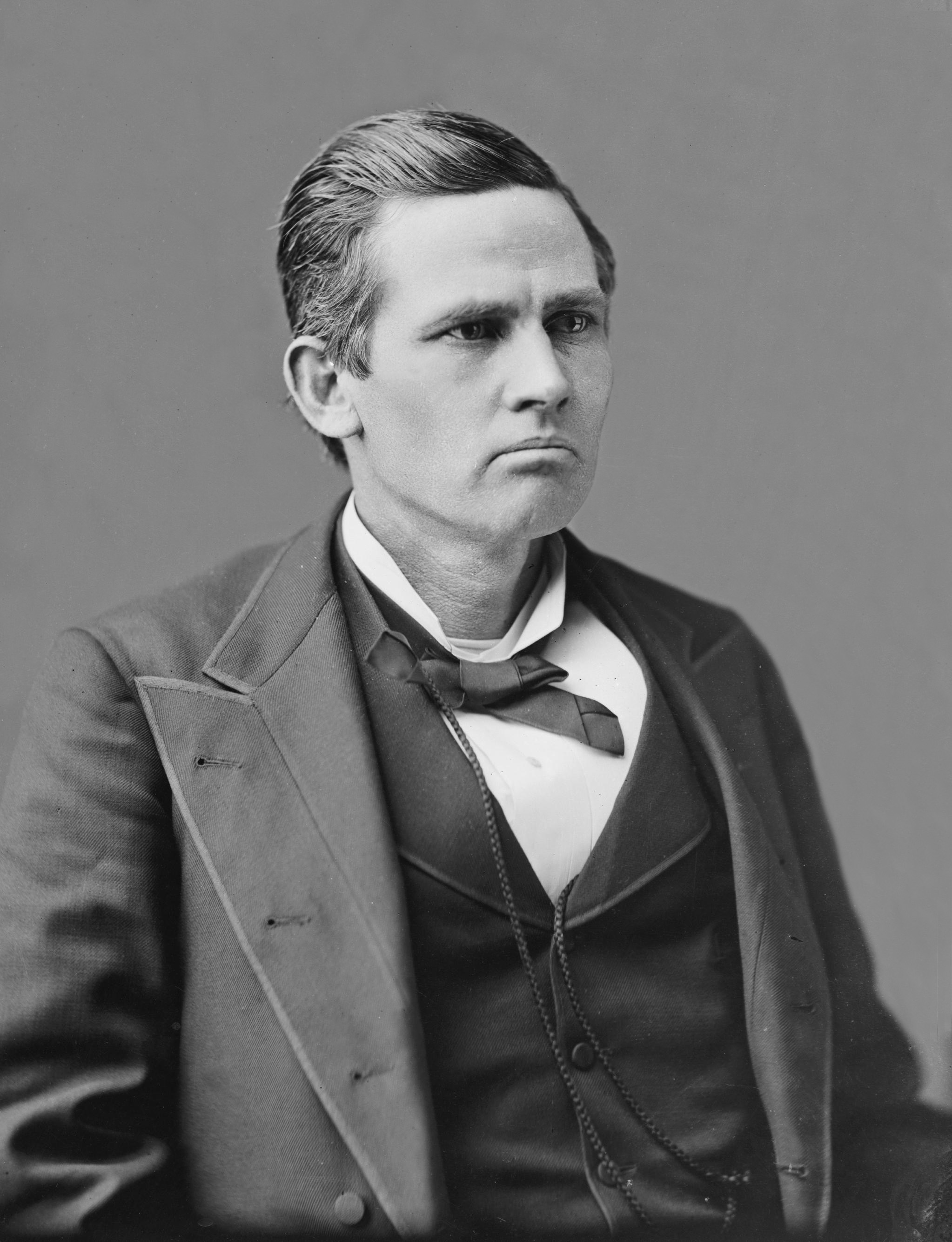
Historical · U.S. House · Georgia · District 6
James Blount
Former U.S. Representative · Georgia District 6 · 1873–1893 · Democratic
James Blount represented Georgia's District 6 in the United States House of Representatives (1873–1893) for the Democratic party. The page below collects sourced biographical facts, term history, committee roles, and provenance for Blount.
Bioguide ID: B000568
Key facts
- Full name
- James Blount
- State
- Georgia
- District
- District 6
- Party
- Democratic
- House service
- 1873–1893
- First House term
- 1873
- Status
- Left office
- Current term ends
- —
- Born
- 1837
- Bioguide ID
- B000568
- Committee assignments
- —
- Dataset version
- 1.20260606
Biographical narrative
848 words · sourced from the Wikipedia REST extract
James Blount was an American politician who served as a U.S. Representative for Georgia's sixth congressional district from 1873 until 1893. A member of the Democratic Party, Blount's political career was marked by his involvement in significant legislative matters, including his opposition to the annexation of Hawaii during a pivotal moment in U.S. foreign policy. His background as a Confederate soldier and his role in the Redeemer movement among Southern Democrats shaped his political views and actions throughout his tenure in Congress.
Early life and career
James Henderson Blount was born on September 12, 1837, near Clinton in Jones County, Georgia. He received his early education at private schools in his hometown and in Tuscaloosa, Alabama. Blount pursued higher education at the University of Georgia in Athens, where he graduated in 1858. Following his graduation, he studied law and was admitted to the Georgia bar in 1859, marking the beginning of his professional career.
With the onset of the American Civil War, Blount enlisted in the Confederate States Army, where he served as a private in the Second Georgia Battalion, known as the Floyd Rifles, for two years. His military service eventually led to a promotion to the rank of lieutenant colonel, a position he held for an additional two years. This experience in the military likely influenced his later political career, as many veterans sought to shape the post-war South through public service.
House tenure
Blount's political career in the U.S. House of Representatives began in 1873 when he was elected to represent Georgia's sixth congressional district. He served in this capacity for a total of ten consecutive terms, concluding his service on March 3, 1893. Throughout his tenure, Blount was associated with the Southern Democratic faction known as the Redeemers, which sought to restore white supremacy and reduce the influence of Republicans in the South following the Civil War.
During his time in Congress, Blount held significant positions, including serving as the Chairman of the House Committee on Foreign Relations from 1891 until the end of his term in 1893. This role placed him at the forefront of important discussions regarding U.S. foreign policy, particularly during a period of expansion and imperial interest in territories beyond the continental United States.
Blount's congressional career was characterized by his engagement in various legislative matters, but he is perhaps best remembered for his involvement in the political events surrounding the Kingdom of Hawaii. His actions during this time would have lasting implications for U.S. foreign relations and the status of Hawaii.
Legislative focus and committees
Blount's legislative focus during his time in the House was influenced by his background and the political climate of the era. As a member of the Democratic Party and a representative of the South, he aligned himself with the interests of his constituents while also engaging with broader national issues. His role as Chairman of the House Committee on Foreign Relations allowed him to influence U.S. policy on international matters, particularly in the context of American expansionism.
One of the most notable events during Blount's career was his investigation into the annexation of Hawaii. Following a coup in January 1893 that overthrew Queen Liliʻuokalani, the new government sought annexation by the United States. Initially, President Benjamin Harrison supported this move and submitted a treaty to the Senate. However, after Harrison's term ended, President Grover Cleveland, a Democrat, opposed the annexation and appointed Blount to investigate the circumstances surrounding the coup.
Blount's investigation culminated in a report known as the Blount Report, which he submitted in July 1893. In this report, he recommended against the annexation of Hawaii and argued that the native population should be allowed to maintain their sovereignty. He attributed the coup to the actions of the U.S. consul, suggesting that American involvement had undermined the legitimate government of Hawaii.
The findings of the Blount Report were met with controversy. Cleveland's administration initially considered using military force to restore the deposed queen, but this plan faltered when Liliʻuokalani refused to grant amnesty to the coup leaders. The matter was subsequently referred to Congress, where the Senate, under Democratic control, produced its own report, known as the Morgan Report. This report contradicted Blount's conclusions, asserting that the revolution in Hawaii was an internal affair and not a result of U.S. intervention.
As a result of these conflicting reports and the political dynamics at play, the U.S. government ultimately shifted its stance. Following the Turpie Resolution of May 1894, which established a policy of non-interference in Hawaiian affairs, Cleveland abandoned efforts to reinstate the queen and recognized the Republic of Hawaii. This decision reflected the complexities of American foreign policy during a time of significant change and expansion.
After concluding his congressional service in 1893, Blount returned to Georgia, where he continued to be involved in local affairs until his death on March 8, 1903, in Macon, Bibb County, Georgia. He was buried at Rose Hill Cemetery in Macon. His legacy includes being the namesake of the community of Blount, Georgia, a testament to his impact on the region he represented.
Notable legislation
Sponsored and co-sponsored legislation for James Blount is pending operator curation. The biographical narrative above carries the same provenance trail until per-bill rows are written.
Sources
- [1]https://en.wikipedia.org/wiki/James_Henderson_BlountWikipedia · retrieved 2026-06-06
Notable quotes
Sourced quotes for James Blount are pending operator curation. Narrative-scope provenance remains attached below.
Sources
- [1]https://en.wikipedia.org/wiki/James_Henderson_BlountWikipedia · retrieved 2026-06-06
Key positions
Curated policy positions for James Blount are pending operator review. The biographical narrative above carries the same provenance trail until per-topic positions are written.
Sources
- [1]https://en.wikipedia.org/wiki/James_Henderson_BlountWikipedia · retrieved 2026-06-06
Terms served
- 1873–1875U.S. House · Term 1 · Democratic
- 1875–1877U.S. House · Term 2 · Democratic
- 1877–1879U.S. House · Term 3 · Democratic
- 1879–1881U.S. House · Term 4 · Democratic
- 1881–1883U.S. House · Term 5 · Democratic
- 1883–1885U.S. House · Term 6 · Democratic
- 1885–1887U.S. House · Term 7 · Democratic
- 1887–1889U.S. House · Term 8 · Democratic
- 1889–1891U.S. House · Term 9 · Democratic
- 1891–1893U.S. House · Term 10 · Democratic
Sources & provenance
Every attributable claim above carries a per-section [N] marker that resolves to the corresponding URL below. Each entry records the upstream provider, the canonical URL, and the timestamp at which the source was retrieved by the ingest pipeline.
Key facts
- https://bioguide.congress.gov/search/bio/B000568bioguide · retrieved 2026-06-06
- https://www.govtrack.us/congress/members/401541govtrack · retrieved 2026-06-06
Biographical narrative
- https://en.wikipedia.org/wiki/James_Henderson_Blountwikipedia · retrieved 2026-06-06
Find your representative
Every U.S. state elects representatives by district. Browse Georgia’s delegation, the full former-representative roster, or explore the role and term length.
Related on The Candidate
- Preceded by William PriceEarlier holder of the Georgia District 6 House seat · Democratic.Open
- Succeeded by Thomas CabanissLater holder of the Georgia District 6 House seat · Democratic.Open
- Andrew SloanFormer U.S. Representative · Georgia District 1 · RepublicanOpen
- Anthony WayneFormer U.S. Representative · Georgia District 1Open
- Archibald MacIntyreFormer U.S. Representative · Georgia District 1 · DemocraticOpen
- Bo GinnFormer U.S. Representative · Georgia District 1 · DemocraticOpen