
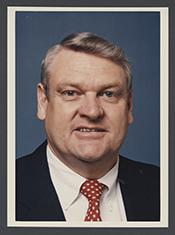
Historical · U.S. House · Georgia · District 8
Mac Collins
Former U.S. Representative · Georgia District 8 · 1993–2005 · Republican
Mac Collins represented Georgia's District 8 in the United States House of Representatives (1993–2005) for the Republican party. The page below collects sourced biographical facts, term history, committee roles, and provenance for Collins.
Bioguide ID: C000640
Key facts
- Full name
- Mac Collins
- State
- Georgia
- District
- District 8
- Party
- Republican
- House service
- 1993–2005
- First House term
- 1993
- Status
- Left office
- Current term ends
- —
- Born
- 1944
- Bioguide ID
- C000640
- Committee assignments
- —
- Dataset version
- 1.20260605
Biographical narrative
902 words · sourced from the Wikipedia REST extract
Michael Allen "Mac" Collins was an American businessman and politician who served as a Republican member of the United States House of Representatives from 1993 to 2005. He represented Georgia's 8th congressional district and previously served Georgia's 3rd congressional district from 1993 to 2003. Collins was known for his involvement in various legislative committees and his focus on issues related to commerce, tax reform, and technology. After leaving Congress, he made an unsuccessful bid for the United States Senate in 2004 and later attempted to return to the House in 2006. Collins passed away on November 20, 2018.
Early life and career
Mac Collins was born on October 15, 1944, in Jackson, Georgia. He grew up in a family engaged in local business, as his father operated a concrete products company. Following his high school graduation, Collins joined his father's business, where he played a significant role in expanding it into a ready-mix concrete company. His mother was notable for being the first woman to serve on the city council of Flovilla, Georgia, which may have influenced Collins's early interest in public service and community involvement.
Collins attended public schools in his youth and later served in the Georgia Army National Guard from 1964 to 1970. His military service contributed to his understanding of civic duty and leadership, which would later inform his political career. In 1977, Collins began his political journey by being elected to the Butts County Commission. His colleagues quickly recognized his leadership abilities, electing him as chairman, a position he held for two terms. In 1980, Collins left the commission when he changed his party affiliation from Democratic to Republican, a significant shift that marked the beginning of his alignment with the Republican Party.
After his departure from the Butts County Commission, Collins faced challenges in his political career, losing two elections for the Georgia State Senate. However, he persevered and was elected to the Senate in 1988, representing a district in Henry County, located south of Atlanta. During his tenure in the state legislature, he served two terms, gaining valuable experience in governance and legislative processes.
House tenure
Collins's entry into the U.S. House of Representatives came during a period of significant political change in Georgia. Following the 1990s round of redistricting, the Democratic-controlled state legislature reconfigured congressional districts, which included the dismantling of Newt Gingrich's former 6th District. This redistricting shifted much of the territory south of Atlanta, including Collins's home, into the newly drawn 3rd District, which was then represented by five-term Democrat Richard Ray.
In 1992, Collins entered the race for the 3rd District seat, where he faced Paul Broun in the Republican primary and subsequently Richard Ray in the general election. Collins won the primary and then defeated Ray by a margin of nearly ten points, marking the beginning of his six terms in Congress. His electoral success continued in subsequent elections, where he consistently defeated Democratic challengers. Notably, in 1994, he won against Democrat Fred Overby with a significant margin, and in 1998, he ran unopposed for re-election.
After the 2000 redistricting, Collins was placed in the 8th District, where he continued to secure victories, including a notable re-election in 2002 with a wide margin against Democrat Angelos Petrakopoulos. In 2004, Collins chose not to seek re-election for the House, instead opting to run for a vacant U.S. Senate seat.
Legislative focus and committees
During his tenure in the U.S. House of Representatives, Collins was actively involved in several key committees and held leadership positions within the Republican Party. He served on the Ways and Means Committee, which is responsible for taxation and other revenue-related matters, and was appointed as Deputy Whip for the Republican Party. Additionally, he was selected by the Speaker of the House to serve on the United States House Permanent Select Committee on Intelligence, which oversees the nation's intelligence activities.
Collins's legislative focus included a range of issues such as commerce, tax reform, foreign trade, international finance, and technology legislation. He was involved in sponsoring the passage of two notable bills during his time in Congress. One bill designated a federal building and courthouse in Newnan, Georgia, in honor of Lewis R. Morgan, while the other amended provisions related to life insurance benefits under federal law.
Despite his active participation in legislative matters, Collins's role as Deputy Whip came to an end following the September 11 attacks in 2001. He expressed his opposition to the establishment of the Transportation Security Administration (TSA), which led to a shift in his responsibilities within the party.
In 2004, Collins sought the Republican nomination for the U.S. Senate seat left vacant by Senator Zell Miller's retirement. However, he was unsuccessful in the primary, finishing behind Johnny Isakson and Herman Cain. Following his Senate campaign, Collins attempted to return to the House in 2006, running against Democrat Jim Marshall in a competitive race that garnered significant attention and funding. Despite a strong campaign, Collins narrowly lost the election.
Collins's personal life included a long marriage of 54 years and four children, one of whom, Mike Collins, later became a U.S. Representative for Georgia's 10th congressional district. Mac Collins passed away on November 20, 2018, in Flovilla, Georgia, at the age of 74. His legacy includes his contributions to Georgia politics and his service in the U.S. Congress, where he focused on various legislative issues impacting his constituents and the nation.
Notable legislation
Sponsored and co-sponsored legislation for Mac Collins is pending operator curation. The biographical narrative above carries the same provenance trail until per-bill rows are written.
Sources
- [1]https://en.wikipedia.org/wiki/Mac_CollinsWikipedia · retrieved 2026-06-05
Notable quotes
Sourced quotes for Mac Collins are pending operator curation. Narrative-scope provenance remains attached below.
Sources
- [1]https://en.wikipedia.org/wiki/Mac_CollinsWikipedia · retrieved 2026-06-05
Key positions
Curated policy positions for Mac Collins are pending operator review. The biographical narrative above carries the same provenance trail until per-topic positions are written.
Sources
- [1]https://en.wikipedia.org/wiki/Mac_CollinsWikipedia · retrieved 2026-06-05
Terms served
- 1993–1995U.S. House · Term 1 · Republican
- 1995–1997U.S. House · Term 2 · Republican
- 1997–1999U.S. House · Term 3 · Republican
- 1999–2001U.S. House · Term 4 · Republican
- 2001–2003U.S. House · Term 5 · Republican
- 2003–2005U.S. House · Term 6 · Republican
Sources & provenance
Every attributable claim above carries a per-section [N] marker that resolves to the corresponding URL below. Each entry records the upstream provider, the canonical URL, and the timestamp at which the source was retrieved by the ingest pipeline.
Key facts
- https://bioguide.congress.gov/search/bio/C000640bioguide · retrieved 2026-06-05
- http://www.house.gov/maccollinshouse.gov · retrieved 2026-06-05
Biographical narrative
- https://en.wikipedia.org/wiki/Mac_Collinswikipedia · retrieved 2026-06-05
Find your representative
Every U.S. state elects representatives by district. Browse Georgia’s delegation, the full former-representative roster, or explore the role and term length.
Related on The Candidate
- Preceded by Billy EvansEarlier holder of the Georgia District 8 House seat · Democratic.Open
- Andrew SloanFormer U.S. Representative · Georgia District 1 · RepublicanOpen
- Anthony WayneFormer U.S. Representative · Georgia District 1Open
- Archibald MacIntyreFormer U.S. Representative · Georgia District 1 · DemocraticOpen
- Bo GinnFormer U.S. Representative · Georgia District 1 · DemocraticOpen
- Republican PartyFederal candidates and office holders on the Republican line.Open