
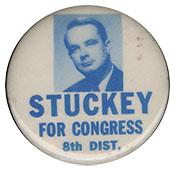
Historical · U.S. House · Georgia · District 8
Williamson Stuckey Jr.
Former U.S. Representative · Georgia District 8 · 1967–1977 · Democratic
Williamson Stuckey Jr. represented Georgia's District 8 in the United States House of Representatives (1967–1977) for the Democratic party. The page below collects sourced biographical facts, term history, committee roles, and provenance for Jr..
Bioguide ID: S001039
Key facts
- Full name
- Williamson Stuckey Jr.
- State
- Georgia
- District
- District 8
- Party
- Democratic
- House service
- 1967–1977
- First House term
- 1967
- Status
- Left office
- Current term ends
- —
- Born
- 1935
- Bioguide ID
- S001039
- Committee assignments
- —
- Dataset version
- 1.20260605
Biographical narrative
868 words · sourced from the Wikipedia REST extract
Williamson Sylvester Stuckey Jr., commonly known as Bill Stuckey, is a former American politician and businessman who served as a U.S. Representative for Georgia's 8th congressional district from 1967 until 1977. A member of the Democratic Party, Stuckey's tenure in Congress spanned five terms, during which he was involved in various legislative efforts and represented the interests of his constituents. Before his political career, he was deeply rooted in the family business, which played a significant role in his life and career.
Early life and career
Bill Stuckey was born on May 25, 1935, in Eastman, Georgia. He grew up in a family that was actively engaged in business, as his father, W. S. Stuckey Sr., founded the Stuckey's chain of gift shops, a well-known retail brand that became synonymous with roadside stops across the Southern United States. This early exposure to entrepreneurship and retail would later influence Stuckey's career path.
Stuckey completed his primary education at Woodward Academy, graduating in 1952. He then pursued higher education at the University of Georgia, where he earned a Bachelor of Business Administration (B.B.A.) in 1956, followed by a Bachelor of Laws (LL.B.) in 1959. His academic background provided him with a solid foundation in both business and law, equipping him with skills that would be beneficial in his future endeavors.
After completing his education, Stuckey took on leadership roles within his family's business. He became president and CEO of Stuckey's in 1985, overseeing the operations of the company and its various subsidiaries, including Stuckey Pecan Company, Stuckey Investments, and Stuckey Timberlands. His involvement in the family business not only solidified his understanding of commerce but also established his reputation as a businessman in Georgia. Stuckey remained active in the company until his retirement in 2019, at which point his daughter, Stephanie Stuckey, succeeded him as president and CEO.
House tenure
Bill Stuckey's political career began when he was elected to the United States House of Representatives in 1966, representing Georgia's 8th congressional district. His first term commenced on January 3, 1967, and he continued to serve in this capacity for a decade, being re-elected to four additional terms. Stuckey's tenure in Congress coincided with a period of significant social and political change in the United States, including the civil rights movement, the Vietnam War, and various domestic policy reforms.
During his time in office, Stuckey was part of the 90th United States Congress and the four succeeding Congresses. His election to Congress was indicative of the Democratic Party's strength in the South during this era, as well as the political dynamics that were evolving in the region. Stuckey's ability to secure re-election multiple times suggests that he maintained a level of support among his constituents, although specific details regarding his electoral margins and vote counts are not documented.
Stuckey chose not to seek re-election in 1976, concluding his congressional career on January 3, 1977. His decision not to run again marked the end of a significant chapter in his life, as he transitioned from public service back to the private sector and his family's business.
Legislative focus and committees
Throughout his congressional career, Bill Stuckey was involved in a range of legislative issues that reflected the interests and needs of his constituents in Georgia. While specific details about the bills he sponsored or co-sponsored are not provided, it is known that he was an active participant in the legislative process during a time of considerable national debate on various issues, including civil rights, economic policies, and social welfare programs.
As a member of the Democratic Party, Stuckey aligned with the party's broader goals of promoting social justice and economic equality. His background in business likely informed his views on economic development and job creation, which were critical issues for many constituents in his district. Stuckey's experience in the family business also positioned him to understand the challenges faced by small businesses and entrepreneurs, which may have influenced his legislative priorities.
In addition to his legislative work, Stuckey served on various committees during his time in Congress. These committees played a crucial role in shaping policy and overseeing the implementation of federal programs. While the specific committees on which he served are not detailed, members of Congress typically engage in committee work that aligns with their interests and the needs of their constituents. This involvement would have allowed Stuckey to advocate for issues pertinent to Georgia and to contribute to national discussions on key topics.
Stuckey's legislative focus and committee assignments would have provided him with opportunities to collaborate with colleagues from both parties, fostering relationships that could facilitate bipartisan efforts on important legislation. His tenure in Congress was marked by a commitment to representing the interests of his district while navigating the complexities of national governance.
In summary, Bill Stuckey's career as a U.S. Representative was characterized by his dedication to public service and his background in business. His five terms in Congress allowed him to engage with significant legislative issues and represent the people of Georgia's 8th congressional district during a transformative period in American history. After leaving Congress, he returned to the family business, where he continued to influence the retail landscape until his retirement.
Notable legislation
Sponsored and co-sponsored legislation for Williamson Stuckey Jr. is pending operator curation. The biographical narrative above carries the same provenance trail until per-bill rows are written.
Sources
- [1]https://en.wikipedia.org/wiki/W._S._Stuckey_Jr.Wikipedia · retrieved 2026-06-05
Notable quotes
Sourced quotes for Williamson Stuckey Jr. are pending operator curation. Narrative-scope provenance remains attached below.
Sources
- [1]https://en.wikipedia.org/wiki/W._S._Stuckey_Jr.Wikipedia · retrieved 2026-06-05
Key positions
Curated policy positions for Williamson Stuckey Jr. are pending operator review. The biographical narrative above carries the same provenance trail until per-topic positions are written.
Sources
- [1]https://en.wikipedia.org/wiki/W._S._Stuckey_Jr.Wikipedia · retrieved 2026-06-05
Terms served
- 1967–1969U.S. House · Term 1 · Democratic
- 1969–1971U.S. House · Term 2 · Democratic
- 1971–1973U.S. House · Term 3 · Democratic
- 1973–1975U.S. House · Term 4 · Democratic
- 1975–1977U.S. House · Term 5 · Democratic
Sources & provenance
Every attributable claim above carries a per-section [N] marker that resolves to the corresponding URL below. Each entry records the upstream provider, the canonical URL, and the timestamp at which the source was retrieved by the ingest pipeline.
Key facts
- https://bioguide.congress.gov/search/bio/S001039bioguide · retrieved 2026-06-05
- https://www.govtrack.us/congress/members/410495govtrack · retrieved 2026-06-05
Biographical narrative
- https://en.wikipedia.org/wiki/W._S._Stuckey_Jr.wikipedia · retrieved 2026-06-05
Find your representative
Every U.S. state elects representatives by district. Browse Georgia’s delegation, the full former-representative roster, or explore the role and term length.
Related on The Candidate
- Preceded by James TutenEarlier holder of the Georgia District 8 House seat · Democratic.Open
- Succeeded by Billy EvansLater holder of the Georgia District 8 House seat · Democratic.Open
- Andrew SloanFormer U.S. Representative · Georgia District 1 · RepublicanOpen
- Anthony WayneFormer U.S. Representative · Georgia District 1Open
- Archibald MacIntyreFormer U.S. Representative · Georgia District 1 · DemocraticOpen
- Bo GinnFormer U.S. Representative · Georgia District 1 · DemocraticOpen