
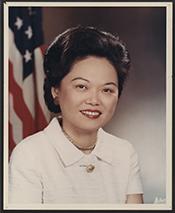
Historical · U.S. House · Hawaii · District 2
Patsy Mink
Former U.S. Representative · Hawaii District 2 · 1965–2002 · Democratic
Patsy Mink represented Hawaii's District 2 in the United States House of Representatives (1965–2002) for the Democratic party. The page below collects sourced biographical facts, term history, committee roles, and provenance for Mink.
Bioguide ID: M000797
Key facts
- Full name
- Patsy Mink
- State
- Hawaii
- District
- District 2
- Party
- Democratic
- House service
- 1965–2002
- First House term
- 1965
- Status
- Left office
- Current term ends
- —
- Born
- 1927
- Bioguide ID
- M000797
- Committee assignments
- —
- Dataset version
- 1.20260605
Biographical narrative
1,064 words · sourced from the Wikipedia REST extract
Patsy T. Mink was an influential American attorney and politician who served as a U.S. Representative from Hawaii for a total of 24 years. A member of the Democratic Party, she was notable for being the first woman of color and the first Asian-American woman elected to Congress. Throughout her career, Mink was recognized for her advocacy in women's rights and education, significantly impacting legislation in these areas. Her tenure in the U.S. House of Representatives spanned from 1965 to 1977 and again from 1990 until her death in 2002.
Early life and career
Patsy Matsu Takemoto was born on December 6, 1927, in Hāmākua Poko, a sugar plantation camp near Paia on the island of Maui, Hawaii. She was a sansei, a third-generation Japanese American, and her family background played a significant role in shaping her identity and future endeavors. Her mother, Mitama Tateyama, was a homemaker, while her father, Suematsu Takemoto, was a civil engineer and the first Japanese American to graduate from the University of Hawaiʻi at Mānoa with a degree in civil engineering. Suematsu faced discrimination in his career, often being overlooked for promotions in favor of white Americans, which instilled in Mink a keen awareness of social justice issues from a young age.
Mink's educational journey began at Hāmākua Poko Grammar School, and she later attended the Kaunoa English Standard School. She graduated as valedictorian from Maui High School in 1944. Following high school, she enrolled at the University of Hawaiʻi at Mānoa for two years before transferring to the University of Nebraska. There, she encountered racial discrimination, which motivated her to advocate against segregation policies. Due to health issues, Mink returned to Hawaii to complete her education.
Initially aspiring to enter medical school, she applied to multiple institutions but faced rejection. Following a suggestion from her employer, she shifted her focus to law and was accepted into the University of Chicago Law School in 1948. During her time there, she married John Francis Mink, a graduate student in geology. After graduating in 1951, Mink struggled to find employment due to her marital status and motherhood. In 1953, with the help of her father, she opened her own law practice in Hawaii.
Mink's political career began when she became an attorney for the Hawaiian territorial legislature in 1955. She made history in 1956 by winning a seat in the territorial House of Representatives, becoming the first Japanese-American woman to serve in that body. Two years later, she was elected to the territorial Senate, further solidifying her role as a trailblazer in Hawaiian politics. In 1960, Mink gained national attention for her speech supporting civil rights at the Democratic National Convention in Los Angeles. The following year, she became the first Asian-American woman elected to a state legislature in the United States when she was elected to the Hawaii State Senate.
House tenure
Mink's congressional career began in 1965 when she won a seat in the U.S. House of Representatives, representing Hawaii's at-large congressional district. She served in this capacity until 1977, after which she took a hiatus from Congress. In 1990, she returned to the House, this time representing Hawaii's second congressional district, and continued to serve until her death in 2002. Over the course of her 13 terms, Mink became known for her commitment to advancing social justice and educational initiatives.
During her initial tenure in Congress, Mink was instrumental in introducing significant legislation, particularly in the realm of education and women's rights. She played a pivotal role in the Early Childhood Education Act, which included the first federal child-care bill. Additionally, she was involved in the Elementary and Secondary Education Act of 1965, which aimed to improve educational opportunities across the nation.
Mink's advocacy extended beyond education; she was also a vocal opponent of discrimination. In 1970, she became the first person to oppose a Supreme Court nominee based on discrimination against women. Her commitment to transparency and accountability in government led her to initiate a lawsuit that resulted in significant changes to presidential authority under the Freedom of Information Act in 1971.
In 1972, Mink co-authored the Title IX Amendment of the Higher Education Act, which aimed to eliminate gender discrimination in education. This legislation was later renamed the Patsy T. Mink Equal Opportunity in Education Act in 2002, honoring her contributions to advancing educational equity.
Mink's political aspirations extended beyond Congress; she was the first East Asian-American woman to seek the presidential nomination of the Democratic Party in the 1972 election, running as an anti-war candidate. After her first congressional tenure, she served as the Assistant Secretary of State for Oceans and International Environmental and Scientific Affairs from 1977 to 1979. Following this role, she returned to Hawaii, where she was elected to the Honolulu City Council and served as its chair until 1985.
Legislative focus and committees
Throughout her legislative career, Mink was dedicated to issues related to education, women's rights, and social justice. Her work on the Title IX Amendment is perhaps one of her most enduring legacies, as it has had a profound impact on gender equality in education. The amendment prohibits discrimination on the basis of sex in any federally funded education program or activity, fundamentally changing the landscape of educational opportunities for women and girls across the United States.
In addition to her work on Title IX, Mink was involved in various committees during her time in the House. She served on committees that focused on education, labor, and civil rights, where she continued to advocate for policies that promoted equity and access. Her legislative efforts often intersected with broader social movements, reflecting her commitment to civil rights and the empowerment of marginalized communities.
Mink's tenure in Congress was marked by her ability to navigate complex political landscapes while remaining steadfast in her advocacy for those who faced discrimination. Her legislative initiatives were often groundbreaking, addressing issues that had been overlooked or marginalized in previous legislative discussions. Her work not only advanced the rights of women and children but also laid the groundwork for future generations of activists and lawmakers.
In summary, Patsy T. Mink's legacy as a U.S. Representative is characterized by her pioneering spirit and dedication to social justice. Her contributions to education and women's rights have left an indelible mark on American society, and her role as a trailblazer continues to inspire future leaders.
Notable legislation
Sponsored and co-sponsored legislation for Patsy Mink is pending operator curation. The biographical narrative above carries the same provenance trail until per-bill rows are written.
Sources
- [1]https://en.wikipedia.org/wiki/Patsy_MinkWikipedia · retrieved 2026-06-05
Notable quotes
Sourced quotes for Patsy Mink are pending operator curation. Narrative-scope provenance remains attached below.
Sources
- [1]https://en.wikipedia.org/wiki/Patsy_MinkWikipedia · retrieved 2026-06-05
Key positions
Curated policy positions for Patsy Mink are pending operator review. The biographical narrative above carries the same provenance trail until per-topic positions are written.
Sources
- [1]https://en.wikipedia.org/wiki/Patsy_MinkWikipedia · retrieved 2026-06-05
Terms served
- 1965–1967U.S. House · Term 1 · Democratic
- 1967–1969U.S. House · Term 2 · Democratic
- 1969–1971U.S. House · Term 3 · Democratic
- 1971–1973U.S. House · Term 4 · Democratic
- 1973–1975U.S. House · Term 5 · Democratic
- 1975–1977U.S. House · Term 6 · Democratic
- 1990–1991U.S. House · Term 7 · Democratic
- 1991–1993U.S. House · Term 8 · Democratic
- 1993–1995U.S. House · Term 9 · Democratic
- 1995–1997U.S. House · Term 10 · Democratic
- 1997–1999U.S. House · Term 11 · Democratic
- 1999–2001U.S. House · Term 12 · Democratic
- 2001–2002U.S. House · Term 13 · Democratic
Sources & provenance
Every attributable claim above carries a per-section [N] marker that resolves to the corresponding URL below. Each entry records the upstream provider, the canonical URL, and the timestamp at which the source was retrieved by the ingest pipeline.
Key facts
- https://bioguide.congress.gov/search/bio/M000797bioguide · retrieved 2026-06-05
- https://www.govtrack.us/congress/members/400554govtrack · retrieved 2026-06-05
Biographical narrative
- https://en.wikipedia.org/wiki/Patsy_Minkwikipedia · retrieved 2026-06-05
Find your representative
Every U.S. state elects representatives by district. Browse Hawaii’s delegation, the full former-representative roster, or explore the role and term length.
Related on The Candidate
- Succeeded by Tulsi GabbardLater holder of the Hawaii District 2 House seat · Democratic.Open
- Cecil HeftelFormer U.S. Representative · Hawaii District 1 · DemocraticOpen
- Charles DjouFormer U.S. Representative · Hawaii District 1 · RepublicanOpen
- Colleen HanabusaFormer U.S. Representative · Hawaii District 1 · DemocraticOpen
- Mark TakaiFormer U.S. Representative · Hawaii District 1 · DemocraticOpen
- Democratic PartyFederal candidates and office holders on the Democratic line.Open