
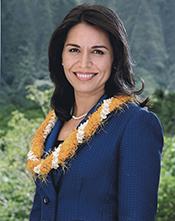
Historical · U.S. House · Hawaii · District 2
Tulsi Gabbard
Former U.S. Representative · Hawaii District 2 · 2013–2021 · Democratic
Tulsi Gabbard represented Hawaii's District 2 in the United States House of Representatives (2013–2021) for the Democratic party. The page below collects sourced biographical facts, term history, committee roles, and provenance for Gabbard.
Bioguide ID: G000571
Key facts
- Full name
- Tulsi Gabbard
- State
- Hawaii
- District
- District 2
- Party
- Democratic
- House service
- 2013–2021
- First House term
- 2013
- Status
- Left office
- Current term ends
- —
- Born
- 1981
- Bioguide ID
- G000571
- Committee assignments
- —
- Dataset version
- 1.20260604
Biographical narrative
1,033 words · sourced from the Wikipedia REST extract
Tulsi Gabbard is a former U.S. Representative who served Hawaii's 2nd congressional district from 2013 until 2021. A member of the Democratic Party for most of her political career, she has also held positions as a military officer and a political activist. Gabbard is notable for being the first Samoan American and Hindu American to serve in the U.S. Congress. Her political journey has included a range of roles, from local to national politics, and she has been involved in various military and civic activities throughout her life.
Early life and career
Tulsi Gabbard was born on April 12, 1981, in Leloaloa, located on the main island of Tutuila in American Samoa. She is the fourth of five children born to Mike Gabbard and Carol Gabbard (née Porter). When she was two years old, her family relocated to Hawaii, where they had previously lived in the late 1970s. Gabbard's father is of Samoan and European descent, while her mother hails from Indiana and grew up in Michigan. The name "Tulsi" is derived from the herb tulasi, which has significant cultural and spiritual importance.
Gabbard spent her formative years in Honolulu, where her parents owned a vegetarian restaurant called The Natural Deli. Her upbringing included activities such as surfing, martial arts, and yoga. Gabbard was primarily home-schooled, with the exception of two years spent at a girls' school in the Philippines. During her childhood, she was introduced to spiritual concepts, including karma, through the ancient Indian text, the Bhagavad Gita. As a teenager, she adopted the Hindu faith, which has influenced her personal and political life.
In her early adulthood, Gabbard was involved in various initiatives, including working for Stand Up For America (SUFA), an organization founded by her father in response to the September 11 attacks. Her father later entered local politics, serving on the Honolulu City Council. Gabbard also worked with The Alliance for Traditional Marriage and Values, a political action committee focused on opposing same-sex marriage. Additionally, she briefly worked as an educator with the Healthy Hawai'i Coalition, which aimed to protect the state's natural environment, and served as a self-employed martial arts instructor.
At the age of 21, Gabbard made a significant political move by dropping out of Leeward Community College, where she was studying television production, to run for the Hawaii state legislature. In 2002, she became the youngest woman ever elected to the Hawaii State Legislature. Her political career continued to evolve, and in 2006, her father was elected as a Hawaii state senator. Gabbard graduated from Hawaii Pacific University in 2009 with a Bachelor of Science degree in business administration, focusing on international business.
House tenure
Tulsi Gabbard was elected to the U.S. House of Representatives in 2012, representing Hawaii's 2nd congressional district. Her first term began in January 2013, and she served a total of four terms in the House until her departure in January 2021. Throughout her tenure, Gabbard distinguished herself as a prominent figure in Congress, particularly known for her military background and her advocacy on various issues.
During her time in the House, Gabbard served on the House Armed Services Committee and the House Foreign Affairs Committee. Her military experience informed her legislative priorities, as she supported efforts to combat Islamic extremism while expressing opposition to U.S. military intervention in the Syrian civil war. Gabbard's stance on foreign policy was characterized by an anti-interventionist approach, which she articulated during her campaign for the Democratic presidential nomination in 2020.
In addition to her committee assignments, Gabbard served on the Armed Services Committee's Subcommittee on Intelligence, which focused on military intelligence and counterterrorism efforts. Her military service, which included deployment to Iraq, provided her with a unique perspective on national security issues, influencing her legislative actions and public statements.
Gabbard's political career also included a notable role as vice-chair of the Democratic National Committee from 2013 to 2016. However, she resigned from this position to endorse Bernie Sanders for the 2016 Democratic presidential nomination. This decision highlighted her willingness to break from party lines when she believed strongly in a particular cause or candidate.
In 2020, Gabbard announced her candidacy for the presidency, running in the Democratic Party primaries. Her campaign focused on anti-interventionist policies and populist themes. After a period of campaigning, she suspended her campaign and endorsed Joe Biden in March 2020. Following her departure from Congress in January 2021, Gabbard's political affiliations shifted, leading her to take more conservative stances on various issues.
Legislative focus and committees
Throughout her congressional career, Tulsi Gabbard's legislative focus was shaped by her military background and her commitment to various social and foreign policy issues. As a member of the House Armed Services Committee, she was involved in discussions and decisions regarding military funding, national security, and defense policy. Her experience as a veteran informed her advocacy for veterans' issues and her support for military personnel.
Gabbard's opposition to U.S. military intervention in foreign conflicts was a defining aspect of her legislative agenda. She was vocal about her concerns regarding the implications of U.S. involvement in the Syrian civil war, advocating for diplomatic solutions rather than military action. This anti-interventionist stance resonated with a segment of the electorate that sought a reevaluation of U.S. foreign policy.
In addition to her work on military and foreign affairs, Gabbard's legislative priorities included environmental protection, healthcare reform, and civil rights. Her early involvement with the Healthy Hawai'i Coalition reflected her commitment to environmental issues, and she continued to advocate for policies aimed at preserving Hawaii's natural resources during her time in Congress.
Gabbard's tenure in the House was marked by her unique position as a member of Congress who identified as both a Samoan American and a Hindu American. This background contributed to her perspective on issues related to diversity and representation, and she often emphasized the importance of inclusivity in her public statements and legislative efforts.
In summary, Tulsi Gabbard's congressional career was characterized by her military service, her advocacy for anti-interventionist foreign policy, and her commitment to various social issues. Her tenure in the U.S. House of Representatives reflects a blend of her personal experiences and her dedication to serving her constituents in Hawaii.
Notable legislation
Sponsored and co-sponsored legislation for Tulsi Gabbard is pending operator curation. The biographical narrative above carries the same provenance trail until per-bill rows are written.
Sources
- [1]https://en.wikipedia.org/wiki/Tulsi_GabbardWikipedia · retrieved 2026-06-04
Notable quotes
Sourced quotes for Tulsi Gabbard are pending operator curation. Narrative-scope provenance remains attached below.
Sources
- [1]https://en.wikipedia.org/wiki/Tulsi_GabbardWikipedia · retrieved 2026-06-04
Key positions
Curated policy positions for Tulsi Gabbard are pending operator review. The biographical narrative above carries the same provenance trail until per-topic positions are written.
Sources
- [1]https://en.wikipedia.org/wiki/Tulsi_GabbardWikipedia · retrieved 2026-06-04
Terms served
- 2013–2015U.S. House · Term 1 · Democratic
- 2015–2017U.S. House · Term 2 · Democratic
- 2017–2019U.S. House · Term 3 · Democratic
- 2019–2021U.S. House · Term 4 · Democratic
Sources & provenance
Every attributable claim above carries a per-section [N] marker that resolves to the corresponding URL below. Each entry records the upstream provider, the canonical URL, and the timestamp at which the source was retrieved by the ingest pipeline.
Key facts
- https://bioguide.congress.gov/search/bio/G000571bioguide · retrieved 2026-06-04
- https://gabbard.house.govhouse.gov · retrieved 2026-06-04
Biographical narrative
- https://en.wikipedia.org/wiki/Tulsi_Gabbardwikipedia · retrieved 2026-06-04
Find your representative
Every U.S. state elects representatives by district. Browse Hawaii’s delegation, the full former-representative roster, or explore the role and term length.
Related on The Candidate
- Preceded by Patsy MinkEarlier holder of the Hawaii District 2 House seat · Democratic.Open
- Succeeded by Kaialiʻi KaheleLater holder of the Hawaii District 2 House seat · Democratic.Open
- Cecil HeftelFormer U.S. Representative · Hawaii District 1 · DemocraticOpen
- Charles DjouFormer U.S. Representative · Hawaii District 1 · RepublicanOpen
- Colleen HanabusaFormer U.S. Representative · Hawaii District 1 · DemocraticOpen
- Mark TakaiFormer U.S. Representative · Hawaii District 1 · DemocraticOpen