
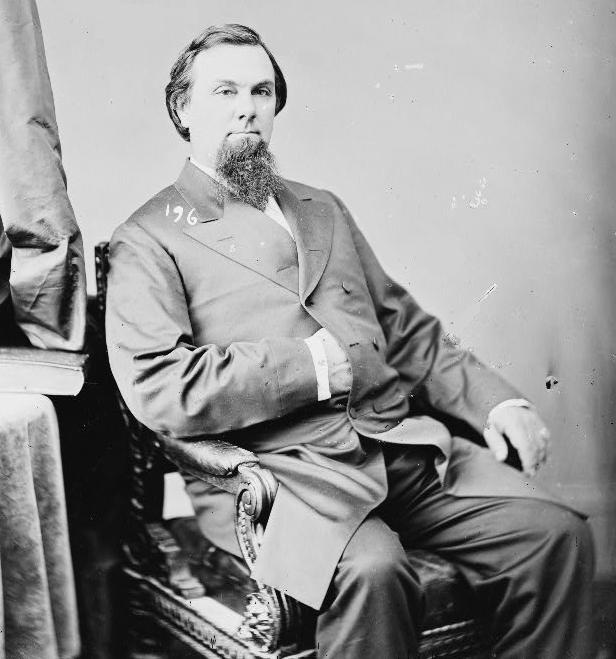
Historical · U.S. House · Illinois · District 13
John Crebs
Former U.S. Representative · Illinois District 13 · 1869–1873 · Democratic
John Crebs represented Illinois's District 13 in the United States House of Representatives (1869–1873) for the Democratic party. The page below collects sourced biographical facts, term history, committee roles, and provenance for Crebs.
Bioguide ID: C000900
Key facts
- Full name
- John Crebs
- State
- Illinois
- District
- District 13
- Party
- Democratic
- House service
- 1869–1873
- First House term
- 1869
- Status
- Left office
- Current term ends
- —
- Born
- 1830
- Bioguide ID
- C000900
- Committee assignments
- —
- Dataset version
- 1.20260606
Biographical narrative
937 words · sourced from the Wikipedia REST extract
John Crebs was a notable figure in American history, serving as a U.S. Representative from Illinois's 13th congressional district during the late 19th century. His career was marked by significant involvement in both military and political spheres, particularly during the tumultuous period of the American Civil War and the subsequent Reconstruction era. A member of the Democratic Party, Crebs's tenure in the House of Representatives spanned from 1869 to 1873, during which he contributed to the legislative processes of the time. After his political career, he returned to his legal practice until his passing in 1890.
Early life and career
John Crebs was born on April 9, 1830, in Middleburg, Virginia. His early life was shaped by his family's move to Illinois in 1837, when he was just a child. Settling in White County, Crebs's formative years were spent in a region that was rapidly developing during the westward expansion of the United States. He received his education through public schools, which laid the foundation for his future endeavors. Demonstrating an early interest in law, Crebs pursued legal studies and was admitted to the bar in 1852. This achievement marked the beginning of his professional career as a lawyer in White County, where he established himself in the local legal community.
As the nation approached the Civil War, Crebs's life took a significant turn. The conflict, which began in 1861, prompted many individuals to take up arms in defense of their beliefs and the Union. In 1862, Crebs was commissioned as a lieutenant colonel in the 87th Illinois Infantry, a regiment that would see considerable action in various campaigns throughout the war. His military service included participation in key battles and operations in the Western Theater, notably the Siege of Corinth in Mississippi and the Vicksburg Campaign. These engagements were critical in the Union's efforts to gain control over strategic locations in the South.
Crebs's military career was marked by his leadership abilities, which eventually led to his promotion to brigade commander of cavalry units in the Department of the Gulf. His experiences during the war not only shaped his character but also influenced his later political career, as many veterans sought to translate their military service into public service in the post-war era.
House tenure
Following the conclusion of the Civil War, John Crebs returned to White County, where he resumed his legal practice. However, his experiences and connections from the war likely influenced his decision to enter politics. In 1868, he ran for a seat in the U.S. House of Representatives, representing the Democratic Party. His campaign was successful, and he was elected to the Forty-first Congress, beginning his first term on March 4, 1869. Crebs's election was notable as he defeated the incumbent, Green Raum, who was also a former officer in the Union Army. This victory reflected the shifting political landscape in the aftermath of the Civil War, as many voters were looking for representatives who understood the complexities of the nation's recovery.
Crebs served in the House during a period characterized by significant legislative challenges, including the implementation of Reconstruction policies aimed at rebuilding the South and integrating formerly enslaved individuals into society. His tenure in the Forty-second Congress continued until March 3, 1873. During this time, he participated in the legislative discussions and decisions that shaped the future of the nation in the wake of the Civil War.
Despite his initial success, Crebs faced challenges in his political career. He sought renomination in 1872 but was unsuccessful in his bid to continue serving in Congress. This loss marked the end of his formal political career, but it did not diminish his commitment to public service. After leaving office, Crebs returned to his legal practice, where he continued to contribute to his community until his death.
Legislative focus and committees
During his time in the House of Representatives, John Crebs was involved in various legislative matters that reflected the priorities and challenges of the post-Civil War era. While specific details regarding the bills he sponsored or the committees he served on are not provided, it is reasonable to infer that his background as a military officer and lawyer influenced his legislative focus. Representatives of this period often dealt with issues related to veterans' affairs, civil rights, and economic recovery, all of which were critical to the nation’s healing process after the war.
Crebs's military service likely provided him with a unique perspective on the needs of veterans and their families, as many former soldiers were seeking assistance and support in reintegrating into civilian life. Additionally, as a member of the Democratic Party, he would have been part of the broader discussions regarding the political and social implications of Reconstruction policies, which aimed to address the rights of newly freed individuals and the rebuilding of Southern states.
After his congressional tenure, Crebs returned to his legal practice in White County, where he continued to engage with the community and contribute to local governance. His commitment to his profession and his community remained strong until his passing on June 26, 1890, in Carmi, Illinois. He was interred in Maple Ridge Cemetery, leaving behind a legacy as a soldier, lawyer, and public servant who navigated the complexities of a nation in transition.
Crebs's life and career illustrate the interconnectedness of military service and political engagement during a pivotal time in American history, reflecting the experiences of many who sought to shape the nation in the aftermath of conflict. His contributions, both in the military and in Congress, remain a part of the historical narrative of the United States during the 19th century.
Notable legislation
Sponsored and co-sponsored legislation for John Crebs is pending operator curation. The biographical narrative above carries the same provenance trail until per-bill rows are written.
Sources
- [1]https://en.wikipedia.org/wiki/John_M._CrebsWikipedia · retrieved 2026-06-06
Notable quotes
Sourced quotes for John Crebs are pending operator curation. Narrative-scope provenance remains attached below.
Sources
- [1]https://en.wikipedia.org/wiki/John_M._CrebsWikipedia · retrieved 2026-06-06
Key positions
Curated policy positions for John Crebs are pending operator review. The biographical narrative above carries the same provenance trail until per-topic positions are written.
Sources
- [1]https://en.wikipedia.org/wiki/John_M._CrebsWikipedia · retrieved 2026-06-06
Terms served
- 1869–1871U.S. House · Term 1 · Democratic
- 1871–1873U.S. House · Term 2 · Democratic
Sources & provenance
Every attributable claim above carries a per-section [N] marker that resolves to the corresponding URL below. Each entry records the upstream provider, the canonical URL, and the timestamp at which the source was retrieved by the ingest pipeline.
Key facts
- https://bioguide.congress.gov/search/bio/C000900bioguide · retrieved 2026-06-06
- https://www.govtrack.us/congress/members/403012govtrack · retrieved 2026-06-06
Biographical narrative
- https://en.wikipedia.org/wiki/John_M._Crebswikipedia · retrieved 2026-06-06
Find your representative
Every U.S. state elects representatives by district. Browse Illinois’s delegation, the full former-representative roster, or explore the role and term length.
Related on The Candidate
- Preceded by Green RaumEarlier holder of the Illinois District 13 House seat · Republican.Open
- Succeeded by John McNultaLater holder of the Illinois District 13 House seat · Republican.Open
- Abner TaylorFormer U.S. Representative · Illinois District 1 · RepublicanOpen
- Adam SnyderFormer U.S. Representative · Illinois District 1 · DemocraticOpen
- Arthur MitchellFormer U.S. Representative · Illinois District 1 · DemocraticOpen
- Bennett StewartFormer U.S. Representative · Illinois District 1 · DemocraticOpen