
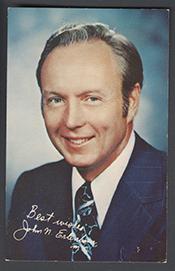
Historical · U.S. House · Illinois · District 13
John Erlenborn
Former U.S. Representative · Illinois District 13 · 1965–1985 · Republican
John Erlenborn represented Illinois's District 13 in the United States House of Representatives (1965–1985) for the Republican party. The page below collects sourced biographical facts, term history, committee roles, and provenance for Erlenborn.
Bioguide ID: E000204
Key facts
- Full name
- John Erlenborn
- State
- Illinois
- District
- District 13
- Party
- Republican
- House service
- 1965–1985
- First House term
- 1965
- Status
- Left office
- Current term ends
- —
- Born
- 1927
- Bioguide ID
- E000204
- Committee assignments
- —
- Dataset version
- 1.20260605
Biographical narrative
976 words · sourced from the Wikipedia REST extract
John N. Erlenborn was an American lawyer and politician who served as a Republican member of the U.S. House of Representatives, representing Illinois's 14th congressional district, which was later redistricted to the 13th district. His congressional career spanned two decades, during which he was elected to ten consecutive terms from 1965 until 1985. Erlenborn's legislative tenure was marked by significant national events and transformations, reflecting the evolving political landscape of the United States during the latter half of the 20th century. After leaving Congress, he continued to contribute to the legal field as an educator and board member for various organizations.
Early life and career
John N. Erlenborn was born on February 8, 1927, in Chicago, Illinois. Growing up in a vibrant urban environment, he attended Immaculate Conception High School located in Elmhurst, Illinois. This educational foundation set the stage for his further academic pursuits. He went on to study at Loyola University Chicago, where he received a well-rounded education that would later inform his career in law and politics. Following his undergraduate studies, Erlenborn attended the Loyola University Chicago School of Law, earning his law degree and preparing himself for a career in the legal profession.
Before entering politics, Erlenborn practiced law, which provided him with a strong understanding of legal principles and the workings of government. His legal background would later influence his approach to legislation and public service. As a lawyer, he developed skills in advocacy and negotiation, which would prove valuable during his time in Congress.
Erlenborn's transition into politics was a natural progression given his legal expertise and interest in public service. He became involved in local Republican politics, aligning himself with the party's values and objectives. His commitment to public service and his understanding of legal matters positioned him as a suitable candidate for elected office.
House tenure
Erlenborn's congressional career began in January 1965 when he was elected to represent Illinois's 14th congressional district in the U.S. House of Representatives. His election came during a period of significant political change in the United States, as the country grappled with civil rights issues, the Vietnam War, and various social movements. Over the course of his ten consecutive terms, Erlenborn served in the 89th through the 98th U.S. Congress, navigating a complex legislative landscape.
During his time in office, Erlenborn participated in numerous debates and votes on key pieces of legislation. Notably, he voted against the Voting Rights Act of 1965, a landmark piece of legislation aimed at eliminating racial discrimination in voting. However, he supported the Civil Rights Act of 1968, which sought to address discrimination in housing and other areas. These votes illustrate the nuanced positions he held on civil rights issues during a transformative era in American history.
Erlenborn's legislative work extended beyond civil rights. He was involved in various committees and initiatives that addressed a wide range of issues affecting his constituents and the nation. His long tenure allowed him to build relationships with colleagues across the aisle and to influence policy decisions that would shape the future of Illinois and the United States.
Throughout his congressional career, Erlenborn was known for his commitment to his constituents. He worked to address local concerns and advocated for initiatives that would benefit the people of his district. His ability to connect with constituents and understand their needs was a hallmark of his time in office, contributing to his electoral success over the years.
Erlenborn's congressional career came to an end in January 1985 when he retired after serving in the 98th U.S. Congress. His departure marked the conclusion of two decades of public service, during which he had established himself as a prominent figure in Illinois politics.
Legislative focus and committees
During his time in the U.S. House of Representatives, John N. Erlenborn focused on a variety of legislative issues that reflected the interests and needs of his constituents. His legal background informed his approach to policy-making, allowing him to engage with complex issues effectively. Erlenborn's legislative priorities included civil rights, local economic development, and various social policies that impacted the lives of his constituents in Illinois.
In addition to his voting record on significant civil rights legislation, Erlenborn's involvement in committees allowed him to delve deeper into specific policy areas. While the exact committees he served on during his tenure are not detailed, it is common for members of Congress to participate in committees that align with their interests and the needs of their districts. These committees play a crucial role in shaping legislation, conducting hearings, and overseeing government functions.
Erlenborn's legislative focus also included economic issues, as he sought to promote initiatives that would foster growth and development in his district. This included advocating for policies that supported local businesses and addressed the economic challenges faced by his constituents. His efforts in this area were likely informed by his understanding of the legal and regulatory frameworks that impact economic activity.
After retiring from Congress, Erlenborn continued to contribute to the legal field as an adjunct faculty member at the Georgetown University Law Center. This role allowed him to share his knowledge and experience with the next generation of legal professionals, furthering his commitment to education and public service. Additionally, he served as a board member for the Legal Services Corporation from 1989 to 2001, where he contributed to efforts aimed at improving access to legal services for low-income individuals.
John N. Erlenborn passed away on October 30, 2005, at the age of 78, after suffering from Lewy body disease. His contributions to American politics and law, particularly during a transformative period in U.S. history, are preserved in the archives of Benedictine University, where many of his papers and materials from his time in office are held. His legacy continues to be a part of the historical narrative of Illinois politics and the U.S. Congress.
Notable legislation
Sponsored and co-sponsored legislation for John Erlenborn is pending operator curation. The biographical narrative above carries the same provenance trail until per-bill rows are written.
Sources
- [1]https://en.wikipedia.org/wiki/John_N._ErlenbornWikipedia · retrieved 2026-06-05
Notable quotes
Sourced quotes for John Erlenborn are pending operator curation. Narrative-scope provenance remains attached below.
Sources
- [1]https://en.wikipedia.org/wiki/John_N._ErlenbornWikipedia · retrieved 2026-06-05
Key positions
Curated policy positions for John Erlenborn are pending operator review. The biographical narrative above carries the same provenance trail until per-topic positions are written.
Sources
- [1]https://en.wikipedia.org/wiki/John_N._ErlenbornWikipedia · retrieved 2026-06-05
Terms served
- 1965–1967U.S. House · Term 1 · Republican
- 1967–1969U.S. House · Term 2 · Republican
- 1969–1971U.S. House · Term 3 · Republican
- 1971–1973U.S. House · Term 4 · Republican
- 1973–1975U.S. House · Term 5 · Republican
- 1975–1977U.S. House · Term 6 · Republican
- 1977–1979U.S. House · Term 7 · Republican
- 1979–1981U.S. House · Term 8 · Republican
- 1981–1983U.S. House · Term 9 · Republican
- 1983–1985U.S. House · Term 10 · Republican
Sources & provenance
Every attributable claim above carries a per-section [N] marker that resolves to the corresponding URL below. Each entry records the upstream provider, the canonical URL, and the timestamp at which the source was retrieved by the ingest pipeline.
Key facts
- https://bioguide.congress.gov/search/bio/E000204bioguide · retrieved 2026-06-05
- https://www.govtrack.us/congress/members/403891govtrack · retrieved 2026-06-05
Biographical narrative
- https://en.wikipedia.org/wiki/John_N._Erlenbornwikipedia · retrieved 2026-06-05
Find your representative
Every U.S. state elects representatives by district. Browse Illinois’s delegation, the full former-representative roster, or explore the role and term length.
Related on The Candidate
- Preceded by Marguerite ChurchEarlier holder of the Illinois District 13 House seat · Republican.Open
- Succeeded by Harris FawellLater holder of the Illinois District 13 House seat · Republican.Open
- Abner TaylorFormer U.S. Representative · Illinois District 1 · RepublicanOpen
- Adam SnyderFormer U.S. Representative · Illinois District 1 · DemocraticOpen
- Arthur MitchellFormer U.S. Representative · Illinois District 1 · DemocraticOpen
- Bennett StewartFormer U.S. Representative · Illinois District 1 · DemocraticOpen