
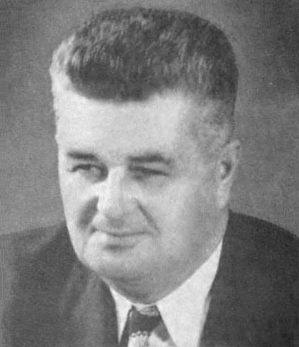
Historical · U.S. House · Illinois · District 14
Elmer Hoffman
Former U.S. Representative · Illinois District 14 · 1959–1965 · Republican
Elmer Hoffman represented Illinois's District 14 in the United States House of Representatives (1959–1965) for the Republican party. The page below collects sourced biographical facts, term history, committee roles, and provenance for Hoffman.
Bioguide ID: H000684
Key facts
- Full name
- Elmer Hoffman
- State
- Illinois
- District
- District 14
- Party
- Republican
- House service
- 1959–1965
- First House term
- 1959
- Status
- Left office
- Current term ends
- —
- Born
- 1899
- Bioguide ID
- H000684
- Committee assignments
- —
- Dataset version
- 1.20260605
Biographical narrative
920 words · sourced from the Wikipedia REST extract
Elmer Joseph Hoffman was an American businessman, law enforcement officer, and politician who served as a U.S. Representative for Illinois's 14th congressional district from 1959 to 1965. A member of the Republican Party, Hoffman had a diverse career that included military service during World War I, law enforcement roles in DuPage County, and a tenure as the State Treasurer of Illinois. His legislative contributions during his time in Congress included support for significant civil rights legislation.
Early life and career
Elmer Hoffman was born on July 7, 1899, on a farm located in DuPage County, near the city of Wheaton, Illinois. Growing up in a rural environment, he attended the public schools in Wheaton, where he likely received a foundational education that would serve him throughout his varied career. In 1917, at the age of 18, Hoffman enlisted in the United States Army, specifically in the Artillery Corps, where he served during World War I. His military service took him to France, where he participated in the conflict that shaped the course of the 20th century. The experiences he gained during the war may have influenced his later career choices and public service philosophy.
After returning from military service in 1919, Hoffman took on the responsibility of helping to operate his father's farm. In addition to agricultural work, he established a trucking firm, which he managed from 1919 until 1930. This entrepreneurial venture provided him with valuable business experience and insights into the economic challenges faced by local businesses.
Hoffman's career took a significant turn in 1930 when he began working in law enforcement. He was employed by the DuPage County sheriff's office, where he served until 1938. His commitment to public service led to his election as sheriff of DuPage County in 1939, a position he held until 1942. Following his initial term as sheriff, Hoffman continued his law enforcement career as chief deputy sheriff from 1943 to 1946. He returned to the role of sheriff from 1947 to 1950, demonstrating a sustained dedication to maintaining law and order in his community. In 1951, he transitioned to a role as a probation officer for the circuit and county courts of DuPage County, further showcasing his commitment to public service and the justice system.
House tenure
Hoffman's political career progressed when he was elected as the State Treasurer of Illinois in 1952. He was successful in his re-election bid in 1956, serving in that capacity until he transitioned to the U.S. Congress. His experience as State Treasurer likely provided him with a strong understanding of fiscal policy and state governance, which would be beneficial during his time in the House of Representatives.
In 1958, Hoffman was elected to the U.S. House of Representatives as a Republican, beginning his first term on January 3, 1959. He was subsequently re-elected to two additional terms, serving in total for three consecutive terms until January 3, 1965. During his time in Congress, Hoffman was a member of the Eighty-sixth Congress and the two succeeding Congresses. His legislative career was marked by active participation in various issues and policies that were significant during the 1960s.
Hoffman's tenure in the House occurred during a period of considerable social and political change in the United States. The civil rights movement was gaining momentum, and significant legislation aimed at addressing racial discrimination and promoting equality was being debated and passed. Hoffman participated in this legislative environment, casting votes in favor of critical civil rights measures, including the Civil Rights Acts of 1960 and 1964. These acts aimed to eliminate racial discrimination in various aspects of American life, including voting rights and public accommodations. Additionally, he supported the 24th Amendment to the U.S. Constitution, which prohibited poll taxes in federal elections, further demonstrating his commitment to expanding voting rights.
Despite his active role in Congress and support for significant legislative measures, Hoffman chose not to seek renomination for the 1964 elections, concluding his congressional career after three terms. His decision not to run again may have been influenced by various personal or political factors, though specific reasons are not documented.
Legislative focus and committees
During his time in the House of Representatives, Elmer Hoffman was involved in various legislative initiatives and discussions that reflected the priorities of his constituents and the broader national context. While specific committee assignments are not detailed in the available records, it can be inferred that his background in law enforcement and state finance likely informed his legislative priorities. His support for civil rights legislation indicates a willingness to engage with the pressing social issues of his time, aligning with the broader Republican Party platform that sought to address civil rights in the early 1960s.
Hoffman's legislative focus also encompassed issues related to local governance and community development, reflecting his roots in DuPage County and his understanding of the needs of his constituents. His experience as a businessman and law enforcement officer likely provided him with insights into the economic and social challenges faced by the communities he represented.
After leaving Congress, Hoffman returned to his home in Wheaton, Illinois, where he continued to engage with his community until his death on June 25, 1976. He was interred in St. Michael's Cemetery, leaving behind a legacy of public service that spanned multiple sectors, including business, law enforcement, and politics. Hoffman's life and career exemplify the diverse pathways through which individuals can contribute to their communities and the nation, reflecting a commitment to public service that is a hallmark of American civic life.
Notable legislation
Sponsored and co-sponsored legislation for Elmer Hoffman is pending operator curation. The biographical narrative above carries the same provenance trail until per-bill rows are written.
Sources
- [1]https://en.wikipedia.org/wiki/Elmer_J._HoffmanWikipedia · retrieved 2026-06-05
Notable quotes
Sourced quotes for Elmer Hoffman are pending operator curation. Narrative-scope provenance remains attached below.
Sources
- [1]https://en.wikipedia.org/wiki/Elmer_J._HoffmanWikipedia · retrieved 2026-06-05
Key positions
Curated policy positions for Elmer Hoffman are pending operator review. The biographical narrative above carries the same provenance trail until per-topic positions are written.
Sources
- [1]https://en.wikipedia.org/wiki/Elmer_J._HoffmanWikipedia · retrieved 2026-06-05
Terms served
- 1959–1961U.S. House · Term 1 · Republican
- 1961–1963U.S. House · Term 2 · Republican
- 1963–1965U.S. House · Term 3 · Republican
Sources & provenance
Every attributable claim above carries a per-section [N] marker that resolves to the corresponding URL below. Each entry records the upstream provider, the canonical URL, and the timestamp at which the source was retrieved by the ingest pipeline.
Key facts
- https://bioguide.congress.gov/search/bio/H000684bioguide · retrieved 2026-06-05
- https://www.govtrack.us/congress/members/405537govtrack · retrieved 2026-06-05
Biographical narrative
- https://en.wikipedia.org/wiki/Elmer_J._Hoffmanwikipedia · retrieved 2026-06-05
Find your representative
Every U.S. state elects representatives by district. Browse Illinois’s delegation, the full former-representative roster, or explore the role and term length.
Related on The Candidate
- Preceded by Russell KeeneyEarlier holder of the Illinois District 14 House seat · Republican.Open
- Succeeded by Thomas CorcoranLater holder of the Illinois District 14 House seat · Republican.Open
- Abner TaylorFormer U.S. Representative · Illinois District 1 · RepublicanOpen
- Adam SnyderFormer U.S. Representative · Illinois District 1 · DemocraticOpen
- Arthur MitchellFormer U.S. Representative · Illinois District 1 · DemocraticOpen
- Bennett StewartFormer U.S. Representative · Illinois District 1 · DemocraticOpen