
Historical · U.S. House · Illinois · District 15
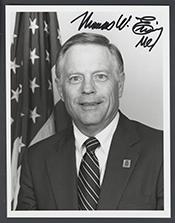
Thomas Ewing
Former U.S. Representative · Illinois District 15 · 1991–2001 · Republican
Thomas Ewing represented Illinois's District 15 in the United States House of Representatives (1991–2001) for the Republican party. The page below collects sourced biographical facts, term history, committee roles, and provenance for Ewing.
Bioguide ID: E000282
Key facts
- Full name
- Thomas Ewing
- State
- Illinois
- District
- District 15
- Party
- Republican
- House service
- 1991–2001
- First House term
- 1991
- Status
- Left office
- Current term ends
- —
- Born
- 1935
- Bioguide ID
- E000282
- Committee assignments
- —
- Dataset version
- 1.20260605
Biographical narrative
971 words · sourced from the Wikipedia REST extract
Thomas W. Ewing is a former U.S. Representative who served Illinois's 15th congressional district as a member of the Republican Party. Ewing's political career spanned over two decades, during which he held significant roles in both the Illinois State House of Representatives and the U.S. House of Representatives. Known for his conservative fiscal policies, Ewing was actively involved in various committees and caucuses, particularly those focused on agriculture and rural issues. His tenure in Congress lasted from 1991 until his retirement in 2001.
Early life and career
Thomas William Ewing was born on September 19, 1935, in Atlanta, Illinois. He pursued higher education at Millikin University in Decatur, Illinois, where he earned a Bachelor of Science degree. During his time at Millikin, he was affiliated with the Illinois Delta chapter of Sigma Alpha Epsilon, a national fraternity. Ewing later attended John Marshall Law School in Chicago, where he obtained his Juris Doctor degree.
Ewing's professional journey began with his service in the United States Army Reserve from 1957 to 1963. After completing his military service, he entered the legal profession, practicing law privately from 1968 until 1991. Additionally, he served as the Assistant State's Attorney for Livingston County, Illinois, from 1968 to 1973, gaining valuable experience in legal and governmental matters.
Ewing's political career commenced in 1974 when he was elected to the Illinois House of Representatives. He served in this capacity until 1991, during which he became known for his expertise in revenue and fiscal matters. Ewing was a member of the Agriculture Committee and held the position of chairman of the House Revenue Committee, where he focused on issues related to taxation and state revenue.
House tenure
In 1991, Ewing transitioned to federal politics when he was elected to the U.S. House of Representatives, representing Illinois's 15th district. His election followed a special election to fill the vacancy left by the resignation of Ed Madigan. Ewing's congressional career began on July 2, 1991, and he served until his retirement on January 3, 2001.
Throughout his time in the House, Ewing was recognized as a conservative member, particularly emphasizing fiscal conservatism. He advocated for a smaller and less intrusive government, focusing primarily on economic issues rather than social ones. Ewing's involvement in the Republican Party was notable; he played a significant role in the Republican Revolution, which led to the party gaining a majority in the House for the first time in over four decades. He was a strong supporter of the "Contract with America," a document outlining the party's legislative agenda.
Ewing's leadership extended to various committees during his congressional tenure. He served on the House Committee on Agriculture, Transportation and Infrastructure, Science, and House Administration. Notably, he chaired the Agriculture Subcommittee on Risk Management and Specialty Crops, where he worked to address the concerns of farmers and rural communities. His leadership in the Congressional Rural Caucus further highlighted his commitment to agricultural issues.
In January 1995, Ewing was appointed as a Deputy Republican House Whip, a position that involved assisting in party leadership and legislative strategy. He was also selected by Newt Gingrich to succeed him as chairman of the Conservative Opportunity Society after Gingrich became Speaker of the House. Ewing's efforts included advocating for a balanced budget and supporting various initiatives aimed at fiscal responsibility.
Ewing's congressional actions included voting in favor of all articles of impeachment against President Bill Clinton in December 1998. He played a pivotal role in supporting Dennis Hastert's rise to leadership within the House Republican Conference, which ultimately positioned Hastert to become Speaker in January 1999. In December 2000, Ewing introduced the Commodity Futures Modernization Act of 2000, reflecting his ongoing engagement with economic and agricultural policy.
Legislative focus and committees
During his time in Congress, Ewing's legislative focus was primarily on agriculture, fiscal policy, and rural development. His chairmanship of the Agriculture Subcommittee on Risk Management and Specialty Crops allowed him to advocate for the interests of farmers and agricultural stakeholders. Ewing's work in this area was characterized by a commitment to addressing the challenges faced by the agricultural sector, particularly in relation to risk management and specialty crops.
Ewing's involvement in the House Committee on Agriculture enabled him to contribute to broader discussions on agricultural policy, food security, and rural economic development. His expertise in fiscal matters was also evident in his participation in the House Committee on Transportation and Infrastructure, where he engaged in discussions related to infrastructure development and funding.
As a member of the House Administration Committee, Ewing took part in overseeing the operational aspects of the House of Representatives, ensuring that legislative processes functioned effectively. His role in these committees underscored his dedication to public service and his desire to influence policy in a manner that aligned with his conservative principles.
After leaving Congress, Ewing continued to engage in public service and advocacy, particularly in the areas of renewable energy and agricultural policy. He served as chairman of the Biomass Research and Development Technical Advisory Committee from 2001 to 2007, a position that involved promoting the development of renewable fuel sources. Ewing's ongoing involvement in agricultural and energy initiatives reflects his commitment to addressing contemporary challenges in these sectors.
Ewing's contributions to public life have been recognized through various honors and awards, including honorary Doctor of Law degrees from multiple institutions and recognition from agricultural organizations. His work has left a lasting impact on both state and national levels, particularly in the realms of agriculture and fiscal policy.
In summary, Thomas W. Ewing's career as a U.S. Representative and state legislator was marked by his commitment to conservative fiscal policies and his advocacy for agricultural interests. His legislative focus and leadership roles in various committees highlight his dedication to serving the constituents of Illinois's 15th district and contributing to the broader political landscape.
Notable legislation
Sponsored and co-sponsored legislation for Thomas Ewing is pending operator curation. The biographical narrative above carries the same provenance trail until per-bill rows are written.
Sources
- [1]https://en.wikipedia.org/wiki/Tom_EwingWikipedia · retrieved 2026-06-05
Notable quotes
Sourced quotes for Thomas Ewing are pending operator curation. Narrative-scope provenance remains attached below.
Sources
- [1]https://en.wikipedia.org/wiki/Tom_EwingWikipedia · retrieved 2026-06-05
Key positions
Curated policy positions for Thomas Ewing are pending operator review. The biographical narrative above carries the same provenance trail until per-topic positions are written.
Sources
- [1]https://en.wikipedia.org/wiki/Tom_EwingWikipedia · retrieved 2026-06-05
Terms served
- 1991–1993U.S. House · Term 1 · Republican
- 1993–1995U.S. House · Term 2 · Republican
- 1995–1997U.S. House · Term 3 · Republican
- 1997–1999U.S. House · Term 4 · Republican
- 1999–2001U.S. House · Term 5 · Republican
Sources & provenance
Every attributable claim above carries a per-section [N] marker that resolves to the corresponding URL below. Each entry records the upstream provider, the canonical URL, and the timestamp at which the source was retrieved by the ingest pipeline.
Key facts
- https://bioguide.congress.gov/search/bio/E000282bioguide · retrieved 2026-06-05
- https://www.govtrack.us/congress/members/400581govtrack · retrieved 2026-06-05
Biographical narrative
- https://en.wikipedia.org/wiki/Tom_Ewingwikipedia · retrieved 2026-06-05
Find your representative
Every U.S. state elects representatives by district. Browse Illinois’s delegation, the full former-representative roster, or explore the role and term length.
Related on The Candidate
- Preceded by Edward MadiganEarlier holder of the Illinois District 15 House seat · Republican.Open
- Succeeded by Timothy JohnsonLater holder of the Illinois District 15 House seat · Republican.Open
- Abner TaylorFormer U.S. Representative · Illinois District 1 · RepublicanOpen
- Adam SnyderFormer U.S. Representative · Illinois District 1 · DemocraticOpen
- Arthur MitchellFormer U.S. Representative · Illinois District 1 · DemocraticOpen
- Bennett StewartFormer U.S. Representative · Illinois District 1 · DemocraticOpen