
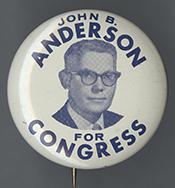
Historical · U.S. House · Illinois · District 16
John Anderson
Former U.S. Representative · Illinois District 16 · 1961–1981 · Republican
John Anderson represented Illinois's District 16 in the United States House of Representatives (1961–1981) for the Republican party. The page below collects sourced biographical facts, term history, committee roles, and provenance for Anderson.
Bioguide ID: A000195
Key facts
- Full name
- John Anderson
- State
- Illinois
- District
- District 16
- Party
- Republican
- House service
- 1961–1981
- First House term
- 1961
- Status
- Left office
- Current term ends
- —
- Born
- 1922
- Bioguide ID
- A000195
- Committee assignments
- —
- Dataset version
- 1.20260605
Biographical narrative
1,118 words · sourced from the Wikipedia REST extract
John B. Anderson was a notable American lawyer and politician who served as a U.S. Representative for Illinois's 16th congressional district from 1961 until 1981. Initially a member of the Republican Party, he held significant leadership roles, including Chairman of the House Republican Conference from 1969 to 1979. Anderson's political career is marked by his evolution from a staunch conservative to a more moderate stance on various social issues. In 1980, he made headlines by running an independent campaign for the presidency, garnering 6.6% of the popular vote. His post-congressional career included legal work, advocacy for electoral reform, and academia.
Early life and career
John B. Anderson was born on February 15, 1922, in Rockford, Illinois. He was the son of Mabel Edna Ring and Ernest Albin Anderson, the latter being a Swedish immigrant. Anderson's upbringing in Rockford was shaped by his family's grocery store, where he worked during his youth. He excelled academically, graduating as the valedictorian of Rockford Central High School in 1939. Following high school, he attended the University of Illinois at Urbana–Champaign, earning a bachelor's degree in 1942. His pursuit of a legal education was interrupted by World War II, during which he enlisted in the Army in 1943. Anderson served as a staff sergeant in the U.S. Field Artillery, participating in campaigns in France and Germany, and was awarded four service stars for his service.
After the war, Anderson returned to the University of Illinois to complete his law degree, earning a Juris Doctor (J.D.) in 1946. He was admitted to the Illinois bar the same year and began practicing law in Rockford. Shortly thereafter, he moved to Massachusetts to attend Harvard Law School, where he obtained a Master of Laws (LL.M.) in 1949. His thesis focused on federal jurisdiction and showcased his academic capabilities. While at Harvard, he also served on the faculty of Northeastern University School of Law in Boston. Following his time at Harvard, Anderson returned to Rockford to practice law with the firm Large, Reno & Zahm.
In 1952, Anderson joined the United States Foreign Service, where he served in Berlin from 1952 to 1955 as an Economic Reporting Officer in the Eastern Affairs Division. He worked as an adviser on the staff of the United States High Commissioner for Germany. After concluding his service in the Foreign Service, he returned to Rockford and resumed his legal career.
Anderson's entry into politics began shortly after his return to law practice. In 1956, he was elected State's Attorney for Winnebago County, Illinois, winning a competitive primary and then the general election. After serving one term, he decided to seek a higher office when the incumbent congressman, Leo E. Allen, announced his retirement. Anderson successfully ran in the Republican primary for the 16th District seat, which was a significant contest in this strongly Republican area. He won the primary and subsequently the general election, marking the beginning of his long tenure in the U.S. House of Representatives.
House tenure
John B. Anderson was elected to the United States House of Representatives in 1960, beginning a decade-long career that would see him serve ten consecutive terms until 1981. Initially, he was regarded as one of the more conservative members of the Republican caucus. Throughout his early years in Congress, he introduced several constitutional amendments aimed at recognizing the authority of Jesus Christ over the United States, though these proposals did not advance significantly.
During his time in Congress, Anderson voted in favor of key civil rights legislation, including the Civil Rights Acts of 1964 and 1968, as well as the Voting Rights Act of 1965 and the Twenty-fourth Amendment to the Constitution. His early support for Barry Goldwater's presidential campaign in 1964 reflected his conservative roots, but he later expressed doubts about the viability of Goldwater's ideas on a national scale. Anderson's perspective shifted as he witnessed significant social upheaval in the 1960s, including civil rights protests and urban riots, leading him to adopt a more moderate stance on various issues.
In 1969, Anderson was elected Chairman of the House Republican Conference, a position he held until 1979. This role allowed him to influence party strategy and policy direction during a tumultuous period in American politics. He became known for his vocal opposition to the Vietnam War and criticized President Richard Nixon's actions during the Watergate scandal, reflecting his evolving political ideology.
Anderson's tenure in Congress was characterized by his willingness to engage with complex social issues, and he often sought to bridge divides within the Republican Party. His moderate approach attracted both support and criticism, as he navigated the changing political landscape of the 1970s.
Legislative focus and committees
Throughout his congressional career, John B. Anderson served on various committees that allowed him to influence legislation across a range of issues. His early years in Congress were marked by a focus on conservative principles, but as his views evolved, he became more engaged with social issues and civil rights. His votes in favor of landmark legislation, such as the Civil Rights Acts and the Voting Rights Act, demonstrated his commitment to advancing social justice and equality.
As Chairman of the House Republican Conference, Anderson played a crucial role in shaping the party's legislative agenda. He was involved in discussions surrounding key issues of the day, including the Vietnam War, economic policy, and civil rights. His leadership position enabled him to advocate for a more moderate Republican platform, which sought to appeal to a broader electorate.
Anderson's criticisms of the Vietnam War and his stance on the Watergate scandal highlighted his willingness to challenge the status quo within his party. He sought to represent the interests of his constituents while navigating the complexities of national politics. His legislative focus included not only social issues but also economic policies that aimed to address the needs of his district and the nation.
In 1980, Anderson's political career took a significant turn when he decided to run for president as an independent candidate after initially participating in the Republican primaries. His campaign was marked by innovative proposals, including a plan to raise the gas tax while cutting Social Security taxes. Although he did not win the presidency, his campaign garnered attention and support from a diverse coalition of voters, including disillusioned Democrats and independents.
After leaving Congress in 1981, Anderson continued to engage in public life through various avenues, including legal work, advocacy for electoral reform, and teaching. His contributions to American politics and law have left a lasting impact, reflecting his commitment to public service and civic engagement. Anderson passed away on December 3, 2017, at the age of 95, leaving behind a legacy of political involvement and advocacy for reform.
Notable legislation
Sponsored and co-sponsored legislation for John Anderson is pending operator curation. The biographical narrative above carries the same provenance trail until per-bill rows are written.
Sources
- [1]https://en.wikipedia.org/wiki/John_B._AndersonWikipedia · retrieved 2026-06-05
Notable quotes
Sourced quotes for John Anderson are pending operator curation. Narrative-scope provenance remains attached below.
Sources
- [1]https://en.wikipedia.org/wiki/John_B._AndersonWikipedia · retrieved 2026-06-05
Key positions
Curated policy positions for John Anderson are pending operator review. The biographical narrative above carries the same provenance trail until per-topic positions are written.
Sources
- [1]https://en.wikipedia.org/wiki/John_B._AndersonWikipedia · retrieved 2026-06-05
Terms served
- 1961–1963U.S. House · Term 1 · Republican
- 1963–1965U.S. House · Term 2 · Republican
- 1965–1967U.S. House · Term 3 · Republican
- 1967–1969U.S. House · Term 4 · Republican
- 1969–1971U.S. House · Term 5 · Republican
- 1971–1973U.S. House · Term 6 · Republican
- 1973–1975U.S. House · Term 7 · Republican
- 1975–1977U.S. House · Term 8 · Republican
- 1977–1979U.S. House · Term 9 · Republican
- 1979–1981U.S. House · Term 10 · Republican
Sources & provenance
Every attributable claim above carries a per-section [N] marker that resolves to the corresponding URL below. Each entry records the upstream provider, the canonical URL, and the timestamp at which the source was retrieved by the ingest pipeline.
Key facts
- https://bioguide.congress.gov/search/bio/A000195bioguide · retrieved 2026-06-05
- https://www.govtrack.us/congress/members/400850govtrack · retrieved 2026-06-05
Biographical narrative
- https://en.wikipedia.org/wiki/John_B._Andersonwikipedia · retrieved 2026-06-05
Find your representative
Every U.S. state elects representatives by district. Browse Illinois’s delegation, the full former-representative roster, or explore the role and term length.
Related on The Candidate
- Preceded by Leo AllenEarlier holder of the Illinois District 16 House seat · Republican.Open
- Succeeded by Lynn MartinLater holder of the Illinois District 16 House seat · Republican.Open
- Abner TaylorFormer U.S. Representative · Illinois District 1 · RepublicanOpen
- Adam SnyderFormer U.S. Representative · Illinois District 1 · DemocraticOpen
- Arthur MitchellFormer U.S. Representative · Illinois District 1 · DemocraticOpen
- Bennett StewartFormer U.S. Representative · Illinois District 1 · DemocraticOpen