
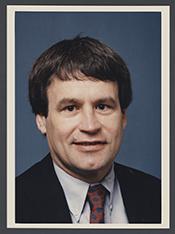
Historical · U.S. House · Illinois · District 17
Lane Evans
Former U.S. Representative · Illinois District 17 · 1983–2007 · Democratic
Lane Evans represented Illinois's District 17 in the United States House of Representatives (1983–2007) for the Democratic party. The page below collects sourced biographical facts, term history, committee roles, and provenance for Evans.
Bioguide ID: E000250
Key facts
- Full name
- Lane Evans
- State
- Illinois
- District
- District 17
- Party
- Democratic
- House service
- 1983–2007
- First House term
- 1983
- Status
- Left office
- Current term ends
- —
- Born
- 1951
- Bioguide ID
- E000250
- Committee assignments
- —
- Dataset version
- 1.20260605
Biographical narrative
909 words · sourced from the Wikipedia REST extract
Lane Evans was an American attorney and politician who served as a Democratic member of the United States House of Representatives from 1983 until 2007, representing Illinois's 17th congressional district. Throughout his twelve terms in Congress, Evans was known for his progressive stance on various issues and was an influential figure in Illinois politics. His tenure was marked by significant legislative achievements, particularly in veterans' affairs, as well as challenges related to his health.
Early life and career
Lane Evans was born on August 4, 1951, in Rock Island, Illinois. He attended Alleman High School in his hometown before pursuing higher education at Augustana College, where he graduated in 1974. Following his undergraduate studies, Evans earned a Juris Doctor degree from Georgetown University in 1977. His legal career began at the Quad Cities Legal Clinic, where he worked as an attorney in Moline, Illinois.
Before embarking on his political career, Evans served in the United States Marine Corps during the Vietnam War, where he was stationed in Okinawa. His military service contributed to his understanding of veterans' issues, which would later become a focal point of his legislative work. In 1982, Evans entered politics by running for the Democratic nomination for Illinois's 17th congressional district. This district had recently been renumbered from the 19th District following the 1980 census and had historically been a Republican stronghold, with the party holding the seat for all but two years since 1939.
Evans's political ascent was facilitated by the defeat of 16-year incumbent Tom Railsback, who lost his renomination bid to a more conservative Republican, State Senator Kenneth McMillan. Capitalizing on the economic challenges of the time, Evans won the general election by a narrow margin, marking the beginning of his lengthy congressional career.
House tenure
Lane Evans was first elected to the U.S. House of Representatives in 1982 and began his first term in 1983. Over the course of his twelve terms, he faced various electoral challenges but consistently managed to secure his seat. His initial victory was notable, as he won against McMillan by approximately five percentage points, despite the district's Republican leanings. In the following election cycle, Evans faced McMillan again and won decisively, garnering a significant portion of the vote even as Ronald Reagan achieved a landslide victory nationwide.
Throughout the 1990s, Evans continued to build on his electoral success, defeating Republican challengers by substantial margins. In 1990, he won re-election by over 50,000 votes, and in 1994, despite the Republican resurgence that year, he retained his seat against a lesser-known opponent. His ability to connect with constituents and address local concerns contributed to his continued success in a district that had shifted politically over the years.
Evans's electoral fortunes were bolstered by redistricting efforts following the 2000 census, which made his seat safer by incorporating more urban areas while removing some rural constituents. This change allowed him to focus on legislative initiatives without the immediate threat of electoral challenges. He was re-elected in 2002 and 2004, further solidifying his position in Congress.
However, Evans's health began to decline in the mid-1990s due to his battle with Parkinson's disease. Despite this challenge, he remained active in his role as a representative, advocating for the needs of his constituents. His health became a point of contention during the 2004 election, when his opponent attempted to question his ability to serve effectively. This strategy ultimately backfired, as Evans won the election by a significant margin.
In November 2006, Evans announced that he would not seek re-election, citing the debilitating effects of his illness. He completed his final term, which ended on January 3, 2007, marking the conclusion of a notable career in public service.
Legislative focus and committees
During his time in Congress, Lane Evans was known for his progressive policies and strong advocacy for veterans' rights. He was instrumental in the passage of the Agent Orange Act of 1991, which addressed health issues related to the herbicide used during the Vietnam War. This legislation was a significant achievement for Evans, reflecting his commitment to supporting veterans and their families.
Evans was a founding member of both the Congressional Progressive Caucus and the House Populist Caucus, aligning himself with the more liberal factions within the Democratic Party. His voting record indicated a strong alignment with progressive values, as he consistently received high ratings from organizations advocating for liberal policies. Conversely, he received low ratings from conservative groups, underscoring his position as one of the most liberal members of Congress, particularly among representatives from outside Chicago.
Throughout his tenure, Evans was actively involved in various committees and legislative initiatives that focused on a range of issues, including healthcare, education, and social justice. His commitment to these causes was evident in his legislative priorities and public statements, which often emphasized the importance of equity and access for all Americans.
In addition to his legislative work, Evans played a role in supporting the election of Barack Obama during the 2004 United States Senate race in Illinois, further demonstrating his influence within the Democratic Party. His political legacy continued to resonate in Illinois politics, and his contributions were recognized posthumously.
Despite the challenges posed by his health, Evans remained a dedicated public servant until the end of his congressional career. His legacy is marked by his advocacy for veterans, his commitment to progressive values, and his ability to navigate the complexities of a long political career in a changing political landscape.
Notable legislation
Sponsored and co-sponsored legislation for Lane Evans is pending operator curation. The biographical narrative above carries the same provenance trail until per-bill rows are written.
Sources
- [1]https://en.wikipedia.org/wiki/Lane_EvansWikipedia · retrieved 2026-06-05
Notable quotes
Sourced quotes for Lane Evans are pending operator curation. Narrative-scope provenance remains attached below.
Sources
- [1]https://en.wikipedia.org/wiki/Lane_EvansWikipedia · retrieved 2026-06-05
Key positions
Curated policy positions for Lane Evans are pending operator review. The biographical narrative above carries the same provenance trail until per-topic positions are written.
Sources
- [1]https://en.wikipedia.org/wiki/Lane_EvansWikipedia · retrieved 2026-06-05
Terms served
- 1983–1985U.S. House · Term 1 · Democratic
- 1985–1987U.S. House · Term 2 · Democratic
- 1987–1989U.S. House · Term 3 · Democratic
- 1989–1991U.S. House · Term 4 · Democratic
- 1991–1993U.S. House · Term 5 · Democratic
- 1993–1995U.S. House · Term 6 · Democratic
- 1995–1997U.S. House · Term 7 · Democratic
- 1997–1999U.S. House · Term 8 · Democratic
- 1999–2001U.S. House · Term 9 · Democratic
- 2001–2003U.S. House · Term 10 · Democratic
- 2003–2005U.S. House · Term 11 · Democratic
- 2005–2007U.S. House · Term 12 · Democratic
Sources & provenance
Every attributable claim above carries a per-section [N] marker that resolves to the corresponding URL below. Each entry records the upstream provider, the canonical URL, and the timestamp at which the source was retrieved by the ingest pipeline.
Key facts
- https://bioguide.congress.gov/search/bio/E000250bioguide · retrieved 2026-06-05
- http://www.house.gov/evanshouse.gov · retrieved 2026-06-05
Biographical narrative
- https://en.wikipedia.org/wiki/Lane_Evanswikipedia · retrieved 2026-06-05
Find your representative
Every U.S. state elects representatives by district. Browse Illinois’s delegation, the full former-representative roster, or explore the role and term length.
Related on The Candidate
- Preceded by James GillespieEarlier holder of the Illinois District 17 House seat · Democratic.Open
- Succeeded by Phil HareLater holder of the Illinois District 17 House seat · Democratic.Open
- Abner TaylorFormer U.S. Representative · Illinois District 1 · RepublicanOpen
- Adam SnyderFormer U.S. Representative · Illinois District 1 · DemocraticOpen
- Arthur MitchellFormer U.S. Representative · Illinois District 1 · DemocraticOpen
- Bennett StewartFormer U.S. Representative · Illinois District 1 · DemocraticOpen