
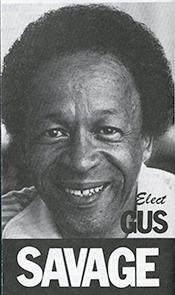
Historical · U.S. House · Illinois · District 2
Gus Savage
Former U.S. Representative · Illinois District 2 · 1981–1993 · Democratic
Gus Savage represented Illinois's District 2 in the United States House of Representatives (1981–1993) for the Democratic party. The page below collects sourced biographical facts, term history, committee roles, and provenance for Savage.
Bioguide ID: S000081
Key facts
- Full name
- Gus Savage
- State
- Illinois
- District
- District 2
- Party
- Democratic
- House service
- 1981–1993
- First House term
- 1981
- Status
- Left office
- Current term ends
- —
- Born
- 1925
- Bioguide ID
- S000081
- Committee assignments
- —
- Dataset version
- 1.20260605
Biographical narrative
861 words · sourced from the Wikipedia REST extract
Augustus Alexander "Gus" Savage was an American entrepreneur, journalist, and politician who served as a Democratic member of the United States House of Representatives from Illinois. His congressional career spanned six terms from 1981 until 1993, representing the 2nd Congressional District, which includes parts of Chicago's South Side. Known for his outspoken nature and controversial remarks, Savage's tenure was marked by both legislative initiatives and significant public scrutiny.
Early life and career
Gus Savage was born on October 30, 1925, in Detroit, Michigan. He pursued higher education at Roosevelt University in Chicago, where he completed his studies before embarking on a diverse career. Savage served in the United States Army from 1943 to 1946, an experience that would shape his views and later inform his public service.
After his military service, Savage transitioned into journalism, beginning a career that would last from 1954 until 1979. He established a chain of weekly community newspapers in the Chicago area, most notably the South End Citizen. His efforts in journalism culminated in the creation of the Chicago Citizen Newspaper Group, which became the largest Black-owned chain of weekly newspapers in the Midwest, boasting a circulation of approximately 121,000. This venture not only highlighted his entrepreneurial spirit but also demonstrated his commitment to serving the African American community through media.
Savage's political engagement began in earnest in 1948 when he became a Progressive Party organizer. His early attempts to enter politics included challenges for the House of Representatives in 1968 and 1970, where he faced established candidates in the Democratic primaries but was unsuccessful on both occasions. Despite these setbacks, his persistence in political activism laid the groundwork for his eventual election to Congress.
House tenure
Gus Savage's political career took a significant turn in 1980 when he successfully won election to the United States House of Representatives, representing Illinois's 2nd Congressional District. His first term began in January 1981, and he would go on to serve a total of six terms before concluding his congressional career on January 3, 1993. Throughout his time in office, Savage was known for his strong advocacy on various issues, particularly those affecting his constituents in Chicago.
During his tenure, Savage was involved in several notable legislative efforts. In 1983, he was one of eight Congressional Representatives who sponsored a resolution to impeach President Ronald Reagan in response to the military invasion of Grenada. This action underscored his willingness to take a stand on contentious national issues, reflecting his commitment to his principles and constituents.
Savage's time in Congress was not without controversy. He faced significant criticism for his remarks, which were often described as racially incendiary and anti-Semitic. These comments drew bipartisan condemnation and complicated his relationships within the political landscape. Despite this, he maintained a strong base of support within his district, although he never won a primary election with more than 52% of the vote, often facing multiple challengers.
In 1992, the political landscape shifted due to redistricting, which altered the demographics of his constituency. The new district included more suburban areas that were less familiar to Savage and did not share the same level of connection with him. This change set the stage for a rematch with Mel Reynolds, who had previously challenged him in earlier primaries. The election proved to be contentious, with both candidates making allegations against each other. Ultimately, Savage lost the election to Reynolds, marking the end of his congressional career.
Legislative focus and committees
Throughout his time in the House, Gus Savage's legislative focus was primarily on issues pertinent to his constituents, particularly those affecting the African American community and urban residents. He served on various committees, where he sought to influence policy on matters such as housing, education, and civil rights. His role as chairman of the House Subcommittee on Public Buildings and Grounds was particularly notable, as it allowed him to address issues related to public infrastructure and historical preservation.
One of Savage's significant contributions in this capacity was his involvement in the preservation of the African Burial Ground in New York City. In 1992, he successfully advocated for a halt to excavation and construction at the site, emphasizing its historical importance. His efforts helped bring national attention to the site, which was later designated as a National Historic Landmark in 1993 and a National Monument in 2006. This achievement underscored his commitment to recognizing and preserving African American history.
Savage's legislative career was characterized by a blend of advocacy, controversy, and resilience. Despite facing significant challenges, including accusations of misconduct and criticism for his remarks, he remained a prominent figure in his district and a vocal advocate for issues he deemed important. His legacy is marked by both his contributions to public service and the complexities of his political career.
In his later years, Gus Savage continued to engage with the community and maintained a presence in the political landscape. He passed away on October 31, 2015, just one day after celebrating his 90th birthday. He is survived by his son, daughter, and grandchildren, leaving behind a multifaceted legacy that reflects both his achievements and the controversies that defined his career in public service.
Notable legislation
Sponsored and co-sponsored legislation for Gus Savage is pending operator curation. The biographical narrative above carries the same provenance trail until per-bill rows are written.
Sources
- [1]https://en.wikipedia.org/wiki/Gus_SavageWikipedia · retrieved 2026-06-05
Notable quotes
Sourced quotes for Gus Savage are pending operator curation. Narrative-scope provenance remains attached below.
Sources
- [1]https://en.wikipedia.org/wiki/Gus_SavageWikipedia · retrieved 2026-06-05
Key positions
Curated policy positions for Gus Savage are pending operator review. The biographical narrative above carries the same provenance trail until per-topic positions are written.
Sources
- [1]https://en.wikipedia.org/wiki/Gus_SavageWikipedia · retrieved 2026-06-05
Terms served
- 1981–1983U.S. House · Term 1 · Democratic
- 1983–1985U.S. House · Term 2 · Democratic
- 1985–1987U.S. House · Term 3 · Democratic
- 1987–1989U.S. House · Term 4 · Democratic
- 1989–1991U.S. House · Term 5 · Democratic
- 1991–1993U.S. House · Term 6 · Democratic
Sources & provenance
Every attributable claim above carries a per-section [N] marker that resolves to the corresponding URL below. Each entry records the upstream provider, the canonical URL, and the timestamp at which the source was retrieved by the ingest pipeline.
Key facts
- https://bioguide.congress.gov/search/bio/S000081bioguide · retrieved 2026-06-05
- https://www.govtrack.us/congress/members/409593govtrack · retrieved 2026-06-05
Biographical narrative
- https://en.wikipedia.org/wiki/Gus_Savagewikipedia · retrieved 2026-06-05
Find your representative
Every U.S. state elects representatives by district. Browse Illinois’s delegation, the full former-representative roster, or explore the role and term length.
Related on The Candidate
- Preceded by Morgan MurphyEarlier holder of the Illinois District 2 House seat · Democratic.Open
- Succeeded by Mel ReynoldsLater holder of the Illinois District 2 House seat · Democratic.Open
- Abner TaylorFormer U.S. Representative · Illinois District 1 · RepublicanOpen
- Adam SnyderFormer U.S. Representative · Illinois District 1 · DemocraticOpen
- Arthur MitchellFormer U.S. Representative · Illinois District 1 · DemocraticOpen
- Bennett StewartFormer U.S. Representative · Illinois District 1 · DemocraticOpen