
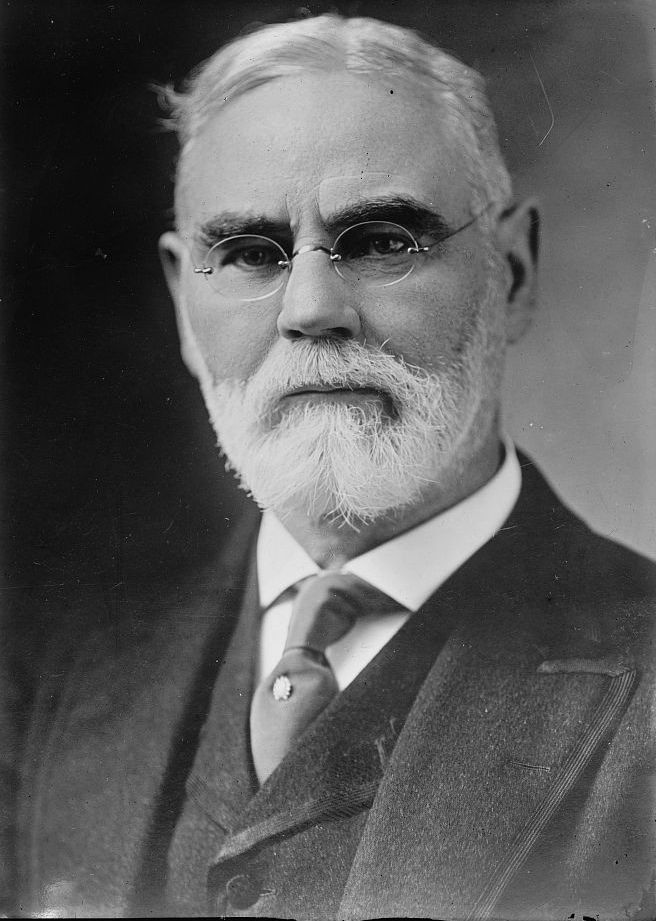
Historical · U.S. House · Illinois · District 2
James Mann
Former U.S. Representative · Illinois District 2 · 1897–1923 · Republican
James Mann represented Illinois's District 2 in the United States House of Representatives (1897–1923) for the Republican party. The page below collects sourced biographical facts, term history, committee roles, and provenance for Mann.
Bioguide ID: M000104
Key facts
- Full name
- James Mann
- State
- Illinois
- District
- District 2
- Party
- Republican
- House service
- 1897–1923
- First House term
- 1897
- Status
- Left office
- Current term ends
- —
- Born
- 1856
- Bioguide ID
- M000104
- Committee assignments
- —
- Dataset version
- 1.20260606
Biographical narrative
911 words · sourced from the Wikipedia REST extract
James Mann was a prominent American politician and attorney who served as a U.S. Representative from Illinois for 13 consecutive terms from 1897 until 1922. A member of the Republican Party, Mann held significant leadership roles during his tenure, including serving as the House Minority Leader from 1911 to 1919. His legislative contributions included key legislation related to commerce, women's rights, and public health, reflecting his active engagement in the political issues of his time.
Early life and career
James Robert Mann was born on October 20, 1856, near Bloomington in McLean County, Illinois. He was the younger brother of Frank Irving Mann, who became a farmer, editor, and author. James Mann pursued his education at the University of Illinois, where he graduated in 1876. He later attended the Union College of Law, completing his studies in 1881, which led to his admission to the Illinois bar the same year. Following his admission, Mann began his legal practice in Chicago.
Mann's early political career included various local offices that laid the groundwork for his future in national politics. He served as a member of the Oakland Board of Education in Chicago starting in 1887 and was appointed as the attorney for the Hyde Park and South Park commissioners. His political involvement expanded when he was elected to the City Council of Chicago, where he served from 1892 to 1896. Additionally, he held the position of Master in Chancery of the Superior Court of Cook County and chaired the Illinois State Republican convention in 1894. His leadership within the Republican Party continued as he chaired the Republican county conventions in Chicago in 1895 and 1902.
In 1896, Mann was elected as a Republican to the 55th Congress, marking the beginning of his long tenure in the House of Representatives. Over the next 13 terms, he became a well-known figure in American politics, recognized for his legislative efforts and leadership roles.
House tenure
Mann's congressional career began in 1897 and continued until his last term ended on March 3, 1923. During his time in the House, he held several important committee positions that influenced key areas of legislation. He served as the Chairman of the Committee on Elections No. 1 during the 58th to 60th Congresses, overseeing election-related matters. His role extended to the Committee on Interstate and Foreign Commerce during the 61st Congress, where he contributed to legislation affecting trade and transportation.
Mann was also a member of the Committee on Women Suffrage during the 66th Congress, reflecting his involvement in the movement for women's rights. His leadership capabilities were recognized when he was appointed as the Minority Leader from the 62nd to the 65th Congresses, a role that placed him at the forefront of the Republican Party's legislative strategy during a period of significant political change.
Mann's legislative efforts were marked by a focus on issues that resonated with the public and addressed pressing societal concerns. His work in the House was characterized by a commitment to reform and regulation, particularly in the areas of commerce and social issues.
Legislative focus and committees
Throughout his congressional career, Mann was involved in several notable pieces of legislation that had a lasting impact on American society. He was a key sponsor of the Mann-Elkins Act, which enhanced the powers of the Interstate Commerce Commission, allowing for greater regulation of railroad rates. This legislation was part of a broader movement during the Progressive Era aimed at curbing corporate power and ensuring fair practices in commerce.
Mann is perhaps best known for his authorship of the Mann Act of 1910, a significant piece of legislation that addressed the issue of "white slavery" and prohibited the transportation of women across state lines for immoral purposes, particularly prostitution. This law was part of a larger societal effort to combat human trafficking and protect women from exploitation.
In addition to his work on the Mann Act, Mann introduced legislation that contributed to the establishment of the Pure Food and Drugs Act of 1906, which aimed to regulate food safety and protect consumers from harmful substances in food and medicine. His advocacy for public health and consumer protection reflected the growing concerns of the American public during the early 20th century.
Mann was also recognized as a leader in the movement to amend the United States Constitution to grant women the right to vote. His involvement in the women's suffrage movement highlighted his commitment to expanding civil rights, although his views on women's roles in society were complex and sometimes contradictory.
Despite his progressive stances on certain issues, Mann was a leading opponent of the Harrison Narcotics Tax Act and Prohibition, which were popular among many of his contemporaries in the Midwest. His opposition to these measures demonstrated his nuanced approach to legislation and his willingness to challenge prevailing sentiments within his party.
James Mann's contributions to American politics and legislation were significant during his lengthy tenure in the House of Representatives. His work on key issues such as commerce, women's rights, and public health left a lasting legacy, and his leadership roles within the House positioned him as a central figure in the political landscape of his time.
Mann passed away on November 30, 1922, in Washington, D.C., due to pneumonia, shortly before the conclusion of the 67th United States Congress. He was interred in Oak Woods Cemetery in Chicago, leaving behind a legacy marked by his extensive service and influence in American legislative history.
Notable legislation
Sponsored and co-sponsored legislation for James Mann is pending operator curation. The biographical narrative above carries the same provenance trail until per-bill rows are written.
Sources
- [1]https://en.wikipedia.org/wiki/James_Robert_Mann_(Illinois_politician)Wikipedia · retrieved 2026-06-06
Notable quotes
Sourced quotes for James Mann are pending operator curation. Narrative-scope provenance remains attached below.
Sources
- [1]https://en.wikipedia.org/wiki/James_Robert_Mann_(Illinois_politician)Wikipedia · retrieved 2026-06-06
Key positions
Curated policy positions for James Mann are pending operator review. The biographical narrative above carries the same provenance trail until per-topic positions are written.
Sources
- [1]https://en.wikipedia.org/wiki/James_Robert_Mann_(Illinois_politician)Wikipedia · retrieved 2026-06-06
Terms served
- 1897–1899U.S. House · Term 1 · Republican
- 1899–1901U.S. House · Term 2 · Republican
- 1901–1903U.S. House · Term 3 · Republican
- 1903–1905U.S. House · Term 4 · Republican
- 1905–1907U.S. House · Term 5 · Republican
- 1907–1909U.S. House · Term 6 · Republican
- 1909–1911U.S. House · Term 7 · Republican
- 1911–1913U.S. House · Term 8 · Republican
- 1913–1915U.S. House · Term 9 · Republican
- 1915–1917U.S. House · Term 10 · Republican
- 1917–1919U.S. House · Term 11 · Republican
- 1919–1921U.S. House · Term 12 · Republican
- 1921–1923U.S. House · Term 13 · Republican
Sources & provenance
Every attributable claim above carries a per-section [N] marker that resolves to the corresponding URL below. Each entry records the upstream provider, the canonical URL, and the timestamp at which the source was retrieved by the ingest pipeline.
Key facts
- https://bioguide.congress.gov/search/bio/M000104bioguide · retrieved 2026-06-06
- https://www.govtrack.us/congress/members/407128govtrack · retrieved 2026-06-06
Biographical narrative
- https://en.wikipedia.org/wiki/James_Robert_Mann_(Illinois_politician)wikipedia · retrieved 2026-06-06
Find your representative
Every U.S. state elects representatives by district. Browse Illinois’s delegation, the full former-representative roster, or explore the role and term length.
Related on The Candidate
- Preceded by Frank LawlerEarlier holder of the Illinois District 2 House seat · Democratic.Open
- Succeeded by Morton HullLater holder of the Illinois District 2 House seat · Republican.Open
- Abner TaylorFormer U.S. Representative · Illinois District 1 · RepublicanOpen
- Adam SnyderFormer U.S. Representative · Illinois District 1 · DemocraticOpen
- Arthur MitchellFormer U.S. Representative · Illinois District 1 · DemocraticOpen
- Bennett StewartFormer U.S. Representative · Illinois District 1 · DemocraticOpen