
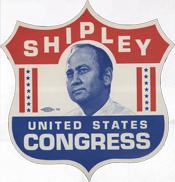
Historical · U.S. House · Illinois · District 22
George Shipley
Former U.S. Representative · Illinois District 22 · 1959–1979 · Democratic
George Shipley represented Illinois's District 22 in the United States House of Representatives (1959–1979) for the Democratic party. The page below collects sourced biographical facts, term history, committee roles, and provenance for Shipley.
Bioguide ID: S000367
Key facts
- Full name
- George Shipley
- State
- Illinois
- District
- District 22
- Party
- Democratic
- House service
- 1959–1979
- First House term
- 1959
- Status
- Left office
- Current term ends
- —
- Born
- 1927
- Bioguide ID
- S000367
- Committee assignments
- —
- Dataset version
- 1.20260605
Biographical narrative
847 words · sourced from the Wikipedia REST extract
George E. Shipley was a prominent U.S. Representative from Illinois, serving the 22nd congressional district as a member of the Democratic Party. His congressional career spanned two decades, during which he was elected to ten consecutive terms in the House of Representatives from 1959 until 1979. Shipley was known for his electoral victory over conservative activist Phyllis Schlafly in 1970, a significant event in his political career. After choosing not to seek re-election in 1978, he concluded his tenure in Congress and returned to his community, where he remained active until his passing in 2003.
Early life and career
George E. Shipley was born on April 21, 1927, in Richland County, near Olney, Illinois. He completed his education at East Richland High School, graduating from Olney High School in 1950. Following his high school education, Shipley served in the United States Marine Corps from 1944 to 1947, a period that likely influenced his later public service and leadership roles.
After his military service, Shipley transitioned into local governance and law enforcement. He began his career in public service as the Chief Deputy Sheriff of Richland County, Illinois, a position he held from 1950 to 1954. His commitment to public safety and community service led to his election as sheriff of Richland County, a role he occupied from 1954 until 1958. During this time, Shipley developed a reputation for leadership and community engagement, which would later serve as a foundation for his political career.
In addition to his law enforcement background, Shipley was also a business owner, which contributed to his understanding of economic issues and the needs of local constituents. His experiences in both law enforcement and business provided him with a unique perspective on the challenges facing his community, ultimately shaping his approach to governance and policy-making.
House tenure
George E. Shipley's political career in the U.S. House of Representatives began when he was elected as a Democrat to the Eighty-sixth Congress, which commenced on January 3, 1959. Over the next two decades, he would be re-elected to nine additional Congresses, serving a total of ten terms until his departure from the House on January 3, 1979. Throughout his tenure, Shipley was involved in various legislative initiatives and contributed to discussions on a wide range of issues affecting his constituents and the nation.
One notable aspect of Shipley's congressional career was his electoral victory in 1970 against Phyllis Schlafly, a well-known conservative activist. This election was significant not only for Shipley but also for the political landscape of the time, as it highlighted the ideological divisions within the country. Shipley won the election with a substantial margin, securing approximately 54% of the vote compared to Schlafly's 46%. This victory underscored his appeal to voters in his district and solidified his position as a prominent figure within the Democratic Party in Illinois.
During his time in Congress, Shipley was known for his active participation in legislative debates and his commitment to representing the interests of his constituents. He navigated the complexities of federal legislation and worked collaboratively with colleagues across party lines to address pressing issues. His dedication to public service and his constituents was evident throughout his long tenure in the House.
In 1978, Shipley chose not to seek re-election to the Ninety-sixth Congress, marking the end of his two-decade-long service in the House of Representatives. His decision not to run again reflected a personal choice rather than a defeat, as he had established a significant legacy during his time in office.
Legislative focus and committees
Throughout his congressional career, George E. Shipley focused on a variety of legislative issues that were pertinent to his constituents and the broader national landscape. While specific details regarding the bills he sponsored or supported are not provided, it is known that he engaged in discussions and initiatives that aligned with the Democratic Party's platform during the mid-20th century.
Shipley's background in law enforcement and business likely informed his legislative priorities, particularly in areas related to public safety, economic development, and community welfare. His experience as sheriff may have influenced his perspectives on crime and justice, while his business ownership could have shaped his understanding of economic policies and their impact on local communities.
In addition to his legislative priorities, Shipley served on various committees during his time in the House. These committees played a crucial role in shaping policy and legislation, and Shipley's participation would have allowed him to advocate for the interests of his district effectively. His involvement in committee work would have also provided him with opportunities to collaborate with other lawmakers and contribute to the legislative process.
After concluding his service in Congress, Shipley returned to his community in Illinois, where he continued to be involved in civic activities. He passed away on June 28, 2003, in Olney, Illinois, leaving behind a legacy of public service and dedication to his constituents. His career in the U.S. House of Representatives remains a notable chapter in the political history of Illinois, reflecting the complexities and challenges of governance during a transformative period in American history.
Notable legislation
Sponsored and co-sponsored legislation for George Shipley is pending operator curation. The biographical narrative above carries the same provenance trail until per-bill rows are written.
Sources
- [1]https://en.wikipedia.org/wiki/George_E._ShipleyWikipedia · retrieved 2026-06-05
Notable quotes
Sourced quotes for George Shipley are pending operator curation. Narrative-scope provenance remains attached below.
Sources
- [1]https://en.wikipedia.org/wiki/George_E._ShipleyWikipedia · retrieved 2026-06-05
Key positions
Curated policy positions for George Shipley are pending operator review. The biographical narrative above carries the same provenance trail until per-topic positions are written.
Sources
- [1]https://en.wikipedia.org/wiki/George_E._ShipleyWikipedia · retrieved 2026-06-05
Terms served
- 1959–1961U.S. House · Term 1 · Democratic
- 1961–1963U.S. House · Term 2 · Democratic
- 1963–1965U.S. House · Term 3 · Democratic
- 1965–1967U.S. House · Term 4 · Democratic
- 1967–1969U.S. House · Term 5 · Democratic
- 1969–1971U.S. House · Term 6 · Democratic
- 1971–1973U.S. House · Term 7 · Democratic
- 1973–1975U.S. House · Term 8 · Democratic
- 1975–1977U.S. House · Term 9 · Democratic
- 1977–1979U.S. House · Term 10 · Democratic
Sources & provenance
Every attributable claim above carries a per-section [N] marker that resolves to the corresponding URL below. Each entry records the upstream provider, the canonical URL, and the timestamp at which the source was retrieved by the ingest pipeline.
Key facts
- https://bioguide.congress.gov/search/bio/S000367bioguide · retrieved 2026-06-05
- https://www.govtrack.us/congress/members/409861govtrack · retrieved 2026-06-05
Biographical narrative
- https://en.wikipedia.org/wiki/George_E._Shipleywikipedia · retrieved 2026-06-05
Find your representative
Every U.S. state elects representatives by district. Browse Illinois’s delegation, the full former-representative roster, or explore the role and term length.
Related on The Candidate
- Preceded by Rolla McMillenEarlier holder of the Illinois District 22 House seat · Republican.Open
- Abner TaylorFormer U.S. Representative · Illinois District 1 · RepublicanOpen
- Adam SnyderFormer U.S. Representative · Illinois District 1 · DemocraticOpen
- Arthur MitchellFormer U.S. Representative · Illinois District 1 · DemocraticOpen
- Bennett StewartFormer U.S. Representative · Illinois District 1 · DemocraticOpen
- Democratic PartyFederal candidates and office holders on the Democratic line.Open