
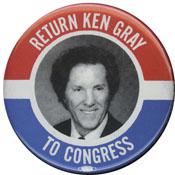
Historical · U.S. House · Illinois · District 22
Kenneth Gray
Former U.S. Representative · Illinois District 22 · 1955–1989 · Democratic
Kenneth Gray represented Illinois's District 22 in the United States House of Representatives (1955–1989) for the Democratic party. The page below collects sourced biographical facts, term history, committee roles, and provenance for Gray.
Bioguide ID: G000400
Key facts
- Full name
- Kenneth Gray
- State
- Illinois
- District
- District 22
- Party
- Democratic
- House service
- 1955–1989
- First House term
- 1955
- Status
- Left office
- Current term ends
- —
- Born
- 1924
- Bioguide ID
- G000400
- Committee assignments
- —
- Dataset version
- 1.20260605
Biographical narrative
1,129 words · sourced from the Wikipedia REST extract
Kenneth J. Gray was a prominent American businessman and politician who served as a U.S. Representative for Illinois's 22nd congressional district. A member of the Democratic Party, Gray's congressional career spanned from 1955 to 1974 and then again from 1985 to 1989. Known for his distinctive style and flamboyant appearance, he became a notable figure in the House of Representatives, where he was recognized for his advocacy of federal spending projects in his district and his unique approach to public speaking.
Early life and career
Kenneth James Gray was born on November 14, 1924, in West Frankfort, Illinois. He received his early education in local schools, attending both West Frankfort and Pope County elementary schools before graduating from Frankfort Community High School. Gray demonstrated entrepreneurial spirit from a young age; at the age of 13, he started his own business, Gray's Roller Rink, where he took on multiple roles, including floor manager, concession stand cashier, and janitor. By the age of 16, he had become an auctioneer, and at 18, he owned Gray Motors, a car dealership that he operated until 1954.
In January 1943, Gray enlisted in the Army Air Forces during World War II. He served with the Twelfth Air Force in North Africa and with the combat engineers of the Fifth Army in Italy, later returning to the Twelfth Air Force in Southern France and other parts of Europe. Throughout his military service, Gray held the position of aircraft crew chief and rose to the rank of first sergeant before his discharge in December 1945. His wartime experience included being assigned as a driver for General Dwight D. Eisenhower, and he participated in significant events leading up to the Normandy invasion. Gray's military service earned him several commendations, including the European-African-Middle Eastern Campaign Medal and the World War II Victory Medal.
Following the war, Gray remained active in veteran affairs, serving as the commander of the Southern Illinois region of the American Legion and as Vice President of the Illinois Jaycees. He credited these experiences with helping him build the connections and recognition necessary to pursue a political career. In addition to his political ambitions, Gray trained as an airplane and helicopter pilot and operated an air service in Benton, Illinois, from 1948 to 1952.
Gray first sought a seat in the U.S. House of Representatives in 1950 but lost the Democratic nomination. He did not run again in 1952. However, he became a founding member of the Walking Dog Foundation for the Blind in 1953, an organization dedicated to providing guide dogs for individuals with visual impairments. His political career gained momentum when he successfully ran for Congress in 1954, defeating the incumbent C. W. Bishop to secure his place in the 84th Congress.
House tenure
Kenneth Gray's tenure in the U.S. House of Representatives began on January 3, 1955, after he was elected as a Democratic representative for Illinois's 22nd congressional district. Over the course of his political career, he was re-elected multiple times, serving a total of 12 terms in Congress until his resignation on December 31, 1974. After a hiatus from Congress, he returned to serve another term from 1985 to 1989.
Gray was known for his distinctive personal style, which included flamboyant clothing and hairstyles that set him apart from many of his colleagues. His appearance often featured bright colors, patterned bow ties, and unconventional attire, which contributed to his reputation as a colorful figure in Washington politics. This unique style was complemented by his engaging personality and theatrical approach to public speaking, which often included dramatic props and performances.
During his time in Congress, Gray was involved in various legislative initiatives and became a senior member of the Public Works Committee. He was particularly focused on securing federal funding for projects that would benefit his district, earning him the moniker "Prince of Pork" for his efforts in obtaining over $7 billion for local infrastructure and development projects. His advocacy included funding for interstate highways, dams, housing, and the construction of the Marion Penitentiary.
One of Gray's notable achievements was his role in the transformation of Washington, D.C.'s Union Station into the National Visitor Center for the United States Bicentennial. Although the project faced challenges related to design and budget overruns, it was completed in time for the 1976 Bicentennial celebrations. Gray's commitment to his constituents was evident in his efforts to secure funding for projects that he believed would have lasting benefits for the community.
In addition to his legislative work, Gray was known for his interests outside of politics. He was an amateur magician and often performed for civic groups and youth organizations in his district. His flair for the dramatic was evident in his speeches, such as a memorable address in which he used a bouquet of roses to illustrate the prospects of the proposed Interstate Highway System, captivating his colleagues with his theatrical presentation.
Legislative focus and committees
Throughout his congressional career, Kenneth Gray focused on a variety of issues, primarily centered around infrastructure and federal funding for projects in his district. As a member of the Public Works Committee, he played a crucial role in advocating for significant investments in transportation and public works, which he believed were essential for the economic development of southern Illinois. His efforts contributed to the construction of vital infrastructure, including highways and flood control measures, which were designed to enhance the safety and prosperity of the region.
Gray's approach to securing federal funds often involved a combination of persuasive advocacy and a deep understanding of the needs of his constituents. He was known for his ability to navigate the complexities of federal funding processes and to build coalitions that supported his initiatives. His tenure was marked by a commitment to ensuring that his district received its fair share of federal resources, which he argued were necessary for the well-being of the community.
In addition to his work on infrastructure, Gray was involved in various other legislative matters, reflecting the diverse interests of his constituents. His participation in committees and subcommittees allowed him to engage with a wide range of issues, from housing to public safety. Gray's ability to connect with his constituents and understand their needs was a hallmark of his legislative style, and he often used his platform to advocate for policies that would directly benefit the people he represented.
Kenneth Gray's legacy in Congress is characterized by his distinctive personality, his commitment to public service, and his efforts to secure federal funding for his district. His tenure spanned significant changes in American politics and society, and he left a lasting impact on the communities he served. Gray passed away on July 12, 2014, leaving behind a complex legacy as a colorful and dedicated public servant.
Notable legislation
Sponsored and co-sponsored legislation for Kenneth Gray is pending operator curation. The biographical narrative above carries the same provenance trail until per-bill rows are written.
Sources
- [1]https://en.wikipedia.org/wiki/Kenneth_J._GrayWikipedia · retrieved 2026-06-05
Notable quotes
Sourced quotes for Kenneth Gray are pending operator curation. Narrative-scope provenance remains attached below.
Sources
- [1]https://en.wikipedia.org/wiki/Kenneth_J._GrayWikipedia · retrieved 2026-06-05
Key positions
Curated policy positions for Kenneth Gray are pending operator review. The biographical narrative above carries the same provenance trail until per-topic positions are written.
Sources
- [1]https://en.wikipedia.org/wiki/Kenneth_J._GrayWikipedia · retrieved 2026-06-05
Terms served
- 1955–1957U.S. House · Term 1 · Democratic
- 1957–1959U.S. House · Term 2 · Democratic
- 1959–1961U.S. House · Term 3 · Democratic
- 1961–1963U.S. House · Term 4 · Democratic
- 1963–1965U.S. House · Term 5 · Democratic
- 1965–1967U.S. House · Term 6 · Democratic
- 1967–1969U.S. House · Term 7 · Democratic
- 1969–1971U.S. House · Term 8 · Democratic
- 1971–1973U.S. House · Term 9 · Democratic
- 1973–1975U.S. House · Term 10 · Democratic
- 1985–1987U.S. House · Term 11 · Democratic
- 1987–1989U.S. House · Term 12 · Democratic
Sources & provenance
Every attributable claim above carries a per-section [N] marker that resolves to the corresponding URL below. Each entry records the upstream provider, the canonical URL, and the timestamp at which the source was retrieved by the ingest pipeline.
Key facts
- https://bioguide.congress.gov/search/bio/G000400bioguide · retrieved 2026-06-05
- https://www.govtrack.us/congress/members/404750govtrack · retrieved 2026-06-05
Biographical narrative
- https://en.wikipedia.org/wiki/Kenneth_J._Graywikipedia · retrieved 2026-06-05
Find your representative
Every U.S. state elects representatives by district. Browse Illinois’s delegation, the full former-representative roster, or explore the role and term length.
Related on The Candidate
- Preceded by Rolla McMillenEarlier holder of the Illinois District 22 House seat · Republican.Open
- Abner TaylorFormer U.S. Representative · Illinois District 1 · RepublicanOpen
- Adam SnyderFormer U.S. Representative · Illinois District 1 · DemocraticOpen
- Arthur MitchellFormer U.S. Representative · Illinois District 1 · DemocraticOpen
- Bennett StewartFormer U.S. Representative · Illinois District 1 · DemocraticOpen
- Democratic PartyFederal candidates and office holders on the Democratic line.Open