
Historical · U.S. House · Illinois · District 4
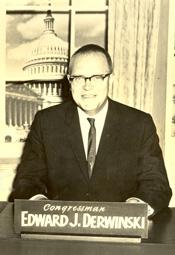
Edward Derwinski
Former U.S. Representative · Illinois District 4 · 1959–1983 · Republican
Edward Derwinski represented Illinois's District 4 in the United States House of Representatives (1959–1983) for the Republican party. The page below collects sourced biographical facts, term history, committee roles, and provenance for Derwinski.
Bioguide ID: D000269
Key facts
- Full name
- Edward Derwinski
- State
- Illinois
- District
- District 4
- Party
- Republican
- House service
- 1959–1983
- First House term
- 1959
- Status
- Left office
- Current term ends
- —
- Born
- 1926
- Bioguide ID
- D000269
- Committee assignments
- —
- Dataset version
- 1.20260605
Biographical narrative
946 words · sourced from the Wikipedia REST extract
Edward J. Derwinski was an American politician who served as a U.S. Representative for Illinois's 4th congressional district from 1959 until 1983. A member of the Republican Party, Derwinski was notable for his long tenure in the House of Representatives, where he participated in various legislative activities and held significant positions, including ranking member of the House Foreign Affairs Committee. Following his congressional career, he became the first Secretary of Veterans Affairs under President George H. W. Bush, a role that elevated the Veterans Administration to cabinet-level status.
Early life and career
Edward Joseph Derwinski was born on September 15, 1926, in Chicago, Illinois, to parents Sophia Zmijewski and Casimir Ignatius Derwinski. His father passed away in 1947, leaving a significant impact on his early life. Derwinski pursued higher education at Loyola University of Chicago, where he graduated in 1951. His college years were marked by his involvement in the Alpha Delta Gamma National Fraternity, which contributed to his social and professional development.
Derwinski's early career was shaped by his military service during World War II. He served in the United States Army, participating in combat in the Pacific Theater and later in the postwar occupation of Japan. This experience likely influenced his later political career, particularly in areas related to foreign affairs and veterans' issues.
In 1957, Derwinski began his political career in earnest when he was elected to the Illinois House of Representatives, where he served a single term. His political aspirations continued to grow, leading him to run for a seat in the U.S. House of Representatives. In 1958, he successfully won election to represent Illinois's 4th congressional district, a suburban area located south and west of Chicago.
House tenure
Derwinski's tenure in the U.S. House of Representatives spanned twelve terms, beginning in 1959 and concluding in 1983. Throughout his time in Congress, he was known for his active participation in legislative matters and his dedication to his constituents. As a Republican representative, he focused on a range of issues pertinent to his district and the nation.
During his time in the House, Derwinski held several important positions, including that of ranking member of the House Foreign Affairs Committee, which is responsible for overseeing U.S. foreign policy and international relations. His leadership role on this committee allowed him to influence significant legislative decisions and engage in discussions on critical global issues. Additionally, he served as a delegate to the United Nations General Assembly from 1971 to 1972, further enhancing his involvement in international affairs.
Derwinski's commitment to public service extended beyond domestic issues. He was also involved in various international delegations, including serving as chairman of the U.S. delegation to the Interparliamentary Union during two separate periods, from 1970 to 1972 and from 1978 to 1980. His participation in these international forums underscored his interest in fostering diplomatic relations and addressing global challenges.
In the late 1970s, Derwinski's name became associated with a significant event in U.S. history when he was invited to accompany fellow Congressman Leo Ryan on an investigation into the Jonestown settlement in Guyana. Although he initially agreed to participate, he later withdrew from the trip. Tragically, during the visit, Ryan was murdered, and the incident culminated in a mass suicide by members of the Peoples Temple, marking a dark chapter in American history.
Despite his long and distinguished career, Derwinski faced challenges in the political landscape following the 1980 Census. A Democratic redistricting plan significantly altered the boundaries of the 4th District, resulting in a loss of approximately 85% of its territory. This redistricting placed him in direct competition with fellow Republican Congressman George M. O'Brien, who ultimately won the primary election in 1982. Following his defeat, Derwinski transitioned to a role in the executive branch of government.
Legislative focus and committees
Throughout his congressional career, Edward Derwinski was known for his focus on various legislative issues, particularly those related to foreign affairs and veterans' services. His long-standing position on the House Foreign Affairs Committee allowed him to engage deeply with matters of international significance, and he was recognized for his efforts to advocate for U.S. interests abroad.
Derwinski's Polish American heritage influenced his legislative priorities, particularly in relation to Eastern Europe. He was an advocate for policies that supported the region, reflecting his commitment to fostering democracy and stability in countries that had been affected by historical conflicts. His efforts included advocating for the rehabilitation of figures such as Serbian Royalist general Draža Mihailović, whom he defended against accusations of collaboration with the Nazis during World War II.
In addition to his work on foreign affairs, Derwinski was involved in various committees and initiatives that addressed the needs of veterans. His experience as a veteran himself informed his advocacy for improved services and support for those who had served in the military. This focus on veterans' issues would later culminate in his appointment as the first Secretary of Veterans Affairs, a position he held from 1989 to 1992.
Derwinski's legislative career was characterized by a commitment to public service and a dedication to the constituents of Illinois's 4th District. His long tenure in the House of Representatives and subsequent role in the executive branch reflected his enduring influence in American politics. After leaving Congress, he continued to engage in public life and advocacy, contributing to various political campaigns and initiatives.
In summary, Edward J. Derwinski's career spanned decades of public service, marked by significant contributions to both domestic and international policy. His legacy includes his role as a pioneering figure in veterans' affairs and his extensive work in Congress, where he represented the interests of his constituents and engaged in critical discussions on foreign relations.
Notable legislation
Sponsored and co-sponsored legislation for Edward Derwinski is pending operator curation. The biographical narrative above carries the same provenance trail until per-bill rows are written.
Sources
- [1]https://en.wikipedia.org/wiki/Ed_DerwinskiWikipedia · retrieved 2026-06-05
Notable quotes
Sourced quotes for Edward Derwinski are pending operator curation. Narrative-scope provenance remains attached below.
Sources
- [1]https://en.wikipedia.org/wiki/Ed_DerwinskiWikipedia · retrieved 2026-06-05
Key positions
Curated policy positions for Edward Derwinski are pending operator review. The biographical narrative above carries the same provenance trail until per-topic positions are written.
Sources
- [1]https://en.wikipedia.org/wiki/Ed_DerwinskiWikipedia · retrieved 2026-06-05
Terms served
- 1959–1961U.S. House · Term 1 · Republican
- 1961–1963U.S. House · Term 2 · Republican
- 1963–1965U.S. House · Term 3 · Republican
- 1965–1967U.S. House · Term 4 · Republican
- 1967–1969U.S. House · Term 5 · Republican
- 1969–1971U.S. House · Term 6 · Republican
- 1971–1973U.S. House · Term 7 · Republican
- 1973–1975U.S. House · Term 8 · Republican
- 1975–1977U.S. House · Term 9 · Republican
- 1977–1979U.S. House · Term 10 · Republican
- 1979–1981U.S. House · Term 11 · Republican
- 1981–1983U.S. House · Term 12 · Republican
Sources & provenance
Every attributable claim above carries a per-section [N] marker that resolves to the corresponding URL below. Each entry records the upstream provider, the canonical URL, and the timestamp at which the source was retrieved by the ingest pipeline.
Key facts
- https://bioguide.congress.gov/search/bio/D000269bioguide · retrieved 2026-06-05
- https://www.govtrack.us/congress/members/403405govtrack · retrieved 2026-06-05
Biographical narrative
- https://en.wikipedia.org/wiki/Ed_Derwinskiwikipedia · retrieved 2026-06-05
Find your representative
Every U.S. state elects representatives by district. Browse Illinois’s delegation, the full former-representative roster, or explore the role and term length.
Related on The Candidate
- Preceded by William McVeyEarlier holder of the Illinois District 4 House seat · Republican.Open
- Succeeded by Jack DavisLater holder of the Illinois District 4 House seat · Republican.Open
- Abner TaylorFormer U.S. Representative · Illinois District 1 · RepublicanOpen
- Adam SnyderFormer U.S. Representative · Illinois District 1 · DemocraticOpen
- Arthur MitchellFormer U.S. Representative · Illinois District 1 · DemocraticOpen
- Bennett StewartFormer U.S. Representative · Illinois District 1 · DemocraticOpen