
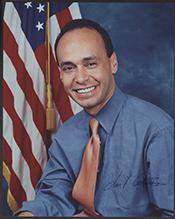
Historical · U.S. House · Illinois · District 4
Luis Gutiérrez
Former U.S. Representative · Illinois District 4 · 1993–2019 · Democratic
Luis Gutiérrez represented Illinois's District 4 in the United States House of Representatives (1993–2019) for the Democratic party. The page below collects sourced biographical facts, term history, committee roles, and provenance for Gutiérrez.
Bioguide ID: G000535
Key facts
- Full name
- Luis Gutiérrez
- State
- Illinois
- District
- District 4
- Party
- Democratic
- House service
- 1993–2019
- First House term
- 1993
- Status
- Left office
- Current term ends
- —
- Born
- 1953
- Bioguide ID
- G000535
- Committee assignments
- —
- Dataset version
- 1.20260605
Biographical narrative
1,018 words · sourced from the Wikipedia REST extract
Luis V. Gutierrez is a former U.S. Representative who served Illinois's 4th congressional district from 1993 until 2019. A member of the Democratic Party, Gutierrez is known for his advocacy on issues such as immigration reform, workers' rights, and social justice. He has a notable history of public service, having previously served on the Chicago City Council. Throughout his congressional tenure, he was recognized as a prominent voice within the Latino community and was involved in various progressive causes.
Early life and career
Luis Vicente Gutiérrez was born on December 10, 1953, in Chicago, Illinois, in the Lincoln Park neighborhood, which at the time was characterized by its immigrant and working-class population. His upbringing was shaped by the experiences of his parents; his mother worked as an assembly-line worker, while his father was a cab driver. In his early years, Gutiérrez faced the challenges of being part of a minority community in a predominantly white city. After his freshman year at St. Michael's High School, his family relocated to San Sebastián, Puerto Rico, a move that Gutiérrez initially approached with reluctance. This transition marked a significant turning point in his life, as he learned to speak Spanish fluently and experienced a shift in cultural identity.
Upon returning to Chicago in 1974, Gutiérrez enrolled at Northeastern Illinois University, where he became actively involved in student activism and issues related to social justice. He contributed to the university's student publication, Que Ondee Sola, and took on leadership roles, including serving as president of the Union for Puerto Rican Students. His commitment to activism was evident during his college years, as he sought to raise funds by driving a taxi to visit his girlfriend in Puerto Rico. After graduating with a degree in English in 1977, he married Soraida and returned to Chicago, where he initially continued working as a taxi driver. Eventually, he transitioned into education, becoming a teacher in the Chicago Public Schools, and later worked as a child abuse caseworker with the Illinois Department of Children & Family Services.
Gutiérrez's early political career began in 1983 when he decided to run for the position of Democratic committeeman for the 32nd ward against the incumbent, Dan Rostenkowski. To finance his campaign, he returned to taxi driving, working long hours to gather the necessary funds. Despite his efforts, Gutiérrez was defeated in the primary election, receiving a significant minority of the vote. However, this loss did not deter him; instead, it propelled him into further political activism. He co-founded the Cook County Coalition for New Politics, aimed at creating a multiracial and grassroots counterbalance to the established Cook County Democratic Party. His growing influence within the Latino community caught the attention of Harold Washington, Chicago's first African-American mayor, who appointed him as deputy superintendent in the Department of Streets and Sanitation in 1984.
During his time in the Washington administration, Gutiérrez faced challenges, including a violent attack on his home, which he attributed to political opposition. Nevertheless, he continued to advocate for political reform and community engagement, founding the West Town-26th Ward Independent Political Organization in 1985 to support Washington's reform initiatives. This organization aimed to unite residents of diverse backgrounds in pursuit of common political goals.
House tenure
Luis Gutierrez was elected to the U.S. House of Representatives in 1992, representing Illinois's 4th congressional district. His first term began in 1993, and he served a total of 13 consecutive terms until his retirement in January 2019. Throughout his tenure, Gutierrez became known for his strong advocacy for immigration reform, particularly in relation to the Latino community. His district, which was notably shaped to include majority Hispanic areas of Chicago, reflected the demographic changes and needs of his constituents.
During his time in Congress, Gutierrez was recognized for his leadership within the Democratic Party and was a member of the Congressional Progressive Caucus. His long service made him one of the most senior members of the Illinois House delegation, and he was often referred to as the unofficial "dean" of the delegation. His experience and influence allowed him to play a significant role in shaping legislation and advocating for the rights of marginalized communities.
In November 2017, Gutierrez announced his decision not to seek re-election in 2018, stating that he would retire at the end of his current term. His departure marked the end of a significant chapter in his political career, as he had become a well-known figure in national discussions surrounding immigration and social justice issues.
Legislative focus and committees
Throughout his congressional career, Luis Gutierrez focused on a range of legislative priorities, with a particular emphasis on immigration reform, workers' rights, and social justice. He was a vocal advocate for comprehensive immigration reform, often speaking out against policies that he viewed as detrimental to immigrant communities. His commitment to these issues resonated with many constituents in his district, which had a large Hispanic population.
Gutierrez served on several committees during his time in the House, where he worked to influence policy and legislation. His involvement in these committees allowed him to address a variety of issues, including education, labor, and civil rights. He was known for his passionate speeches and advocacy efforts, which earned him respect among his colleagues and constituents alike.
In addition to his legislative work, Gutierrez was involved in various community initiatives and organizations, further solidifying his role as a leader within the Latino community. His advocacy extended beyond the halls of Congress, as he participated in grassroots movements and supported efforts aimed at improving the lives of working-class families.
Luis Gutierrez's legacy in Congress is marked by his dedication to progressive causes and his unwavering commitment to advocating for the rights of immigrants and marginalized communities. His tenure in the House of Representatives reflects a significant period of change and activism within American politics, particularly concerning issues affecting the Latino population. Following his retirement, he has continued to engage with these issues, maintaining a presence in discussions surrounding social justice and immigration reform. As of 2021, Gutierrez resides in Puerto Rico, where he remains active in civic and political matters.
Notable legislation
Sponsored and co-sponsored legislation for Luis Gutiérrez is pending operator curation. The biographical narrative above carries the same provenance trail until per-bill rows are written.
Sources
- [1]https://en.wikipedia.org/wiki/Luis_Guti%C3%A9rrezWikipedia · retrieved 2026-06-05
Notable quotes
Sourced quotes for Luis Gutiérrez are pending operator curation. Narrative-scope provenance remains attached below.
Sources
- [1]https://en.wikipedia.org/wiki/Luis_Guti%C3%A9rrezWikipedia · retrieved 2026-06-05
Key positions
Curated policy positions for Luis Gutiérrez are pending operator review. The biographical narrative above carries the same provenance trail until per-topic positions are written.
Sources
- [1]https://en.wikipedia.org/wiki/Luis_Guti%C3%A9rrezWikipedia · retrieved 2026-06-05
Terms served
- 1993–1995U.S. House · Term 1 · Democratic
- 1995–1997U.S. House · Term 2 · Democratic
- 1997–1999U.S. House · Term 3 · Democratic
- 1999–2001U.S. House · Term 4 · Democratic
- 2001–2003U.S. House · Term 5 · Democratic
- 2003–2005U.S. House · Term 6 · Democratic
- 2005–2007U.S. House · Term 7 · Democratic
- 2007–2009U.S. House · Term 8 · Democratic
- 2009–2011U.S. House · Term 9 · Democratic
- 2011–2013U.S. House · Term 10 · Democratic
- 2013–2015U.S. House · Term 11 · Democratic
- 2015–2017U.S. House · Term 12 · Democratic
- 2017–2019U.S. House · Term 13 · Democratic
Sources & provenance
Every attributable claim above carries a per-section [N] marker that resolves to the corresponding URL below. Each entry records the upstream provider, the canonical URL, and the timestamp at which the source was retrieved by the ingest pipeline.
Key facts
- https://bioguide.congress.gov/search/bio/G000535bioguide · retrieved 2026-06-05
- https://gutierrez.house.govhouse.gov · retrieved 2026-06-05
Biographical narrative
- https://en.wikipedia.org/wiki/Luis_Guti%C3%A9rrezwikipedia · retrieved 2026-06-05
Find your representative
Every U.S. state elects representatives by district. Browse Illinois’s delegation, the full former-representative roster, or explore the role and term length.
Related on The Candidate
- Preceded by Jack DavisEarlier holder of the Illinois District 4 House seat · Republican.Open
- Abner TaylorFormer U.S. Representative · Illinois District 1 · RepublicanOpen
- Adam SnyderFormer U.S. Representative · Illinois District 1 · DemocraticOpen
- Arthur MitchellFormer U.S. Representative · Illinois District 1 · DemocraticOpen
- Bennett StewartFormer U.S. Representative · Illinois District 1 · DemocraticOpen
- Democratic PartyFederal candidates and office holders on the Democratic line.Open