
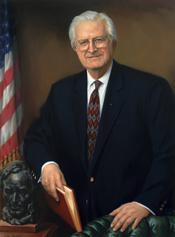
Historical · U.S. House · Illinois · District 6
Henry Hyde
Former U.S. Representative · Illinois District 6 · 1975–2007 · Republican
Henry Hyde represented Illinois's District 6 in the United States House of Representatives (1975–2007) for the Republican party. The page below collects sourced biographical facts, term history, committee roles, and provenance for Hyde.
Bioguide ID: H001022
Key facts
- Full name
- Henry Hyde
- State
- Illinois
- District
- District 6
- Party
- Republican
- House service
- 1975–2007
- First House term
- 1975
- Status
- Left office
- Current term ends
- —
- Born
- 1924
- Bioguide ID
- H001022
- Committee assignments
- —
- Dataset version
- 1.20260605
Biographical narrative
976 words · sourced from the Wikipedia REST extract
Henry J. Hyde was a prominent American politician who served as a Republican member of the United States House of Representatives for Illinois's 6th congressional district from 1975 until 2007. His tenure in Congress spanned over three decades, during which he held significant leadership roles, including Chairman of the Judiciary Committee and the House International Relations Committee. Hyde is particularly known for his staunch opposition to abortion and for sponsoring the Hyde Amendment, which restricts federal funding for abortions. His political career was marked by a blend of conservative values and a willingness to engage in bipartisan efforts on various legislative issues.
Early life and career
Henry John Hyde was born on April 18, 1924, in Chicago, Illinois. He was the son of Monica Kelly and Henry Clay Hyde, with his father being of English descent and his mother having Irish Catholic roots. Raised in a family that traditionally supported the Democratic Party, Hyde's political views shifted to the right during his college years. He graduated from St. George High School in 1942 and subsequently attended Duke University, where he was a member of the Sigma Chi fraternity. He later transferred to Georgetown University, where he played basketball for the Hoyas and contributed to the team reaching the championship game in 1943. Hyde completed his education with a Juris Doctor degree from Loyola University Chicago School of Law.
Hyde's military service began during World War II when he joined the U.S. Navy. He served actively during the war and continued in the Naval Reserve until 1968, achieving the rank of Commander while overseeing the U.S. Naval Intelligence Reserve Unit in Chicago. In 1955, he became a member of the Knights of Columbus, reflecting his commitment to his Catholic faith. Hyde was married to Jeanne Simpson Hyde from 1947 until her death in 1992, and together they had four children and four grandchildren.
Hyde's political career began in earnest in the 1960s. After shifting his political affiliation to the Republican Party in 1952, he made his first congressional bid in 1962 but was unsuccessful against the Democratic incumbent. He subsequently served in the Illinois House of Representatives, where he was elected in 1967 and held the position of Majority Leader from 1971 to 1972. Hyde remained in the Illinois House until 1974, when he successfully ran for a seat in the U.S. House of Representatives.
House tenure
Hyde's election to the U.S. House of Representatives in November 1974 came during a challenging period for the Republican Party, following the Watergate scandal. Despite the political climate, he won his seat in Illinois's 6th congressional district, which encompasses parts of Chicago's northwestern suburbs, by a margin of approximately 8,000 votes against former Cook County state's attorney Edward Hanrahan. His first term began in 1975, and he would go on to serve a total of 16 consecutive terms in the House, concluding his service on January 3, 2007.
Throughout his tenure, Hyde was known for his active participation in various legislative matters and his leadership roles within the House. He served on the House Judiciary Committee for the entirety of his congressional career, eventually becoming its chairman from 1995 to 2001. In this capacity, he played a pivotal role during the impeachment trial of President Bill Clinton, serving as the lead manager for the House. His leadership extended to the House International Relations Committee, where he served as chairman from 2001 until the end of his term in 2007.
Hyde's political career was characterized by his ability to navigate complex legislative landscapes and engage in significant national debates. He was involved in discussions surrounding U.S.-Soviet relations, Central American policy, and the War Powers Act, among other issues. His influence in Congress was marked by his ability to build coalitions and work across party lines on various initiatives.
Legislative focus and committees
Hyde's legislative focus was heavily influenced by his conservative values, particularly regarding social issues. He became one of the most prominent opponents of abortion in American politics and was the primary sponsor of the Hyde Amendment. This amendment, first introduced in 1976, prohibited the use of federal funds for elective abortions through Medicaid, reflecting Hyde's commitment to limiting federal involvement in abortion funding. Over the years, he engaged in various discussions and legislative efforts surrounding abortion rights and restrictions.
In addition to his work on abortion-related issues, Hyde was an original sponsor of the Brady Bill, which mandated background checks for gun buyers. He also broke with his party in 1994 by supporting a ban on the sale of semi-automatic firearms, showcasing his willingness to take independent stances on certain issues. Hyde was also involved in family leave legislation, advocating for policies that he believed would promote a more humane form of capitalism.
His legislative contributions extended to civil rights, as he played a key role in the reauthorization of the Voting Rights Act in 1981. Hyde's work on this legislation underscored his commitment to ensuring equal access to the electoral process for all citizens.
Hyde's involvement in international affairs was notable as well. He participated in the congressional investigation of the Iran-Contra affair, defending the Reagan administration and various individuals implicated in the scandal. His work on the House Select Committee on Intelligence from 1985 to 1991 further demonstrated his engagement with national security issues. Alongside his Democratic counterpart, he co-authored significant legislation addressing the U.S. response to the HIV/AIDS crisis and the establishment of the Millennium Challenge Corporation.
Throughout his time in Congress, Hyde's influence was felt across a range of issues, from social policies to international relations. His leadership roles and committee assignments allowed him to shape important legislation and engage in critical national debates. His legacy in the House of Representatives is marked by his long service, his commitment to conservative principles, and his ability to navigate the complexities of American politics.
Notable legislation
Sponsored and co-sponsored legislation for Henry Hyde is pending operator curation. The biographical narrative above carries the same provenance trail until per-bill rows are written.
Sources
- [1]https://en.wikipedia.org/wiki/Henry_HydeWikipedia · retrieved 2026-06-05
Notable quotes
Sourced quotes for Henry Hyde are pending operator curation. Narrative-scope provenance remains attached below.
Sources
- [1]https://en.wikipedia.org/wiki/Henry_HydeWikipedia · retrieved 2026-06-05
Key positions
Curated policy positions for Henry Hyde are pending operator review. The biographical narrative above carries the same provenance trail until per-topic positions are written.
Sources
- [1]https://en.wikipedia.org/wiki/Henry_HydeWikipedia · retrieved 2026-06-05
Terms served
- 1975–1977U.S. House · Term 1 · Republican
- 1977–1979U.S. House · Term 2 · Republican
- 1979–1981U.S. House · Term 3 · Republican
- 1981–1983U.S. House · Term 4 · Republican
- 1983–1985U.S. House · Term 5 · Republican
- 1985–1987U.S. House · Term 6 · Republican
- 1987–1989U.S. House · Term 7 · Republican
- 1989–1991U.S. House · Term 8 · Republican
- 1991–1993U.S. House · Term 9 · Republican
- 1993–1995U.S. House · Term 10 · Republican
- 1995–1997U.S. House · Term 11 · Republican
- 1997–1999U.S. House · Term 12 · Republican
- 1999–2001U.S. House · Term 13 · Republican
- 2001–2003U.S. House · Term 14 · Republican
- 2003–2005U.S. House · Term 15 · Republican
- 2005–2007U.S. House · Term 16 · Republican
Sources & provenance
Every attributable claim above carries a per-section [N] marker that resolves to the corresponding URL below. Each entry records the upstream provider, the canonical URL, and the timestamp at which the source was retrieved by the ingest pipeline.
Key facts
- https://bioguide.congress.gov/search/bio/H001022bioguide · retrieved 2026-06-05
- http://www.house.gov/hydehouse.gov · retrieved 2026-06-05
Biographical narrative
- https://en.wikipedia.org/wiki/Henry_Hydewikipedia · retrieved 2026-06-05
Find your representative
Every U.S. state elects representatives by district. Browse Illinois’s delegation, the full former-representative roster, or explore the role and term length.
Related on The Candidate
- Preceded by Harold CollierEarlier holder of the Illinois District 6 House seat · Republican.Open
- Succeeded by Peter RoskamLater holder of the Illinois District 6 House seat · Republican.Open
- Abner TaylorFormer U.S. Representative · Illinois District 1 · RepublicanOpen
- Adam SnyderFormer U.S. Representative · Illinois District 1 · DemocraticOpen
- Arthur MitchellFormer U.S. Representative · Illinois District 1 · DemocraticOpen
- Bennett StewartFormer U.S. Representative · Illinois District 1 · DemocraticOpen