
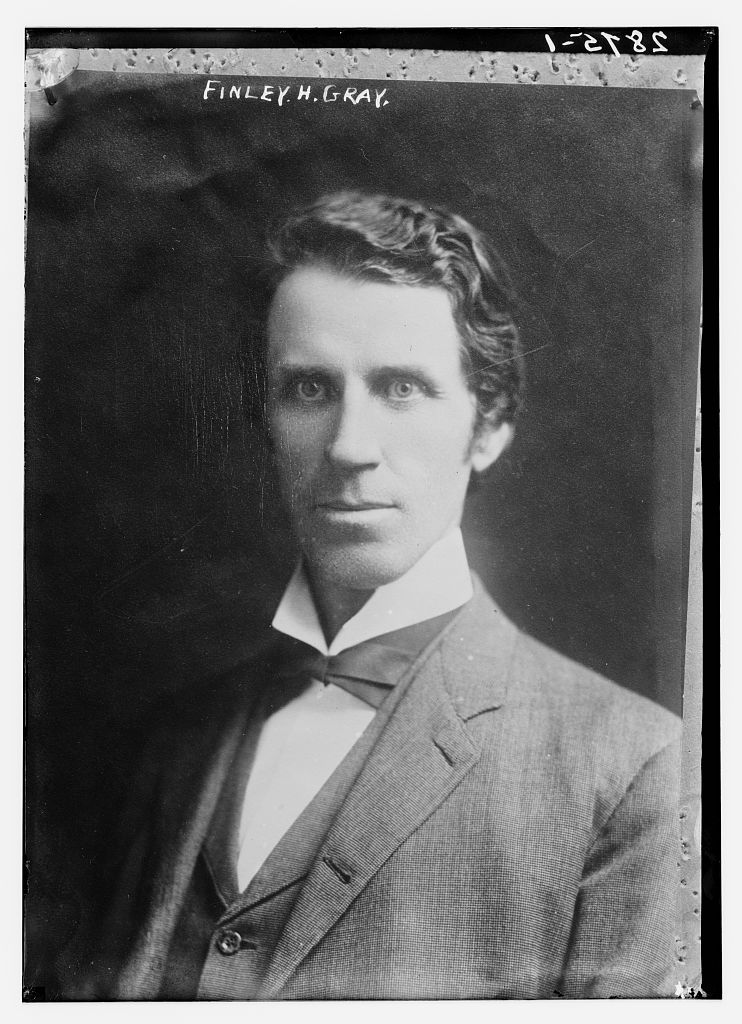
Historical · U.S. House · Indiana · District 10
Finly Gray
Former U.S. Representative · Indiana District 10 · 1911–1939 · Democratic
Finly Gray represented Indiana's District 10 in the United States House of Representatives (1911–1939) for the Democratic party. The page below collects sourced biographical facts, term history, committee roles, and provenance for Gray.
Bioguide ID: G000395
Key facts
- Full name
- Finly Gray
- State
- Indiana
- District
- District 10
- Party
- Democratic
- House service
- 1911–1939
- First House term
- 1911
- Status
- Left office
- Current term ends
- —
- Born
- 1863
- Bioguide ID
- G000395
- Committee assignments
- —
- Dataset version
- 1.20260605
Biographical narrative
803 words · sourced from the Wikipedia REST extract
Finly Gray was a prominent American lawyer and politician who served as a U.S. Representative for Indiana's 10th congressional district during the early 20th century. A member of the Democratic Party, Gray had a notable political career that spanned two separate periods in the U.S. House of Representatives, encompassing six terms in total. His legislative service was marked by his commitment to his constituents and his active involvement in various political and civic activities throughout his life.
Early life and career
Finly Hutchinson Gray was born on July 21, 1863, near Orange, Indiana. His early education took place in local common schools, where he laid the groundwork for his future academic and professional endeavors. Following his schooling, Gray pursued a career in law, which led him to study legal principles and practices. He was admitted to the bar in 1892, marking the beginning of his legal career in Connersville, Indiana.
Gray's professional life was not limited to law; he also engaged in public service. He served as the mayor of Connersville from 1904 to 1910, a role that allowed him to gain valuable experience in governance and community leadership. His tenure as mayor likely contributed to his understanding of the needs and concerns of his constituents, which would later inform his work in Congress.
After completing his term as mayor, Gray continued to practice law while also taking on roles as a lecturer. His legal expertise and public speaking skills helped him establish a reputation as a knowledgeable and articulate figure in his community. This combination of legal practice and public service set the stage for his entry into national politics.
House tenure
Finly Gray's political career in the U.S. House of Representatives began when he was elected as a Democrat to the Sixty-second Congress, serving from March 4, 1911, to March 3, 1917. During this initial period, he was re-elected to the Sixty-third and Sixty-fourth Congresses, solidifying his position as a representative of Indiana's 10th congressional district. His legislative work during these terms focused on various issues pertinent to his constituents and the nation.
However, Gray faced challenges in his political career. In 1916, he was unsuccessful in his bid for re-election to the Sixty-fifth Congress. Following this defeat, he returned to his legal practice and also engaged in lecturing, remaining active in public discourse and community affairs.
Gray's political journey did not end there. He made a comeback by winning election to the Seventy-third, Seventy-fourth, and Seventy-fifth Congresses, serving from March 4, 1933, until January 3, 1939. This second period in Congress allowed him to further contribute to legislative discussions and decisions during a time of significant national challenges, including the Great Depression.
Despite his efforts and experience, Gray was unsuccessful in his attempt for re-election in 1938 to the Seventy-sixth Congress. After concluding his service in the House, he returned once more to the practice of law in Connersville, where he continued to be involved in community and civic activities.
Legislative focus and committees
Throughout his tenure in Congress, Finly Gray was involved in various legislative initiatives and discussions that reflected the interests and needs of his constituents. While specific details regarding the bills he sponsored or the committees he served on are not available, it is known that his legislative focus was likely shaped by the pressing issues of his time, including economic recovery efforts during the Great Depression and social welfare policies.
Gray's background as a lawyer and his experience as a local government official would have provided him with a unique perspective on the legislative process and the importance of effective governance. His dual roles as a practicing attorney and a public servant likely influenced his approach to policymaking, emphasizing the need for practical solutions to the challenges faced by his constituents.
In addition to his legislative work, Gray's commitment to his community extended beyond his time in office. After his congressional career, he and his wife undertook the restoration of the Canal House in Connersville, which served as their residence from 1936 until his death in 1947. The Canal House later became a local history museum and was added to the National Register of Historic Places in 1973, reflecting Gray's lasting impact on his community.
Finly Gray passed away on May 8, 1947, in Connersville, Indiana. He was interred in Dale Cemetery, leaving behind a legacy of public service and dedication to his community. His contributions to Indiana and the nation during his time in Congress are remembered as part of the broader tapestry of American political history. Gray's family also continued to honor his memory through charitable efforts, including the establishment of the Mary Gray Bird Sanctuary, which serves as a living memorial to his daughter. This sanctuary, located in Fayette County, Indiana, reflects the family's commitment to conservation and community engagement.
Notable legislation
Sponsored and co-sponsored legislation for Finly Gray is pending operator curation. The biographical narrative above carries the same provenance trail until per-bill rows are written.
Sources
- [1]https://en.wikipedia.org/wiki/Finly_Hutchinson_GrayWikipedia · retrieved 2026-06-05
Notable quotes
Sourced quotes for Finly Gray are pending operator curation. Narrative-scope provenance remains attached below.
Sources
- [1]https://en.wikipedia.org/wiki/Finly_Hutchinson_GrayWikipedia · retrieved 2026-06-05
Key positions
Curated policy positions for Finly Gray are pending operator review. The biographical narrative above carries the same provenance trail until per-topic positions are written.
Sources
- [1]https://en.wikipedia.org/wiki/Finly_Hutchinson_GrayWikipedia · retrieved 2026-06-05
Terms served
- 1911–1913U.S. House · Term 1 · Democratic
- 1913–1915U.S. House · Term 2 · Democratic
- 1915–1917U.S. House · Term 3 · Democratic
- 1933–1935U.S. House · Term 4 · Democratic
- 1935–1937U.S. House · Term 5 · Democratic
- 1937–1939U.S. House · Term 6 · Democratic
Sources & provenance
Every attributable claim above carries a per-section [N] marker that resolves to the corresponding URL below. Each entry records the upstream provider, the canonical URL, and the timestamp at which the source was retrieved by the ingest pipeline.
Key facts
- https://bioguide.congress.gov/search/bio/G000395bioguide · retrieved 2026-06-05
- https://www.govtrack.us/congress/members/404745govtrack · retrieved 2026-06-05
Biographical narrative
- https://en.wikipedia.org/wiki/Finly_Hutchinson_Graywikipedia · retrieved 2026-06-05
Find your representative
Every U.S. state elects representatives by district. Browse Indiana’s delegation, the full former-representative roster, or explore the role and term length.
Related on The Candidate
- Preceded by Jethro HatchEarlier holder of the Indiana District 10 House seat · Republican.Open
- Succeeded by Raymond SpringerLater holder of the Indiana District 10 House seat · Republican.Open
- Adam Benjamin Jr.Former U.S. Representative · Indiana District 1 · DemocraticOpen
- Alvin HoveyFormer U.S. Representative · Indiana District 1 · RepublicanOpen
- Arthur TaylorFormer U.S. Representative · Indiana District 1 · DemocraticOpen
- Benoni FullerFormer U.S. Representative · Indiana District 1 · DemocraticOpen