
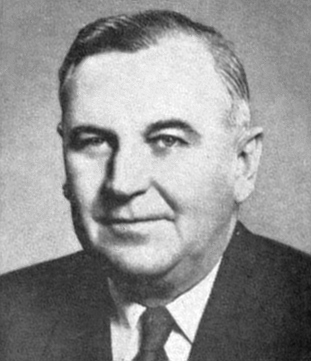
Historical · U.S. House · Indiana · District 10
Ralph Harvey
Former U.S. Representative · Indiana District 10 · 1947–1967 · Republican
Ralph Harvey represented Indiana's District 10 in the United States House of Representatives (1947–1967) for the Republican party. The page below collects sourced biographical facts, term history, committee roles, and provenance for Harvey.
Bioguide ID: H000310
Key facts
- Full name
- Ralph Harvey
- State
- Indiana
- District
- District 10
- Party
- Republican
- House service
- 1947–1967
- First House term
- 1947
- Status
- Left office
- Current term ends
- —
- Born
- 1901
- Bioguide ID
- H000310
- Committee assignments
- —
- Dataset version
- 1.20260605
Biographical narrative
895 words · sourced from the Wikipedia REST extract
Ralph Harvey was an American politician who served as a U.S. Representative for Indiana's 10th congressional district. A member of the Republican Party, he had a lengthy career in the House of Representatives, spanning from 1947 until 1967. Over his political tenure, he was known for his involvement in various legislative matters, particularly those related to agriculture, reflecting his background as a farmer and agricultural instructor. Harvey's political journey included multiple terms in office, marked by both successes and challenges, including a significant redistricting that affected his later political career.
Early life and career
Ralph Harvey was born on August 9, 1901, on a farm near Mount Summit, Indiana. Growing up in a rural setting, he was immersed in agricultural life from an early age, which would later influence his professional pursuits and political focus. Harvey attended public schools in his local area, where he likely developed a foundational understanding of the issues facing his community. He furthered his education at Purdue University in Lafayette, Indiana, graduating in 1923. His academic background in agriculture positioned him well for a career that intertwined education and farming.
Following his graduation, Harvey took on the role of an agricultural instructor, sharing his knowledge and expertise with students and aspiring farmers. This position allowed him to contribute to the agricultural community and foster a new generation of farmers. In addition to his teaching career, Harvey was actively involved in farming, which provided him with firsthand experience of the challenges and opportunities within the agricultural sector. His dual roles as an educator and farmer laid the groundwork for his future political career, as he gained insights into the needs and concerns of rural constituents.
Harvey's political career began at the local level when he served as a county councilman from 1932 to 1942. This role provided him with valuable experience in governance and public service, allowing him to understand the intricacies of local government operations. His commitment to public service continued as he was elected to the Indiana House of Representatives, where he served from 1942 until 1947. During this time, he further honed his legislative skills and built a network of political connections that would serve him well in his future endeavors.
House tenure
Ralph Harvey's entry into the U.S. House of Representatives came in 1947 when he was elected as a Republican to fill a vacancy caused by the death of fellow Republican Raymond S. Springer. This marked the beginning of a significant chapter in his political career, as he was subsequently re-elected to five additional terms, serving from November 4, 1947, until January 3, 1959. His tenure in the House was characterized by a focus on issues pertinent to his constituents, particularly those related to agriculture, reflecting his background and expertise.
Despite his initial successes, Harvey faced challenges in the political arena. In 1958, he sought re-election but was narrowly defeated, losing by a margin of approximately one-and-a-half points. This setback did not deter him from returning to Congress; in 1960, he successfully defeated the Democrat who had previously unseated him. This victory allowed him to serve in the Eighty-seventh Congress and the two succeeding Congresses, from January 3, 1961, until his resignation on December 30, 1966.
Harvey's later years in Congress were marked by a significant redistricting that altered the political landscape of his constituency. He was redistricted into a new area that included another Republican incumbent, Richard L. Roudebush. This change ultimately led to Harvey's unsuccessful bid for renomination in 1966, marking the end of his congressional career.
Legislative focus and committees
Throughout his time in the House of Representatives, Ralph Harvey was actively involved in various legislative matters, particularly those related to agriculture. He served on the Agriculture Committee for seven terms, which allowed him to advocate for policies that supported farmers and the agricultural industry. His background as an agricultural instructor and farmer informed his contributions to discussions and decisions regarding agricultural legislation.
Harvey's voting record included support for key civil rights legislation, such as the Civil Rights Acts of 1957 and 1964, as well as the 24th Amendment to the U.S. Constitution. However, he did not cast a vote on the Voting Rights Act of 1965, a significant piece of legislation aimed at eliminating racial discrimination in voting. His involvement in civil rights issues reflected the evolving political landscape of the time and the growing importance of these matters in American society.
Despite his active participation in legislative discussions, Harvey did not sponsor any enacted public bills during his time in Congress. This aspect of his legislative career has been noted in discussions of his overall impact as a legislator. Additionally, his autobiography reveals a personal interest in travel, as he dedicated a substantial portion of the text to recounting various trips, which he referred to as "junkets." This aspect of his life illustrates a different dimension of his experiences as a public servant, showcasing his engagement with the broader world beyond legislative duties.
Ralph Harvey passed away on November 7, 1991, in Fort Lauderdale, Florida. His life and career reflect a commitment to public service and a deep connection to the agricultural community in Indiana. Through his multiple terms in the U.S. House of Representatives, he contributed to the legislative process and represented the interests of his constituents, leaving a legacy that is part of Indiana's political history.
Notable legislation
Sponsored and co-sponsored legislation for Ralph Harvey is pending operator curation. The biographical narrative above carries the same provenance trail until per-bill rows are written.
Sources
- [1]https://en.wikipedia.org/wiki/Ralph_HarveyWikipedia · retrieved 2026-06-05
Notable quotes
Sourced quotes for Ralph Harvey are pending operator curation. Narrative-scope provenance remains attached below.
Sources
- [1]https://en.wikipedia.org/wiki/Ralph_HarveyWikipedia · retrieved 2026-06-05
Key positions
Curated policy positions for Ralph Harvey are pending operator review. The biographical narrative above carries the same provenance trail until per-topic positions are written.
Sources
- [1]https://en.wikipedia.org/wiki/Ralph_HarveyWikipedia · retrieved 2026-06-05
Terms served
- 1947–1949U.S. House · Term 1 · Republican
- 1949–1951U.S. House · Term 2 · Republican
- 1951–1953U.S. House · Term 3 · Republican
- 1953–1955U.S. House · Term 4 · Republican
- 1955–1957U.S. House · Term 5 · Republican
- 1957–1959U.S. House · Term 6 · Republican
- 1961–1963U.S. House · Term 7 · Republican
- 1963–1965U.S. House · Term 8 · Republican
- 1965–1967U.S. House · Term 9 · Republican
Sources & provenance
Every attributable claim above carries a per-section [N] marker that resolves to the corresponding URL below. Each entry records the upstream provider, the canonical URL, and the timestamp at which the source was retrieved by the ingest pipeline.
Key facts
- https://bioguide.congress.gov/search/bio/H000310bioguide · retrieved 2026-06-05
- https://www.govtrack.us/congress/members/405183govtrack · retrieved 2026-06-05
Biographical narrative
- https://en.wikipedia.org/wiki/Ralph_Harveywikipedia · retrieved 2026-06-05
Find your representative
Every U.S. state elects representatives by district. Browse Indiana’s delegation, the full former-representative roster, or explore the role and term length.
Related on The Candidate
- Preceded by Finly GrayEarlier holder of the Indiana District 10 House seat · Democratic.Open
- Succeeded by David DennisLater holder of the Indiana District 10 House seat · Republican.Open
- Adam Benjamin Jr.Former U.S. Representative · Indiana District 1 · DemocraticOpen
- Alvin HoveyFormer U.S. Representative · Indiana District 1 · RepublicanOpen
- Arthur TaylorFormer U.S. Representative · Indiana District 1 · DemocraticOpen
- Benoni FullerFormer U.S. Representative · Indiana District 1 · DemocraticOpen