
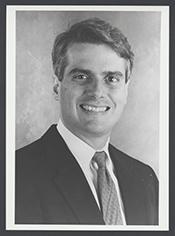
Historical · U.S. House · Indiana · District 2
David McIntosh
Former U.S. Representative · Indiana District 2 · 1995–2001 · Republican
David McIntosh represented Indiana's District 2 in the United States House of Representatives (1995–2001) for the Republican party. The page below collects sourced biographical facts, term history, committee roles, and provenance for McIntosh.
Bioguide ID: M000481
Key facts
- Full name
- David McIntosh
- State
- Indiana
- District
- District 2
- Party
- Republican
- House service
- 1995–2001
- First House term
- 1995
- Status
- Left office
- Current term ends
- —
- Born
- 1958
- Bioguide ID
- M000481
- Committee assignments
- —
- Dataset version
- 1.20260605
Biographical narrative
886 words · sourced from the Wikipedia REST extract
David M. McIntosh is a former American attorney and politician who served as a U.S. Representative for Indiana's 2nd congressional district from 1995 to 2001. A member of the Republican Party, McIntosh was involved in various political and legal initiatives throughout his career, including co-founding influential conservative organizations such as the Federalist Society and the Club for Growth. He also ran for the governorship of Indiana in 2000, although he was unsuccessful in that bid.
Early life and career
David McIntosh was born on June 8, 1958, in Oakland, California. He was raised in Kendallville, Indiana, after his family relocated there when he was five years old, following the death of his father, Norman McIntosh. His mother, Jean Marie Slough, served as a judge, which likely influenced his interest in law and public service. McIntosh pursued higher education at Yale University, where he earned a Bachelor of Arts degree with cum laude honors in 1980. During his time at Yale, he was actively involved in student government, serving as a member and later president of the Yale Political Union, including its Progressive Party, despite his eventual alignment with conservative politics.
After completing his undergraduate studies, McIntosh attended the University of Chicago Law School, where he obtained his Juris Doctor degree in 1983. At Chicago, he was taught by Antonin Scalia, who later became a Supreme Court Justice. Following his education, McIntosh began his career in public service during the Reagan administration, where he held positions as Special Assistant to the Attorney General and Special Assistant to the President for Domestic Affairs. His work during this period focused on various domestic policy issues.
In the administration of George H. W. Bush, McIntosh served as the executive director of Vice President Dan Quayle's Council for Competitiveness. In this role, he advocated for the reduction or elimination of certain environmental regulations, arguing that they hindered economic growth. His tenure in these positions laid the groundwork for his future political career, as he became increasingly involved in conservative political movements.
House tenure
David McIntosh entered the U.S. House of Representatives after winning the Republican primary for Indiana's 2nd congressional district in 1994. The incumbent, Democratic Congressman Philip Sharp, had decided to retire, creating an opportunity for McIntosh. He secured the nomination with a plurality of the votes in a four-candidate primary. In the general election, he faced Democratic Secretary of State Joe Hogsett and won with a margin of 54% to 46%.
During his time in Congress, McIntosh was re-elected twice, demonstrating a solid base of support within his district. In the 1996 election, he won his second term with 58% of the vote, and in 1998, he achieved a further increase in support, securing 61% of the vote for his third term.
Throughout his congressional tenure, McIntosh was known for his efforts to reduce regulations in the health and food industries. He was a vocal advocate for deregulation and often found himself at odds with other political figures, including U.S. Senator Bob Dole. Following the resignation of Speaker Newt Gingrich, McIntosh considered running for the position himself but ultimately chose to endorse William Reynolds Archer, Jr. instead.
In Congress, McIntosh served on the House Oversight and Government Reform Committee and held the position of Chairman of the House Oversight and Reform subcommittee. His committee work focused on governmental accountability and reform, aligning with his broader political philosophy of limited government intervention.
Legislative focus and committees
During his time in the U.S. House of Representatives, McIntosh's legislative focus was characterized by a commitment to conservative principles, particularly in the areas of deregulation and economic policy. He was a strong proponent of reducing government oversight in various sectors, particularly those related to health and food safety. His advocacy for deregulation was part of a broader Republican agenda aimed at promoting economic growth through less government intervention.
In addition to his work on the Oversight and Government Reform Committee, McIntosh's involvement in legislative matters reflected his background in law and public policy. He utilized his legal expertise to navigate complex legislative issues and worked to influence policy decisions that aligned with his conservative values.
After leaving Congress in 2001, McIntosh continued to engage in political activities and advocacy. He became a partner at the global law firm Mayer Brown and took on roles in various conservative organizations. In 2014, he was appointed head of the Club for Growth, an influential political action committee that supports pro-growth economic policies and candidates. His leadership in this organization underscored his ongoing commitment to conservative economic principles.
In 2000, McIntosh ran for Governor of Indiana but was defeated by incumbent Democrat Frank O'Bannon. His campaign focused on a proposed property tax cut, although he faced challenges in articulating a detailed plan for its implementation. He later attempted another gubernatorial run in 2004 but withdrew before the primary.
In 2012, McIntosh sought to return to Congress by running in the newly redrawn 5th Congressional District. However, he was narrowly defeated in the Republican primary by former U.S. Attorney Susan Brooks.
Throughout his career, McIntosh has remained active in political discourse, including involvement in significant events surrounding the nomination of Supreme Court justices. His political journey reflects a consistent alignment with conservative values and a commitment to influencing policy through both legislative and organizational avenues.
Notable legislation
Sponsored and co-sponsored legislation for David McIntosh is pending operator curation. The biographical narrative above carries the same provenance trail until per-bill rows are written.
Sources
- [1]https://en.wikipedia.org/wiki/David_McIntosh_(politician)Wikipedia · retrieved 2026-06-05
Notable quotes
Sourced quotes for David McIntosh are pending operator curation. Narrative-scope provenance remains attached below.
Sources
- [1]https://en.wikipedia.org/wiki/David_McIntosh_(politician)Wikipedia · retrieved 2026-06-05
Key positions
Curated policy positions for David McIntosh are pending operator review. The biographical narrative above carries the same provenance trail until per-topic positions are written.
Sources
- [1]https://en.wikipedia.org/wiki/David_McIntosh_(politician)Wikipedia · retrieved 2026-06-05
Terms served
- 1995–1997U.S. House · Term 1 · Republican
- 1997–1999U.S. House · Term 2 · Republican
- 1999–2001U.S. House · Term 3 · Republican
Sources & provenance
Every attributable claim above carries a per-section [N] marker that resolves to the corresponding URL below. Each entry records the upstream provider, the canonical URL, and the timestamp at which the source was retrieved by the ingest pipeline.
Key facts
- https://bioguide.congress.gov/search/bio/M000481bioguide · retrieved 2026-06-05
- https://www.govtrack.us/congress/members/400597govtrack · retrieved 2026-06-05
Biographical narrative
- https://en.wikipedia.org/wiki/David_McIntosh_(politician)wikipedia · retrieved 2026-06-05
Find your representative
Every U.S. state elects representatives by district. Browse Indiana’s delegation, the full former-representative roster, or explore the role and term length.
Related on The Candidate
- Preceded by Philip SharpEarlier holder of the Indiana District 2 House seat · Democratic.Open
- Succeeded by Chris ChocolaLater holder of the Indiana District 2 House seat · Republican.Open
- Adam Benjamin Jr.Former U.S. Representative · Indiana District 1 · DemocraticOpen
- Alvin HoveyFormer U.S. Representative · Indiana District 1 · RepublicanOpen
- Arthur TaylorFormer U.S. Representative · Indiana District 1 · DemocraticOpen
- Benoni FullerFormer U.S. Representative · Indiana District 1 · DemocraticOpen